findsthe logic. For anyone trying to move from basic scripting to actual AI development, understanding the transition from simple linear models to neural networks is non-negotiable.
Core Concepts and the Training Loop #
At its heart, a model is just a function f(x) -> y
. The "learning" part is simply an optimization problem: finding the specific version of f
that minimizes error.
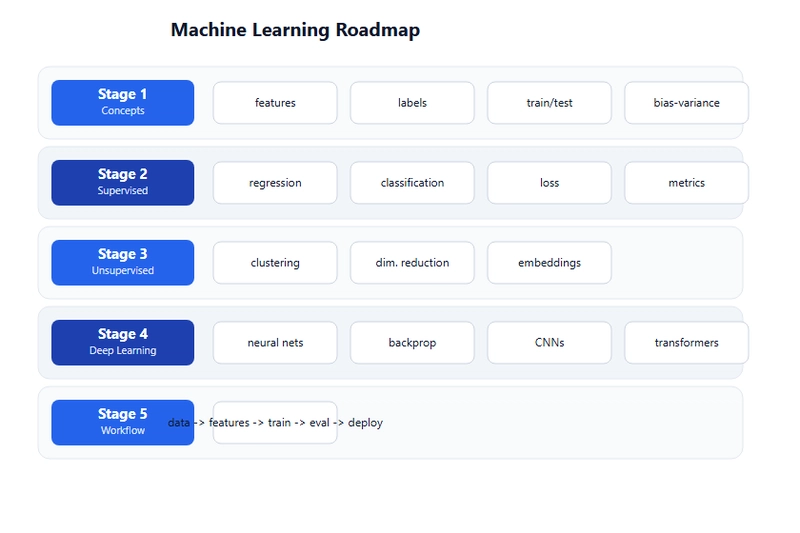
Features (X): Your input variables (e.g., square footage of a house).Labels (y): The target you're predicting (e.g., the actual sale price).The Split: To avoid the cardinal sin of ML—evaluating a model on data it has already seen—you must split your dataset into training, validation, and test sets.
from sklearn.model_selection import train_test_split
X_train, X_test, y_train, y_test = train_test_split(X, y, test_size=0.2, random_state=42)
The biggest hurdle for beginners is the bias-variance tradeoff. Overfitting happens when your model memorizes the noise in your training set rather than the actual pattern. If your training accuracy is 99% but your validation accuracy is 60%, you've overfit. Fix this with regularization (L1/L2), dropout for neural nets, or simply by gathering more data.
Supervised Learning Paradigms #
Supervised learning requires labeled data and generally falls into two buckets:
Regression: Predicting continuous values. Common loss functions here are Mean Squared Error (MSE) or Mean Absolute Error (MAE).Classification: Predicting discrete categories. We typically use cross-entropy loss and measure success via precision, recall, or F1 scores.
For a basic linear regression implementation:
from sklearn.linear_model import LinearRegression
model = LinearRegression()
model.fit(X_train, y_train)
The ML Workflow #
A real-world AI workflow isn't just calling .fit()
. It's a cycle:
-
Data Prep: Cleaning, scaling, and feature engineering.
-
Model Selection: Choosing between linear models, decision trees, or deep learning based on data size and complexity.
-
Training & Tuning: Using the validation set to tweak hyperparameters.
-
Evaluation: A final, honest check on the test set.
Whether you are deploying a simple scikit-learn model or a massive LLM agent, these fundamentals remain the same. The goal is always the same: find the sweet spot where the model is complex enough to learn the pattern but simple enough to generalize to new data.
Next Building AI agents from scratch vs. Frameworks →