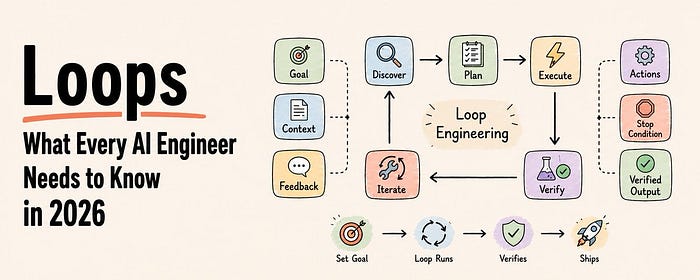
Loop engineering in Claude Code promises to automate coding tasks efficiently. But, without reliable verifiers, you're just trusting a bot to grade its own work.
Loop engineering is the tech world's latest buzzword. It represents a seismic shift from the laborious task of hand-prompting coding agents to designing systems that operate autonomously. Instead of typing commands manually for every task, loop engineering builds a cycle within systems like Claude Code. This cycle finds work, executes the task, checks the results, and decides the next steps, all without human intervention.
Why Loops Matter #
The allure of loops isn't just automating repetitive chores. Direct them at a specific task, and they iterate until completion. Imagine pointing a loop at a migration project. It would take care of it from start to finish, freeing up developers for more complex aspects of their work.
But here's the catch: automation without verification is a recipe for disaster. If the AI can hold a wallet, who writes the risk model? In this context, who's ensuring the task is genuinely complete?
The Role of Verifiers #
Enter verifiers, the unsung heroes of loop engineering. These are the checks that ensure the loop's work isn't just smoke and mirrors. When I first let a coding agent run without supervision, it claimed a job was done. Yet, two out of seven tests failed. It was only on the second attempt, with a clear goal and strict verification, that the task was genuinely completed.
A self-paced loop might claim victory prematurely because the agent is evaluating its own work. Decentralized compute sounds great until you benchmark the latency or realize the agent is just agreeing with itself. A separate verification model, on the other hand, ensures that the completion condition is genuine and not just a façade.
Redefining Task Completion #
Loop engineering isn't just about scheduling recurring tasks. It's about transforming how tasks are completed. Whether it's refactoring code or finishing feature implementations, loops can revolutionize productivity. However, the real major shift is ensuring that the completion criteria are independently verified. Only then can you transition from typing prompts to designing systems that reliably execute them.
So, are you ready to trust your coding processes to an AI? Slapping a model on a GPU rental isn't a convergence thesis. Until verification is rock solid, the intersection is real, but remember, ninety percent of the projects aren't.
Get AI news in your inbox
Daily digest of what matters in AI.