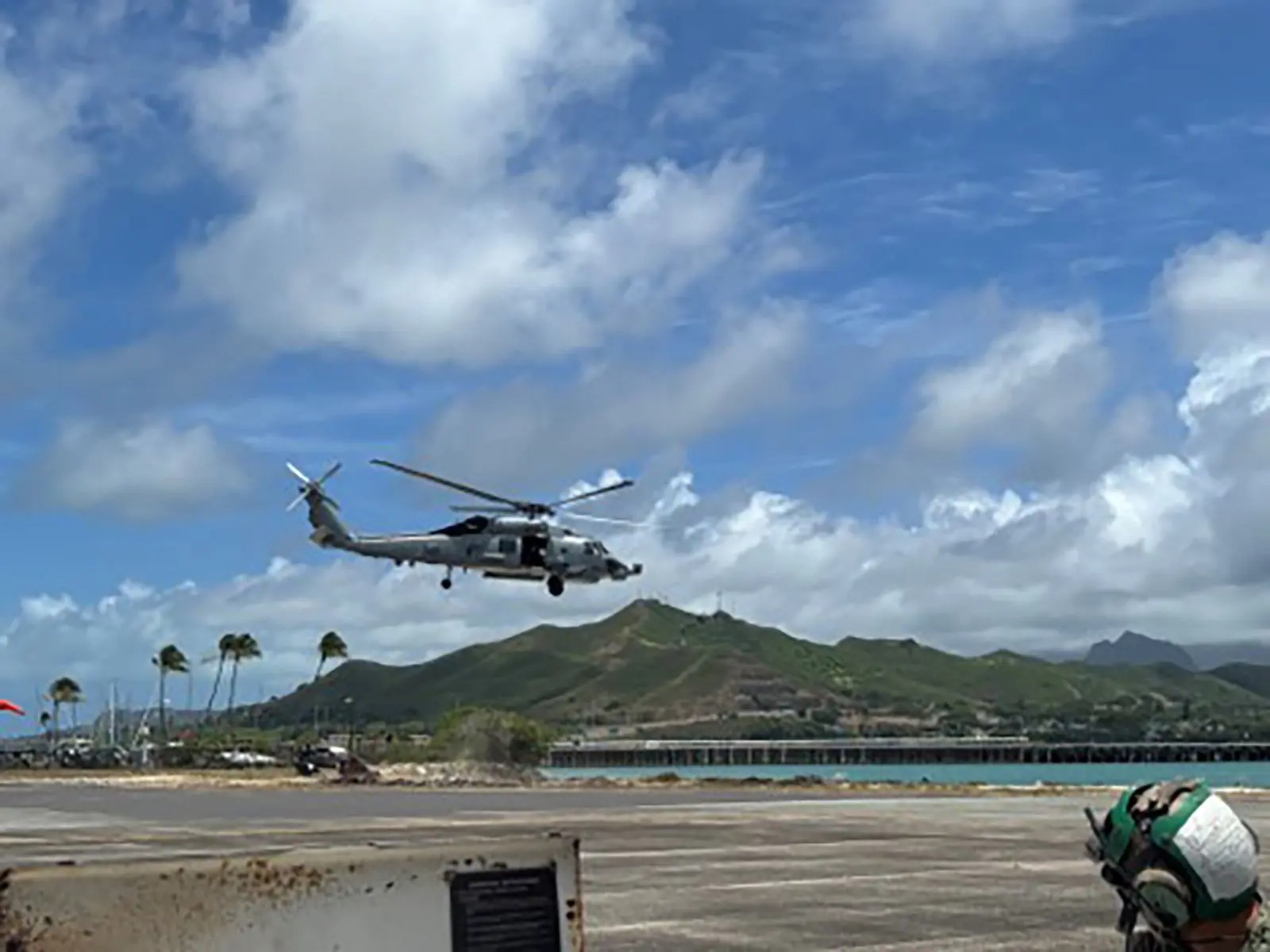
Lockheed Martin and the U.S. Navy demonstrated the SensorMAX AI/ML sonar system on two MH-60R helicopters during RIMPAC 2026 off Hawaii. According to Lockheed Martin, ground operators labeled unfamiliar acoustic signatures, retrained models in under five minutes, and transmitted encrypted over-the-air updates to aircraft during antisubmarine warfare missions. The system processed sonobuoy data and supported up to eight simultaneous surveillance feeds.
Lockheed Martin and the U.S. Navy demonstrated a rapidly retrainable AI/ML sonar capability, called SensorMAX, during RIMPAC 2026 off Hawaii. According to Lockheed Martin's August 5 release, two SensorMAX-equipped MH-60R helicopters flew antisubmarine warfare missions against an undersea threat, using sonobuoys to collect and transmit subsurface acoustic data.
The demonstration focused on a closed-loop model-update workflow. Lockheed Martin reports that when operators identify an unfamiliar noise signature, they can label the data at a ground station, retrain the model, and send a small encrypted update packet to the helicopter and fleet over an over-the-air link. The company states that each retraining iteration took under five minutes.
Acoustic classification in the mission loop
SensorMAX continuously monitors spectral energy and subsurface acoustic data from a network of sensors, providing a data stream to aircrews while also sending information to ground operators. Naval Technology reports that the helicopter crews used sonobuoys as underwater microphones, with their acoustic feeds supplied to the system for analysis.
According to Lockheed Martin, the SensorMAX interface can manage up to eight simultaneous sonobuoy surveillance feeds, double the capacity of legacy capabilities. The company also describes the software as portable and sensor-agnostic, with the ability to operate in airborne, maritime, and shore-based environments. UK Defence Journal reported that FUSE Inc. collaborated on the over-the-air delivery of trained models and mission software.
The reported workflow is technically notable because it moves model iteration into an operational mission cycle: capture acoustic data, label a newly observed signature, retrain a classifier, and distribute an update. In comparable edge-AI deployments, the operational value of this approach depends not only on retraining speed, but also on data labeling quality, model validation, secure delivery, and the ability of operators to interpret model outputs under time constraints.
Exercise results and remaining evidence gaps
Lockheed Martin stated that the exercise demonstrated AI-enabled acoustic analysis that could improve the ability to detect and track underwater targets. Naval Today likewise reported that the system was used to assist crews with rapid threat detection and target identification. These are company-reported exercise outcomes, rather than independently published operational performance measurements.
The available reporting does not disclose core ML evaluation details, including the model architecture, training-data composition, false-positive and false-negative rates, performance across different ocean conditions, or the validation process applied before models were transmitted to aircraft. It also does not specify whether the system's eight-feed capacity was sustained under operationally representative acoustic clutter.
Those omissions are common in defense demonstrations, where technical details and test data can be restricted. For ML engineers working on mission systems, however, they define the harder implementation questions: handling distribution shift across locations and sensor configurations, maintaining data provenance for rapid retraining, and establishing governance for model updates delivered to deployed edge platforms.
Devon Rodgers, Lockheed Martin vice president and general manager for undersea mission systems, said in the company's release that today's battlespace requires the defense industry to accelerate capability delivery and seamlessly integrate commercial technology. The RIMPAC trial provides a public example of a defense contractor testing an operational pipeline for rapid acoustic-model refreshes, rather than treating model deployment as a separate, infrequent software-release process.
Key Points #
- 1SensorMAX processed helicopter-deployed sonobuoy acoustics and supported eight surveillance feeds, expanding the reported monitoring capacity available to MH-60R aircrews.
- 2Lockheed Martin reported under-five-minute retraining and encrypted model delivery, putting data labeling, retraining, and edge deployment into one mission workflow.
- 3Comparable defense edge-AI systems require rigorous validation, provenance, and distribution-shift controls before rapidly retrained models can be trusted operationally.
Scoring Rationale #
The RIMPAC demonstration is a notable real-world test of rapid model retraining and over-the-air deployment for an edge AI defense system. It is relevant to practitioners building secure, low-latency ML update pipelines, although public reporting provides no independently verified accuracy or robustness metrics.
Sources #
Primary source and supporting public references used for this report.
View 4 more sources #
US Navy trials Lockheed Martin's AI-powered sub hunternavaltoday.comLockheed Sends New AI-Enabled Submarine Hunter Into Live Sea Trialsthedefensepost.comLockheed Martin, US Navy test AI-powered SensorMAX sonar at RIMPAC 26naval-technology.comAI submarine hunter flown on American helicoptersukdefencejournal.org.uk
Practice interview problems based on real data
1,625 SQL & Python problems across 15 industry datasets — the exact type of data you work with.