The same industries that most need interactive demos are often the ones least able to trust a closed third-party tool with the job.
Most B2B software websites have the same problem, and it sits right on the homepage: the "Book a Demo" button. It promises access to the product, but what it really delivers is a gate. A form, a qualification call, a calendar dance, and days of waiting before a buyer ever sees the software they came to evaluate. Research shows that modern B2B buyers spend less than 20% of their evaluation time talking to sales reps, and a growing share would rather not talk to sales at all. They want to try the product first, on their own time.
Interactive demo platforms like Storylane, Navattic, and Arcade emerged to fix this. But they all share one trait: they are closed, proprietary SaaS. Your demos, your funnel data, and your buyer analytics live on someone else's servers, on someone else's terms. LiveDemo.ai took a different path and built itself as an open-source product demo platform. In July 2026 it launched on Product Hunt with a blunt one-line pitch: the open-source alternative to Storylane, Navattic, and Arcade.
The problem that started it #
The founding insight came from watching real evaluations fall apart at the front door. A financial professional wants to try a new SaaS platform, and the vendor's idea of a "trial" is asking them to connect their live invoices to see how it works. That is a big ask, and a risky one. In regulated industries like fintech, cybersecurity, and healthcare, it is often a non-starter. The prospect leaves without experiencing the product, and the vendor never knows they were there.
The irony is that the same industries that most need interactive demos are the ones least able to use a closed third-party tool for them. A security vendor that asks buyers to trust its product can't easily route its own demo traffic and lead data through an opaque SaaS. That tension is what pushed LiveDemo toward open source. If the code is public and the platform can run on a company's own infrastructure, the trust problem disappears.
What the product actually does #
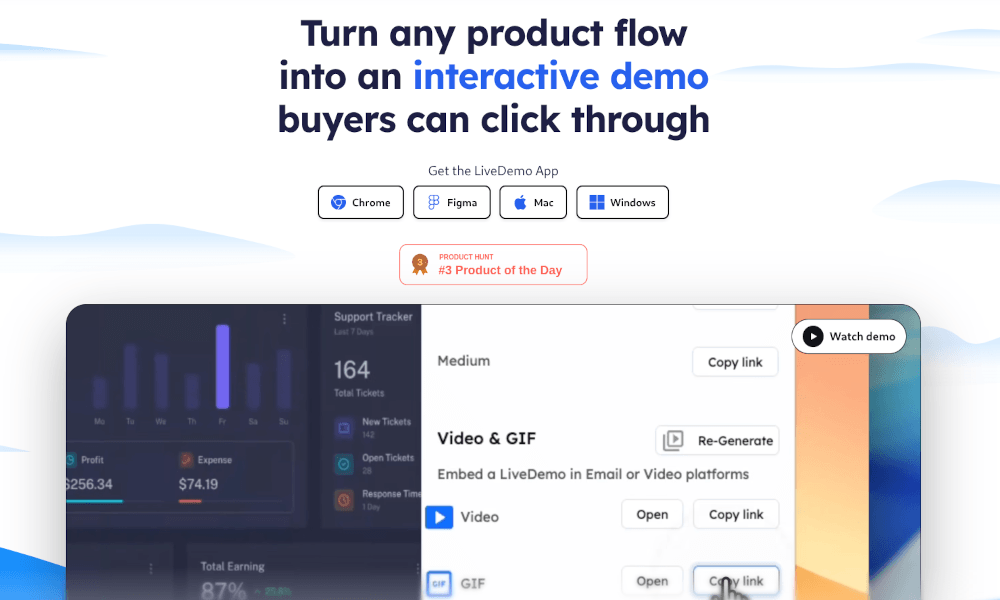
LiveDemo captures a real product flow once, through a Chrome extension, and turns it into a pixel-perfect interactive HTML tour. Not a video, not a slideshow, but a clickable environment that behaves like the software itself. Teams embed these demos on their website, inside product-led growth flows, in docs, or in sales outreach. Visitors click through the actual product on their own schedule. No form, no call.
On top of that come the tools a modern go-to-market team expects. AI voiceover and AI text personalization tailor the same demo per persona or account. There is pan-and-zoom, autoplay, personalization variables, lead capture, and GIF and MP4 exports for channels where interactivity isn't possible. Analytics track views, completion rates, time spent per step, and drop-off, so teams can see which moments move deals forward and which ones lose the room. Because every interaction is tracked, high-intent visitors qualify themselves through behavior instead of form fields and get routed straight to sales.
One captured flow becomes a single library that powers the whole funnel. Marketing gets its teaser, sales gets its deep dive, customer success gets its onboarding walkthrough. Nobody rebuilds the same product story from scratch.
Why open source changes the category #
LiveDemo's deployment repo is public on GitHub, and that single fact reshapes the buying decision in three ways.
First, ownership. Companies in regulated spaces can self-host the entire platform, keeping demo content and visitor data inside their own perimeter. LiveDemo's Business tier offers cloud or self-hosted deployment as a first-class option, something none of the big proprietary players match.
Second, extensibility. Engineering teams can read the code, audit it, and extend it to fit requirements the company never anticipated, instead of waiting on a feature request queue.
Third, honesty. LiveDemo is built in public. The team posted the launch on Hacker News and Indie Hackers themselves, ships changelogs in the open, and answers feature questions directly on the Product Hunt page, including candid admissions about what the product doesn't do yet. For buyers burned by shiny closed-source demos, that transparency is itself a differentiator.
Open source doesn't mean unfinished or free-only. The hosted product starts with a free-forever tier for one creator with three published demos. Pro at $34 per creator per month removes limits and watermarks and adds lead capture. Growth adds multiple workspaces and custom integrations, and Business adds whitelabeling, custom domains, and self-hosting. The model mirrors what GitLab and Supabase proved: open code and a commercial product strengthen each other.
The vision: demos as open infrastructure #
LiveDemo's tagline is "demo the future," and the open-source move shows what that means. “We don’t treat interactive demos as a marketing widget owned by a vendor,” says George Apostolov, co-founder of LiveDemo.ai. “We treat them as infrastructure, like the web server or the analytics stack, something every software company should be able to run, inspect, and own.” In that world the demo is the top of the funnel, the qualification layer, the sales asset, and the onboarding flow, all from one source of truth.
Buyers stopped tolerating gatekept products years ago. LiveDemo's wager is that they are about to stop tolerating gatekept demo platforms too. The companies that win the next decade of SaaS will lead with their product, and increasingly they will do it on rails they own.