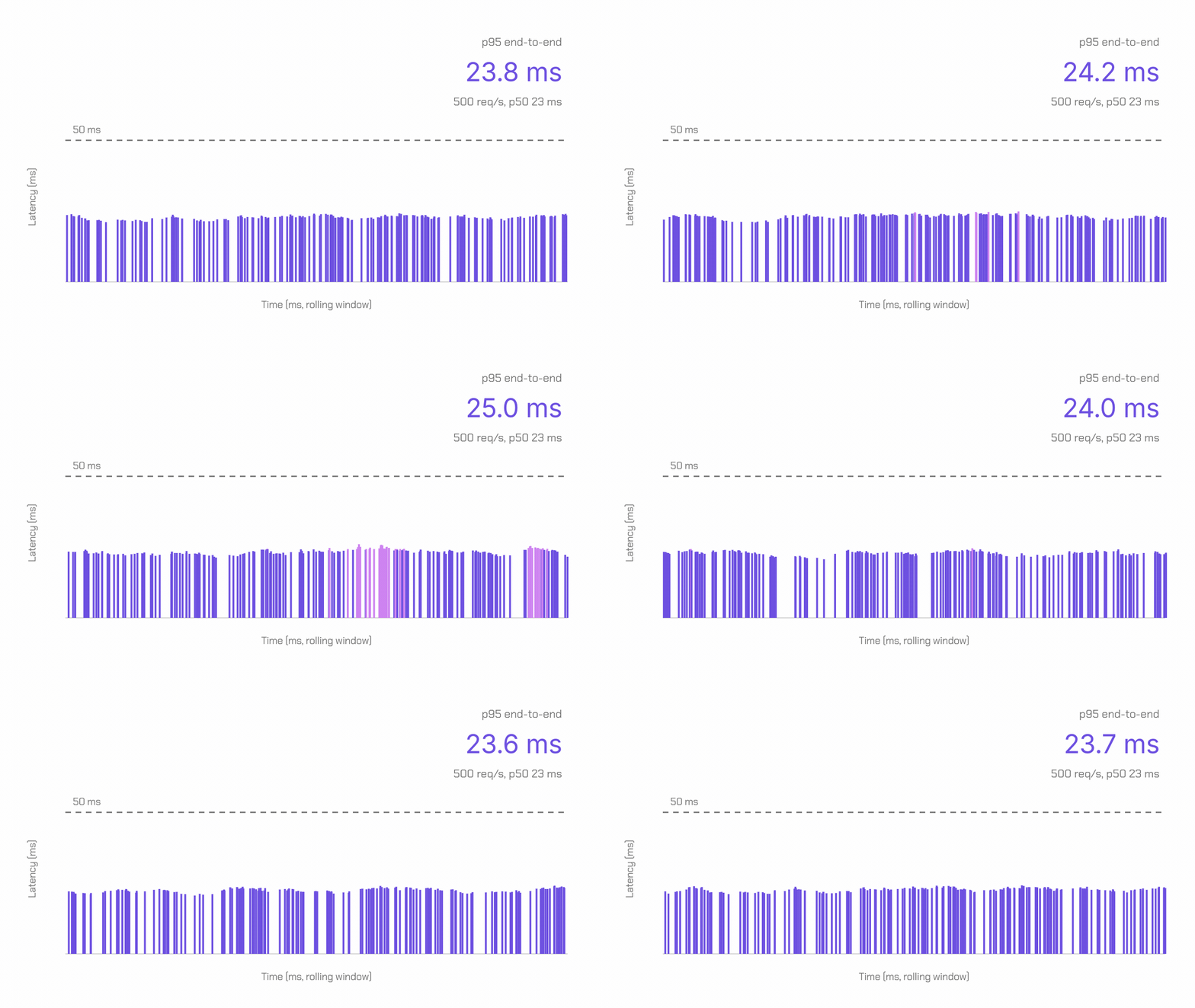
News Today we're announcing Liquid RIPL (Real-time Inference Pipeline), a low-latency inference engine built to put Liquid Foundation Models (LFMs) directly in the path of a live request. It returns complete generated model responses end-to-end in under 50 ms, and it keeps doing so while traffic arrives continuously at peak load.
Most of today's serving infrastructure is built for a different job: general purpose models, large batches, and long running agentic workflows where a few seconds per request is acceptable. Enterprise real-time workloads have far smaller latency budgets. Search rankings, product recommendations, fraud decisions, payment authorizations, and other real-time workloads need an answer in milliseconds. Even small delays add friction to the user experience, like a slower checkout that hurts conversion. That's why these systems have traditionally used fast, but less accurate, methods like gradient-boosted trees or small embedding models.
Liquid’s RIPL changes that trade off. It’s built for real-time constraints, delivering faster, more responsive generative AI experiences that improve how customers search, discover, transact, and interact.
Results across real-time workloads #
In Figure 1, we highlight a few different use cases for small LLMs in real time enterprise workflows, enabled by low-latency LLM inference.
Across the two workloads in Figure 2, LFM2.5-1.2B on Liquid RIPL has 14.4–28.4× lower p95 latency than Qwen3.5-0.8B on vLLM. LFM2.5-2.6B has 5.6–7.7× lower p95 latency than Qwen3.5-2B.