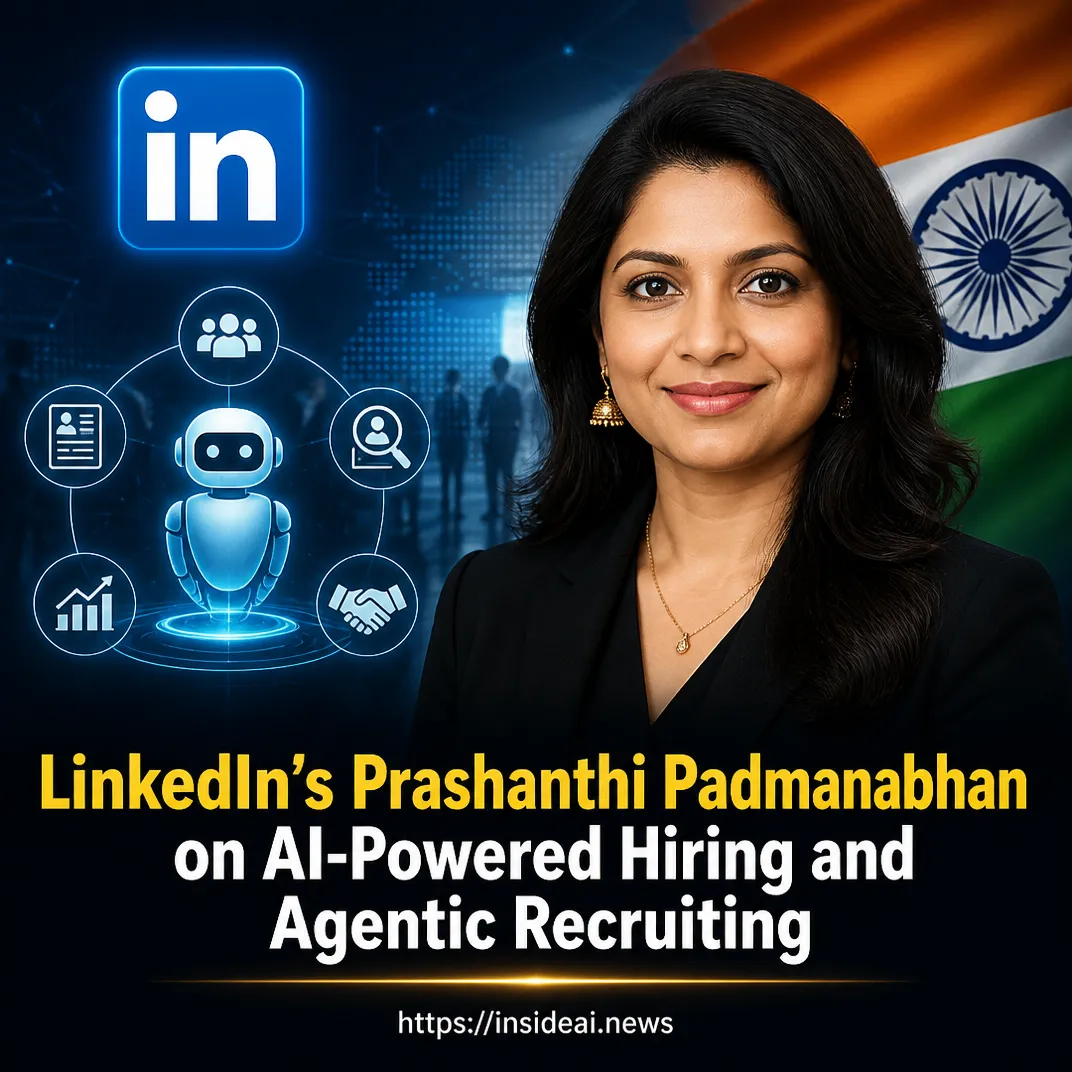
September 3, 2026, (Inside AI) — Recruiters at large enterprises often drown in thousands of applications per role. LinkedIn believes agentic AI can cut that flood without cutting humans out of decisions.
Prashanthi Padmanabhan, Vice President of LinkedIn Talent Solutions Engineering, said the company's LinkedIn Hiring Assistant (LIHA) lets hiring teams review 80 percent fewer profiles while improving candidate acceptance rates by 66 percent.
"You're not handing over control to the agent entirely; you're still in the driver's seat, but able to do far more in the same amount of time," Padmanabhan said.
Those numbers point to a broader shift: AI in recruitment is moving from a side tool to a core workflow. For LinkedIn, the bet is that agentic systems can handle scale while recruiters keep judgment, especially in high-volume markets like India.
"The larger the scale of hiring complexity you're dealing with, the clearer the ROI becomes when you bring in a product that creates that kind of efficiency," she said.
Why India Became the Scaling Ground #
India is now LinkedIn's fastest-growing major market for Talent Solutions. Padmanabhan attributes that to hiring volume and a faster appetite for AI adoption among Indian companies.
"What I find amazing is the calibre of talent we're able to hire here," she said, noting that new graduates and interns are increasingly "AI-primed and AI-native."
LIHA is a full-stack product. Padmanabhan said AI and intelligence work happens in the Bay Area, while significant development also happens in India. She sees the team as global rather than tied to one geography.
The product emerged from a deliberate process, not a rushed deployment. "Even with LIHA, the most interesting - and sometimes challenging, but rewarding - part was that we had a vision: we knew recruiting was ripe for an agentic experience, but we knew we couldn't build it alone," Padmanabhan said.
That meant direct customer conversations, prototypes, and feedback loops. The result is a system that learns recruiter intent and improves recommendations over time.
Trust, Verification, and the Human Loop #
AI-generated resumes and optimized profiles have raised accuracy concerns. Padmanabhan said LinkedIn is expanding data sources to validate profile credibility and adding more over time.
"We're putting a lot of focus into authenticity-verification hooks for both recruiters and candidates because trust works both ways," she said.
Interviews will likely stay human. AI may extract signals from conversations and feed them back into recommendations, but it will not replace interviewers. Padmanabhan sees LIHA eventually acting as a tutor for new recruiters, helping them separate must-have skills from nice-to-haves.
"The combination of a recruiter's experience and LIHA's intelligence - one plus one should feel like 10," she said. "That's our dream: the product itself becomes the teacher."
For job seekers, her advice is practical: focus on evidence, not titles. Build projects, develop skills, and add examples to profiles. "The best way to stand out is to demonstrate your skills regardless of your job title, build skills and share examples of them," she said. Pre-screening and sourcing will automate further. But the final call on who gets hired remains a human decision, at least for now.