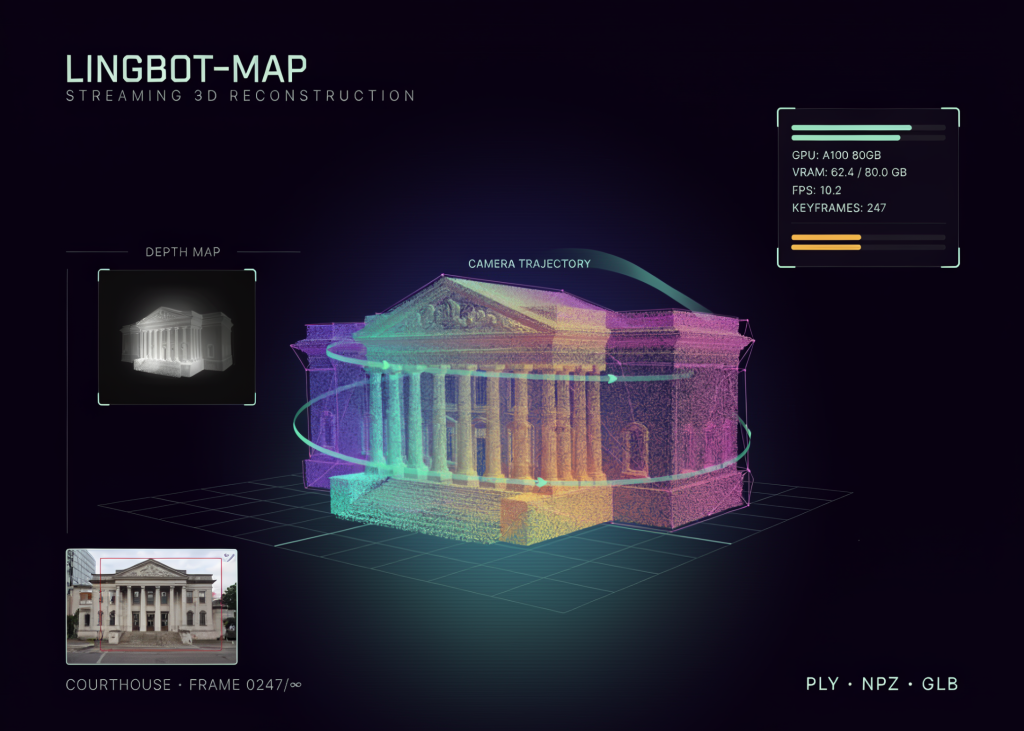
In this tutorial, we implement an end-to-end streaming 3D reconstruction pipeline with LingBot-Map. We begin by configuring the input source, reconstruction settings, checkpoint selection, and output controls, then probe the available GPU and automatically tune frame limits, camera iterations, scale frames, and KV-cache parameters according to the detected VRAM. We install the repository and its dependencies, download the pretrained checkpoint, preprocess image or video frames, and construct the GCTStream model with streaming attention and long-range trajectory memory. We then perform mixed-precision inference, decode the predicted camera poses and intrinsic parameters, convert depth maps into world-coordinate point clouds, validate the recovered geometry, visualize the reconstructed scene and camera trajectory, and export the results as PLY, NPZ, or GLB artifacts.
CFG = {
   "scene":        "courthouse",
   "image_folder": None,
   "video_path":   None,
   "fps":          10,
   "max_frames":   None,
   "stride":       None,
   "checkpoint":   "lingbot-map.pt",
   "image_size":   518,
   "patch_size":   14,
   "use_sdpa":     True,
   "mode":                  "streaming",
   "num_scale_frames":      None,
   "keyframe_interval":     None,
   "kv_cache_sliding_window": 64,
   "camera_num_iterations": None,
   "offload_to_cpu":        True,
   "window_size":           128,
   "overlap_keyframes":     8,
   "conf_percentile":  55.0,
   "pixel_stride":     2,
   "max_plot_points":  60000,
   "export_ply":       True,
   "export_glb":       False,
   "launch_viser":     False,
   "run_ablation":     False,
   "seed":             0,
}
WORK = "/content"
REPO = f"{WORK}/lingbot-map"
OUT  = f"{WORK}/lingbot_out"
import os, sys, subprocess, glob, json, time, math, shutil, textwrap
os.environ.setdefault("PYTORCH_CUDA_ALLOC_CONF", "expandable_segments:True")
os.makedirs(OUT, exist_ok=True)
def sh(cmd, check=True):
   p = subprocess.run(cmd, shell=True, capture_output=True, text=True)
   if p.returncode != 0 and check:
       print(p.stdout[-3000:]); print(p.stderr[-3000:])
       raise RuntimeError(f"command failed: {cmd}")
   return p
def probe_gpu():
   try:
       q = sh("nvidia-smi --query-gpu=name,memory.total --format=csv,noheader", check=False)
       if q.returncode != 0 or not q.stdout.strip():
           return None, 0.0
       name, mem = [x.strip() for x in q.stdout.strip().split("\n")[0].split(",")]
       return name, float(mem.split()[0]) / 1024.0
   except Exception:
       return None, 0.0
GPU_NAME, VRAM_GB = probe_gpu()
print("=" * 78)
print(f"GPU        : {GPU_NAME or 'NONE — enable Runtime > Change runtime type > GPU'}")
print(f"VRAM       : {VRAM_GB:.1f} GB")
try:
   import psutil
   print(f"System RAM : {psutil.virtual_memory().total/2**30:.1f} GB")
except Exception:
   pass
print(f"Free disk  : {shutil.disk_usage(WORK).free/2**30:.1f} GB   (checkpoint is 4.6 GB)")
print("=" * 78)
if GPU_NAME is None:
   raise SystemExit("This model needs a CUDA GPU. Switch the Colab runtime to GPU.")
if VRAM_GB < 18:
   AUTO = dict(max_frames=48, num_scale_frames=4, camera_num_iterations=2, kvsw=48)
   tier = "small (<18 GB)"
elif VRAM_GB < 30:
   AUTO = dict(max_frames=96, num_scale_frames=8, camera_num_iterations=4, kvsw=64)
   tier = "medium (18-30 GB)"
else:
   AUTO = dict(max_frames=240, num_scale_frames=8, camera_num_iterations=4, kvsw=64)
   tier = "large (30+ GB)"
if CFG["max_frames"] is None: CFG["max_frames"] = AUTO["max_frames"]
if CFG["num_scale_frames"] is None: CFG["num_scale_frames"] = AUTO["num_scale_frames"]
if CFG["camera_num_iterations"] is None: CFG["camera_num_iterations"] = AUTO["camera_num_iterations"]
if VRAM_GB < 18: CFG["kv_cache_sliding_window"] = AUTO["kvsw"]
print(f"Auto-tuned for {tier}: max_frames={CFG['max_frames']}, "
     f"scale_frames={CFG['num_scale_frames']}, "
     f"cam_iters={CFG['camera_num_iterations']}, "
     f"kv_window={CFG['kv_cache_sliding_window']}")
print("Raise CFG['max_frames'] if you have headroom — reconstruction quality "
     "improves a lot with more views.\n")
We define the configuration parameters that control the input source, model behavior, inference mode, point-cloud generation, and export settings. We inspect the available GPU, system memory, and disk space before automatically adjusting frame limits, scale frames, camera iterations, and KV-cache size according to the detected VRAM. We also create reusable shell and GPU-probing functions that prepare the Colab environment for the remaining reconstruction workflow.
if not os.path.isdir(REPO):
   print("Cloning repo (shallow) ...")
   sh(f"git clone --depth 1 https://github.com/Robbyant/lingbot-map.git {REPO}")
print("Installing deps ...")
sh("pip install -q einops safetensors huggingface_hub")
sh(f"pip install -q -e {REPO} --no-deps", check=False)
if REPO not in sys.path:
   sys.path.insert(0, REPO)
import importlib
importlib.invalidate_caches()
import cv2, numpy as np
print(f"numpy {np.__version__} | opencv {cv2.__version__}")
from huggingface_hub import hf_hub_download
print(f"\nFetching {CFG['checkpoint']} from robbyant/lingbot-map ...")
t0 = time.time()
CKPT = hf_hub_download(repo_id="robbyant/lingbot-map",
                      filename=CFG["checkpoint"],
                      cache_dir=f"{WORK}/hf_cache")
print(f"  -> {CKPT}  ({os.path.getsize(CKPT)/2**30:.2f} GB, {time.time()-t0:.0f}s)")
We clone the LingBot-Map repository and install the required dependencies without replacing Colab’s existing NumPy and OpenCV packages. We register the repository in the Python environment and verify the installed library versions to ensure that the runtime is ready for execution. We then download the selected pretrained LingBot-Map checkpoint from Hugging Face and store its local path for model initialization.
import torch
import matplotlib.pyplot as plt
from lingbot_map.models.gct_stream import GCTStream
from lingbot_map.utils.load_fn import load_and_preprocess_images
from lingbot_map.utils.pose_enc import pose_encoding_to_extri_intri
from lingbot_map.utils.geometry import (
   closed_form_inverse_se3,
   closed_form_inverse_se3_general,
   depth_to_world_coords_points,
)
torch.manual_seed(CFG["seed"]); np.random.seed(CFG["seed"])
DEVICE = torch.device("cuda")
CC = torch.cuda.get_device_capability()
DTYPE = torch.bfloat16 if CC[0] >= 8 else torch.float16
print(f"torch {torch.__version__} | sm_{CC[0]}{CC[1]} | inference dtype {DTYPE}")
def extract_video_frames(video_path, out_dir, fps=10):
   os.makedirs(out_dir, exist_ok=True)
   cap = cv2.VideoCapture(video_path)
   src_fps = cap.get(cv2.CAP_PROP_FPS) or 30
   interval = max(1, round(src_fps / fps))
   paths, idx = [], 0
   while True:
       ok, frame = cap.read()
       if not ok:
           break
       if idx % interval == 0:
           p = os.path.join(out_dir, f"{len(paths):06d}.jpg")
           cv2.imwrite(p, frame)
           paths.append(p)
       idx += 1
   cap.release()
   print(f"  decoded {idx} frames @ {src_fps:.1f} fps -> kept {len(paths)} (every {interval})")
   return paths
def gather_paths():
   if CFG["video_path"]:
       src = f"{OUT}/video_frames"
       return extract_video_frames(CFG["video_path"], src, CFG["fps"]), src
   folder = CFG["image_folder"] or f"{REPO}/example/{CFG['scene']}"
   if not os.path.isdir(folder):
       raise FileNotFoundError(folder)
   paths = sorted(sum([glob.glob(os.path.join(folder, f"*{e}"))
                       for e in (".jpg", ".jpeg", ".png", ".JPG", ".PNG")], []))
   if not paths:
       raise FileNotFoundError(f"no images in {folder}")
   return paths, folder
print("\n[5]  frames")
all_paths, SRC_FOLDER = gather_paths()
print(f"  source: {SRC_FOLDER}  ({len(all_paths)} frames available)")
stride = CFG["stride"]
if stride is None:
   stride = max(1, math.ceil(len(all_paths) / CFG["max_frames"]))
paths = all_paths[::stride][:CFG["max_frames"]]
print(f"  stride={stride} -> using {len(paths)} frames "
     f"(covering {(len(paths)-1)*stride+1}/{len(all_paths)} of the sequence)")
t0 = time.time()
images = load_and_preprocess_images(
   paths, mode="crop",
   image_size=CFG["image_size"], patch_size=CFG["patch_size"],
)
S, _, H, W = images.shape
n_tok = (H // CFG["patch_size"]) * (W // CFG["patch_size"])
print(f"  tensor {tuple(images.shape)} in [0,1]  |  {W}x{H}  |  ~{n_tok} patch tokens/frame"
     f"  |  {time.time()-t0:.1f}s")
k = min(6, S)
fig, ax = plt.subplots(1, k, figsize=(3 * k, 2.4))
for i, a in enumerate(np.atleast_1d(ax)):
   a.imshow(images[int(i * (S - 1) / max(k - 1, 1))].permute(1, 2, 0).numpy())
   a.set_title(f"frame {int(i*(S-1)/max(k-1,1))}", fontsize=9); a.axis("off")
plt.suptitle("Input frames (after crop/resize)"); plt.tight_layout(); plt.show()
We import PyTorch, LingBot-Map components, geometry utilities, and visualization libraries before selecting the appropriate inference precision for the available GPU. We load frames from a bundled scene, custom image directory, or video file and uniformly sample them according to the configured frame limit and stride. We preprocess the selected images into model-ready tensors and preview representative frames after cropping and resizing.
print("\n[6] Building GCTStream")
model = GCTStream(
   img_size=CFG["image_size"],
   patch_size=CFG["patch_size"],
   enable_3d_rope=True,
   max_frame_num=1024,
   kv_cache_sliding_window=CFG["kv_cache_sliding_window"],
   kv_cache_scale_frames=CFG["num_scale_frames"],
   kv_cache_cross_frame_special=True,
   kv_cache_include_scale_frames=True,
   use_sdpa=CFG["use_sdpa"],
   camera_num_iterations=CFG["camera_num_iterations"],
)
n_par = sum(p.numel() for p in model.parameters())
print(f"  {n_par/1e9:.2f} B params  |  heads: "
     f"camera={model.camera_head is not None}, depth={model.depth_head is not None}, "
     f"point={model.point_head is not None}")
print("   state dict ...")
t0 = time.time()
try:
   ckpt = torch.load(CKPT, map_location="cpu", weights_only=False, mmap=True)
except Exception:
   ckpt = torch.load(CKPT, map_location="cpu", weights_only=False)
sd = ckpt.get("model", ckpt)
missing, unexpected = model.load_state_dict(sd, strict=False)
del ckpt, sd
print(f"  loaded in {time.time()-t0:.0f}s | missing={len(missing)} unexpected={len(unexpected)}")
if len(missing) > 50:
   print("  !! lots of missing keys — wrong checkpoint for this model class?")
model = model.to(DEVICE).eval()
if model.aggregator is not None:
   model.aggregator = model.aggregator.to(dtype=DTYPE)
torch.cuda.empty_cache()
print(f"  GPU after load: {torch.cuda.memory_allocated()/2**30:.2f} GB allocated, "
     f"{torch.cuda.memory_reserved()/2**30:.2f} GB reserved")
kfi = CFG["keyframe_interval"]
if kfi is None:
   kfi = math.ceil(S / 320) if (CFG["mode"] == "streaming" and S > 320) else 1
print(f"\n[7] {CFG['mode']} inference | frames={S} | keyframe_interval={kfi} | dtype={DTYPE}")
torch.cuda.reset_peak_memory_stats()
out_dev = torch.device("cpu") if CFG["offload_to_cpu"] else None
t0 = time.time()
with torch.no_grad(), torch.amp.autocast("cuda", dtype=DTYPE):
   if CFG["mode"] == "streaming":
       preds = model.inference_streaming(
           images,
           num_scale_frames=CFG["num_scale_frames"],
           keyframe_interval=kfi,
           output_device=out_dev,
       )
   else:
       preds = model.inference_windowed(
           images,
           window_size=CFG["window_size"],
           overlap_size=16,
           overlap_keyframes=CFG["overlap_keyframes"],
           num_scale_frames=CFG["num_scale_frames"],
           keyframe_interval=kfi,
           output_device=out_dev,
       )
elapsed = time.time() - t0
print(f"  done in {elapsed:.1f}s  ->  {S/elapsed:.2f} FPS")
print(f"  GPU peak: {torch.cuda.max_memory_allocated()/2**30:.2f} GB allocated "
     f"/ {torch.cuda.max_memory_reserved()/2**30:.2f} GB reserved")
print(f"  outputs: " + ", ".join(f"{k}{tuple(v.shape)}" for k, v in preds.items()
                                if torch.is_tensor(v)))
try:
   print(f"  kv cache: {model.get_kv_cache_info()}")
except Exception:
   pass
model.clean_kv_cache()
torch.cuda.empty_cache()
We construct the GCTStream model with streaming KV-cache controls, camera refinement, 3D rotary embeddings, and scaled dot-product attention. We load the pretrained checkpoint, move the model to the GPU, cast the aggregation trunk to the selected precision, and report its parameter count and memory usage. We then run streaming or windowed inference, record processing speed and peak GPU consumption, and collect the predicted images, depths, confidence maps, and camera pose encodings.
print("\n[8] Decoding camera poses")
def decode_poses(pose_enc, hw):
   extr, intr = pose_encoding_to_extri_intri(pose_enc, hw)
   E = torch.zeros((*extr.shape[:-2], 4, 4), device=extr.device, dtype=extr.dtype)
   E[..., :3, :4] = extr
   E[..., 3, 3] = 1.0
   E = closed_form_inverse_se3_general(E)
   return E[..., :3, :4], intr
def unbatch(t):
   return t[0] if (torch.is_tensor(t) and t.shape[0] == 1) else t
extrinsic, intrinsic = decode_poses(preds["pose_enc"].float(), (H, W))
extrinsic = unbatch(extrinsic).cpu().numpy()
intrinsic = unbatch(intrinsic).cpu().numpy()
depth = unbatch(preds["depth"]).float().cpu().numpy()
depth_conf = unbatch(preds["depth_conf"]).float().cpu().numpy()
rgb = unbatch(preds["images"]).float().cpu().numpy()
c2w = closed_form_inverse_se3(extrinsic)
cam_centers = c2w[:, :3, 3]
path_len = float(np.linalg.norm(np.diff(cam_centers, axis=0), axis=1).sum())
print(f"  focal (px)     : {intrinsic[0,0,0]:.1f}   principal pt "
     f"({intrinsic[0,0,2]:.1f}, {intrinsic[0,1,2]:.1f})")
print(f"  depth range    : {np.percentile(depth,1):.3f} .. {np.percentile(depth,99):.3f} "
     f"(arbitrary but metric-consistent units)")
print(f"  trajectory len : {path_len:.3f}  |  extent "
     f"{np.ptp(cam_centers,axis=0).round(3).tolist()}")
print("\n[9] Unprojecting depth to a world point cloud")
def conf_threshold(conf, pct):
   sub = conf[::max(1, len(conf) // 20)].ravel()
   return float(np.percentile(sub, pct))
THR = conf_threshold(depth_conf, CFG["conf_percentile"])
print(f"  conf threshold @ {CFG['conf_percentile']}th pct = {THR:.3f}")
ps = CFG["pixel_stride"]
pts_all, col_all, frame_id = [], [], []
for i in range(S):
   wp, _, valid = depth_to_world_coords_points(
       depth[i].squeeze(-1), extrinsic[i], intrinsic[i]
   )
   m = valid & (depth_conf[i] > THR)
   m_sub = np.zeros_like(m); m_sub[::ps, ::ps] = True
   m = m & m_sub
   if not m.any():
       continue
   pts_all.append(wp[m].astype(np.float32))
   col_all.append(rgb[i].transpose(1, 2, 0)[m].astype(np.float32))
   frame_id.append(np.full(int(m.sum()), i, dtype=np.int32))
points = np.concatenate(pts_all, 0)
colors = np.clip(np.concatenate(col_all, 0), 0, 1)
frames_of = np.concatenate(frame_id, 0)
del pts_all, col_all, frame_id
print(f"  {len(points):,} points kept "
     f"({100*len(points)/(S*H*W):.1f}% of all pixels, stride {ps}, conf>{THR:.2f})")
i = S // 2
wp, _, valid = depth_to_world_coords_points(depth[i].squeeze(-1), extrinsic[i], intrinsic[i])
m = valid & (depth_conf[i] > THR)
ratio = np.linalg.norm(wp[m] - cam_centers[i], axis=1) / np.maximum(depth[i].squeeze(-1)[m], 1e-6)
print(f"  sanity: median ||p - cam|| / depth = {np.median(ratio):.3f} "
     f"(expected ~1.00-1.15) -> {'OK' if 0.98 < np.median(ratio) < 1.35 else 'SUSPECT'}")
lo, hi = np.percentile(points, [1, 99], axis=0)
scene_scale = float(np.linalg.norm(hi - lo))
print(f"  scene diagonal : {scene_scale:.3f}")
We decode the predicted pose encodings into camera extrinsic and intrinsic matrices and calculate the reconstructed camera trajectory. We convert every confidence-filtered depth map into world-coordinate points while preserving the corresponding RGB values and source-frame identifiers. We also perform a geometric quality check and calculate robust scene boundaries to verify that the reconstructed point cloud follows the expected camera and depth conventions.
print("\n[10] Plots")
k = min(4, S)
idxs = np.linspace(0, S - 1, k).astype(int)
fig, axes = plt.subplots(3, k, figsize=(3.1 * k, 7.2))
axes = np.atleast_2d(axes)
for c, i in enumerate(idxs):
   axes[0, c].imshow(rgb[i].transpose(1, 2, 0)); axes[0, c].set_title(f"frame {i}", fontsize=9)
   d = depth[i].squeeze(-1)
   axes[1, c].imshow(d, cmap="turbo", vmin=np.percentile(d, 2), vmax=np.percentile(d, 98))
   axes[2, c].imshow(depth_conf[i] > THR, cmap="gray")
for r, lbl in enumerate(["RGB", "depth", f"conf > {THR:.2f}"]):
   axes[r, 0].set_ylabel(lbl, fontsize=10)
for a in axes.ravel():
   a.set_xticks([]); a.set_yticks([])
plt.tight_layout(); plt.savefig(f"{OUT}/depth_strip.png", dpi=110); plt.show()
plt.figure(figsize=(11, 3))
plt.subplot(1, 2, 1)
plt.hist(depth_conf[::max(1, S // 15)].ravel(), bins=120, color="#4477aa")
plt.axvline(THR, color="crimson", ls="--", label=f"threshold {THR:.2f}")
plt.yscale("log"); plt.xlabel("depth confidence"); plt.ylabel("pixels (log)")
plt.legend(); plt.title("Confidence distribution")
plt.subplot(1, 2, 2)
plt.plot([(depth_conf[i] > THR).mean() for i in range(S)], lw=1.4, color="#228833")
plt.xlabel("frame"); plt.ylabel("fraction kept"); plt.ylim(0, 1)
plt.title("Per-frame confident-pixel ratio")
plt.tight_layout(); plt.show()
fig = plt.figure(figsize=(11, 4.2))
axA = fig.add_subplot(1, 2, 1, projection="3d")
axA.plot(*cam_centers.T, color="#cc3311", lw=1.8)
axA.scatter(*cam_centers[0], s=45, c="green", label="start")
axA.scatter(*cam_centers[-1], s=45, c="black", label="end")
sub = points[np.random.choice(len(points), min(4000, len(points)), replace=False)]
axA.scatter(*sub.T, s=0.4, c="#bbbbbb", alpha=0.35)
axA.set_title("Camera trajectory (3D)"); axA.legend(fontsize=8)
axB = fig.add_subplot(1, 2, 2)
axB.plot(cam_centers[:, 0], cam_centers[:, 2], color="#cc3311", lw=1.8)
axB.scatter(sub[:, 0], sub[:, 2], s=0.4, c="#bbbbbb", alpha=0.35)
axB.set_xlabel("x"); axB.set_ylabel("z"); axB.set_aspect("equal")
axB.set_title("Top-down (x-z)")
plt.tight_layout(); plt.savefig(f"{OUT}/trajectory.png", dpi=110); plt.show()
import plotly.graph_objects as go
n_show = min(CFG["max_plot_points"], len(points))
sel = np.random.choice(len(points), n_show, replace=False)
P, C = points[sel], (colors[sel] * 255).astype(np.uint8)
inb = np.all((P >= lo) & (P <= hi), axis=1)
P, C = P[inb], C[inb]
fig = go.Figure([
   go.Scatter3d(x=P[:, 0], y=P[:, 1], z=P[:, 2], mode="markers",
                marker=dict(size=1.2, color=[f"rgb({r},{g},{b})" for r, g, b in C]),
                name="points", hoverinfo="skip"),
   go.Scatter3d(x=cam_centers[:, 0], y=cam_centers[:, 1], z=cam_centers[:, 2],
                mode="lines+markers", line=dict(color="red", width=4),
                marker=dict(size=2, color="red"), name="camera path"),
])
fig.update_layout(height=680, margin=dict(l=0, r=0, t=28, b=0),
                 title=f"LingBot-Map reconstruction — {len(P):,} of {len(points):,} points",
                 scene=dict(aspectmode="data",
                            xaxis=dict(visible=False), yaxis=dict(visible=False),
                            zaxis=dict(visible=False), bgcolor="rgb(15,15,20)"))
fig.show()
def write_ply(path, xyz, rgb01):
   rgb8 = (np.clip(rgb01, 0, 1) * 255).astype(np.uint8)
   hdr = (f"ply\nformat binary_little_endian 1.0\nelement vertex {len(xyz)}\n"
          "property float x\nproperty float y\nproperty float z\n"
          "property uchar red\nproperty uchar green\nproperty uchar blue\n"
          "end_header\n")
   dt = np.dtype([("x", "<f4"), ("y", "<f4"), ("z", "<f4"),
                  ("red", "u1"), ("green", "u1"), ("blue", "u1")])
   arr = np.empty(len(xyz), dtype=dt)
   arr["x"], arr["y"], arr["z"] = xyz[:, 0], xyz[:, 1], xyz[:, 2]
   arr["red"], arr["green"], arr["blue"] = rgb8[:, 0], rgb8[:, 1], rgb8[:, 2]
   with open(path, "wb") as f:
       f.write(hdr.encode()); f.write(arr.tobytes())
if CFG["export_ply"]:
   ply = f"{OUT}/{CFG['scene']}_lingbot.ply"
   write_ply(ply, points, colors)
   print(f"  PLY -> {ply}  ({os.path.getsize(ply)/2**20:.1f} MB) "
         "— open in MeshLab / CloudCompare / Blender")
np.savez_compressed(f"{OUT}/predictions.npz",
                   extrinsic=extrinsic, intrinsic=intrinsic,
                   cam_centers=cam_centers, depth=depth.astype(np.float16),
                   depth_conf=depth_conf.astype(np.float16))
print(f"  NPZ -> {OUT}/predictions.npz (poses + depth, fp16)")
if CFG["export_glb"]:
   sh("pip install -q trimesh", check=False)
   from lingbot_map.vis import predictions_to_glb
   wp_full = np.stack([depth_to_world_coords_points(
       depth[i].squeeze(-1), extrinsic[i], intrinsic[i])[0] for i in range(S)])
   scene = predictions_to_glb(
       {"world_points_from_depth": wp_full, "depth_conf": depth_conf,
        "images": rgb, "extrinsic": extrinsic, "intrinsic": intrinsic},
       conf_thres=CFG["conf_percentile"], prediction_mode="Predicted Depthmap")
   scene.export(f"{OUT}/{CFG['scene']}.glb")
   print(f"  GLB -> {OUT}/{CFG['scene']}.glb")
try:
   from google.colab import files
   print("  (run `files.download(path)` in a new cell to pull a file down)")
except Exception:
   pass
if CFG["launch_viser"]:
   sh("pip install -q 'viser>=0.2.23' trimesh", check=False)
   import threading
   from lingbot_map.vis import PointCloudViewer
   vis_pred = {"images": rgb, "depth": depth, "depth_conf": depth_conf,
               "extrinsic": extrinsic, "intrinsic": intrinsic}
   viewer = PointCloudViewer(pred_dict=vis_pred, port=8080,
                             vis_threshold=1.5, downsample_factor=10,
                             point_size=0.00001, use_point_map=False)
   threading.Thread(target=lambda: viewer.run(background_mode=True), daemon=True).start()
   time.sleep(3)
   from google.colab.output import serve_kernel_port_as_window
   serve_kernel_port_as_window(8080)
   print("  viser opened in a new tab (allow pop-ups)")
if CFG["run_ablation"]:
   print("\n[11b] Ablation on the first 24 frames")
   sub_imgs = images[:24]
   rows = []
   for label, kw in [("cam_iters=4, kf=1", dict(keyframe_interval=1)),
                     ("cam_iters=4, kf=2", dict(keyframe_interval=2)),
                     ("cam_iters=4, kf=4", dict(keyframe_interval=4))]:
       model.clean_kv_cache(); torch.cuda.empty_cache()
       torch.cuda.reset_peak_memory_stats()
       t = time.time()
       with torch.no_grad(), torch.amp.autocast("cuda", dtype=DTYPE):
           p = model.inference_streaming(sub_imgs,
                                         num_scale_frames=CFG["num_scale_frames"],
                                         output_device=torch.device("cpu"), **kw)
       dt = time.time() - t
       e, _ = decode_poses(p["pose_enc"].float(), (H, W))
       cc = closed_form_inverse_se3(unbatch(e).cpu().numpy())[:, :3, 3]
       rows.append((label, 24 / dt, torch.cuda.max_memory_allocated() / 2**30,
                    float(np.linalg.norm(np.diff(cc, axis=0), axis=1).sum())))
       del p
   print(f"  {'setting':<20}{'FPS':>8}{'peak GB':>10}{'traj len':>11}")
   for r in rows:
       print(f"  {r[0]:<20}{r[1]:>8.2f}{r[2]:>10.2f}{r[3]:>11.3f}")
   print("  Higher keyframe_interval = less KV memory and more speed; the "
         "trajectory length drifting away from the kf=1 row is your quality cost.")
print("\n" + "=" * 78)
print(f"DONE. {S} frames -> {len(points):,} points at {S/elapsed:.2f} FPS. "
     f"Artifacts in {OUT}/")
print("=" * 78)
print(textwrap.dedent("""
   Where to go next
   ----------------
   * More frames is the single biggest quality lever. Raise CFG['max_frames']
     until you hit OOM, then back off.
   * >320 frames: the KV cache exceeds the 320-view RoPE training range. Set
     keyframe_interval (auto-computed here) rather than growing the cache.
   * >3000 frames: switch CFG['mode'] to 'windowed'. window_size counts KV
     slots, not frames — with scale_frames=8 and keyframe_interval=k, one
     window covers 8 + (window_size - 8) * k actual frames.
   * Outdoor scenes: pip install onnxruntime and use the repo's sky masking
     (lingbot_map.vis.apply_sky_segmentation) to drop sky points, which
     otherwise smear into the far field.
   * FlashInfer (use_sdpa=False) gives paged-KV attention and roughly 20 FPS at
     518x378 on a proper GPU, but JIT-compiles kernels on first call.
   * Pose collapse on long runs = state drift. Shorten the run, raise
     keyframe_interval, or move to windowed mode.
"""))
We visualize the RGB frames, depth maps, confidence masks, confidence distribution, camera trajectory, and reconstructed point cloud. We export the reconstruction as PLY and NPZ files, while optionally generating a GLB scene or launching an interactive Viser viewer inside Colab. We also support an optional ablation experiment that compares keyframe configurations in terms of speed, GPU memory usage, and reconstructed trajectory behavior.
In conclusion, we established a complete and configurable workflow for converting an ordered image or video sequence into a spatially consistent 3D reconstruction. We used LingBot-Map’s streaming architecture to process frames efficiently while controlling KV-cache growth, GPU memory consumption, keyframe density, and camera-refinement cost. We transformed the model’s pose and depth predictions into camera extrinsics, intrinsics, trajectory coordinates, and confidence-filtered world points, and we verified the geometry before generating visualizations and reusable reconstruction files. We also retained support for windowed inference, interactive Viser inspection, alternative export formats, and ablation experiments, which allows us to extend the notebook from a Colab demonstration into a practical environment for evaluating reconstruction quality, runtime performance, and memory trade-offs across different GPUs and scene lengths.
Check out the ** Full Code here. **Also, feel free to follow us on
and don’t forget to join ourTwitter
and Subscribe to
150k+ML SubReddit. Wait! are you on telegram?
now you can join us on telegram as well.Need to partner with us for promoting your GitHub Repo OR Hugging Face Page OR Product Release OR Webinar etc.? Connect with us
Sana Hassan, a consulting intern at Marktechpost and dual-degree student at IIT Madras, is passionate about applying technology and AI to address real-world challenges. With a keen interest in solving practical problems, he brings a fresh perspective to the intersection of AI and real-life solutions.