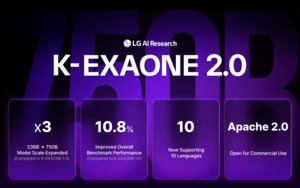
LG AI Research unveiled South Korea’s largest homegrown artificial intelligence model on Friday, a system with 750 billion parameters -- more than three times the size of its predecessor -- as the conglomerate steps up efforts to build a globally competitive AI platform.
The new model, K-Exaone 2.0, was released on open-source platform Hugging Face under the Apache 2.0 license, allowing developers and companies to use it commercially without charge, LG said.
It is the second model developed by LG AI Research under a government-led program aimed at building an independent Korean foundation model and reducing reliance on foreign AI systems.
K-Exaone 2.0's 750 billion parameters compare to 236 billion in the first version. LG said the model scored an average score of 70.1 across 24 benchmarks in nine categories, up more than 10 percent from its predecessor.
“The significance is not simply that we built a model with a large number of parameters,” said Lim Woo-hyung, co-head of LG AI Research. “We have secured the capability to compete in the same weight class as global frontier models.”
Lim added that the model’s performance was only a starting point, and that the institute would continue to improve it by enhancing data quality and refining post-training, reinforcement learning and inference technologies.
The company said the model outperformed China’s GLM-5.1 in long-context understanding and ranked ahead of GLM-5.1 and Alibaba-backed Qwen3.5 in a benchmark measuring the ability of AI agents to use external tools.
On OpenAI-MRCR, a benchmark designed to test comprehension of lengthy inputs, K-Exaone 2.0 scored 94.4, compared with 71.5 for GLM-5.1, LG said. It also scored 89.6 on the Korean-language Ko-LongBench, against 83.6 for the Chinese model.
Its average score across three long-context benchmarks was more than 10 percent better than that of GLM-5.1, according to the company.
LG expanded the number of languages supported by the model to 10 from six, adding French, Italian, Portuguese and Polish to Korean, English, Spanish, German, Japanese and Vietnamese.
The move comes as Korea seeks to strengthen its domestic AI capabilities amid growing competition among US and Chinese developers. Korean technology groups have increasingly promoted "sovereign AI" models tailored to local language, culture and regulatory requirements.
LG said K-Exaone 2.0 also scored 94.6 on average in tests designed to assess compliance with Korean social norms, global ethical standards and geopolitical context. That compared with 71.3 for GLM-5.1, 65.2 for DeepSeek V4 Pro Max and 89 for Qwen3.5, according to LG.
The company underscored that its researchers independently completed the model’s architecture, data training, distributed computing and inference infrastructure, marking South Korea’s first successful large-scale training of a model with 750 billion parameters.
The research unit has been expanding Exaone beyond general-purpose language models into industry-specific applications spanning manufacturing, biotechnology, finance and the public sector.
Its vision-language model, Exaone 4.5, unveiled in April, has been selected to analyze more than 39,000 daily public safety reports for the Ministry of Interior and Safety. It is also being used by the Ministry of Food and Drug Safety to support reviews of new drug applications.
LG plans to unveil another industry-focused foundation model next week and is preparing a public evaluation website and consumer service through which users will be able to test K-Exaone 2.0.
herim@heraldcorp.com