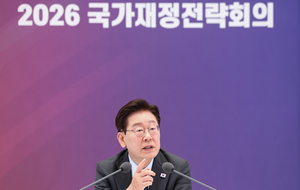
President Lee Jae Myung pledged Monday to mobilize the full resources of the government to ensure investments in three semiconductor and artificial intelligence mega projects proceed on schedule
Presiding over a national fiscal strategy meeting, Lee also proposed creating a “future response fund.” This would channel any excess tax revenue generated from the AI-driven semiconductor boom into strategic investments.
Monday's meeting mapped out the Lee administration's budget priorities and investment plans. A particular focus was placed on a trio of mega projects centered on semiconductors, AI data centers and physical AI.
Lee outlined three principles that would underpin the Lee administration’s 2027 budget and fiscal policy, the first to reflect a complete vision of his government since its launch.
Lee committed to “turning the three mega projects into new opportunities for the Korean economy” during the meeting, under the slogan “Building an Irreplaceable Korea Through Bold Innovation and Investment.”
“We will mobilize the full capabilities of the government and provide concentrated support so that investments in semiconductors, physical AI and AI data centers can proceed properly according to corporate timetables,” Lee said in his opening remarks.
Lee pledged to ensure a stable supply of essential resources such as electricity and water while expanding transportation and logistics infrastructure.
“By improving living conditions through housing, education, healthcare and cultural facilities, while also building the foundations for innovation, we will create new growth hubs across South Korea,” Lee said.
On June 29, the Lee administration unveiled plans to foster balanced regional growth through massive investments into advanced industries, mainly from Samsung and SK groups across the country.
The plan includes 896 trillion won ($595 billion) in investment for the southwestern Honam region, led by Samsung Electronics, SK hynix and Amkor Technology Korea; about 392 trillion won for projects in the central Chungcheong region, involving Samsung, SK hynix and Celltrion; and 312 trillion won for the southeastern Yeongnam region, with participation from major conglomerates including Hanwha, Hyundai Motor Group, Samsung, SK, Doosan and LG.
Lee also pledged Monday to “use additional tax revenue as strategic investment resources for responding to future challenges.”
He underscored that the government would establish a new “future response fund” to make “concentrated investments in areas such as youth, regional development and education. “Through these investments, we will raise the economy’s growth potential and ensure that the benefits are shared with all citizens.”
Lee stressed that achieving that goal would require “a strategic investment platform capable of supporting bold and sustained investment in the future.”
“The future-response fund will serve that purpose,” he said, adding that it would also provide “a foundation for achieving a great leap forward together with future generations.”
As the final principle, Lee pledged to “build the Republic of Korea where no one is left behind through growth shared by all,” referring to South Korea by its official name.
Lee said the government would provide support for young people entering society, ranging from employment and housing to wealth accumulation, while strengthening protections for nontraditional workers expected to proliferate in the AI era.
“We will strengthen the social safety net to the level of a social safety mat, so that nonstandard workers who will inevitably increase in number can also receive protection without gaps,” Lee said.
In the first session, Planning and Budget Minister Park Hong-keun presented the government's 2027 budget framework and medium-term fiscal management plan.
The second session focused on supporting the government's three mega projects, including infrastructure expansion for power, water and advanced industrial complexes. The third session centered on inclusive growth, covering youth policies, stronger social safety nets for workers and the government's "AI for All" initiative, which aims to build a nationwide AI platform accessible to all citizens.
The meeting brought together Prime Minister Han Sung-sook, Cabinet ministers and the heads of all government ministries and agencies, along with presidential aides, ruling party leaders, academics, researchers and representatives from civil society.
The ruling Democratic Party of Korea and government ministries convened a policy consultation meeting Monday morning to discuss economic growth strategies for the second half of 2026 at the National Assembly.
Rep. Han Byung-do, the Democratic Party's acting chair and floor leader, pledged to “concentrate all available resources on reviving the people's economy and delivering tangible results that citizens can feel in their daily lives."
“To this end, the Democratic Party will work to pass key legislation, including the Special Act on Mega Special Zones and the Strategic Export Finance Support Act, by the end of this year,” Han said.
“In particular, we will provide strong legislative and budgetary support for the three mega projects, as the party has already established a special committee and a dedicated support system for them.”
dagyumji@heraldcorp.com