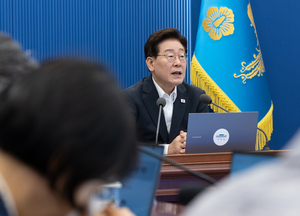
President Lee Jae Myung on Thursday called for a swift overhaul of South Korea’s conscription system that would retain universal service while widening the path into longer-term professional military roles.
Lee said the military should introduce a “selective voluntary enlistment system” as part of a broader effort to transform the armed forces into a technologically advanced, highly capable force during his weekly meeting with senior aides and secretaries at Cheong Wa Dae in Seoul.
He underscored the need for such a shift as AI, drones and robotics rapidly reshape the modern battlefield, and South Korea confronts a demographic cliff.
“It is essential to develop a strategy to reorganize our defense structure around technology and advanced equipment to prepare for future warfare, in which vast amounts of information must be analyzed in real time, and advanced weapons systems are deployed on a large scale,” Lee said.
“Given the continued decline in births, it is neither feasible nor desirable to maintain the current inefficient military structure centered on manpower and infantry,” he added.
Under Lee’s proposed hybrid model, South Korea would retain the basic framework of universal conscription while expanding opportunities for recruits to choose longer-term service as professional noncommissioned officers. Expanded roles would be particularly focused on technology-intensive fields such as artificial intelligence, drones and cybersecurity, which are increasingly important in modern warfare.
Lee called on the government to “move swiftly and thoroughly with defense reforms that introduce a selective voluntary enlistment system and transform our military into a smart, elite force centered on advanced equipment and technology.”
He further stressed that the reform should help young service members build better prospects during and after their military service by redesigning the military personnel system.
“We need to develop detailed policies so that military service can serve as a foundation for securing good jobs, receiving quality education and building financial stability,” Lee said.
The president underscored that the government bears a significant responsibility to ensure that young people do not regard military service as a waste of time or a disadvantage in their lives.
Lee concurrently pressed for “swift and decisive” improvements in pay and working conditions for junior officers and noncommissioned officers.
“Ultimately, national defense comes down to people,” Lee said. “A truly strong military can be built when young people find their service rewarding and when the military provides a solid foundation for their transition into civilian life.”
Lee called on officials to identify and swiftly implement the financial and institutional measures needed to support that transition.
The proposal is not new. Lee campaigned on introducing a selective voluntary enlistment system during his presidential campaign.
Lee renewed the pledge on June 24 during his first visit as president to Yeonpyeongdo, a front-line island near the disputed inter-Korean maritime border in the West Sea, a day before the anniversary of the outbreak of the 1950-53 Korean War.
During the visit to a Marine Corps unit, Lee said South Korea needed to reduce the number of troops maintained through conscription and create more opportunities for people to choose the military as a profession.
The Defense Ministry explained the following day that it was designing the system in tandem with a broader restructuring of the armed forces around advanced science and technology. According to the ministry, a central element would be the gradual expansion of technically skilled noncommissioned officers whose military expertise could translate into civilian careers after discharge.
dagyumji@heraldcorp.com