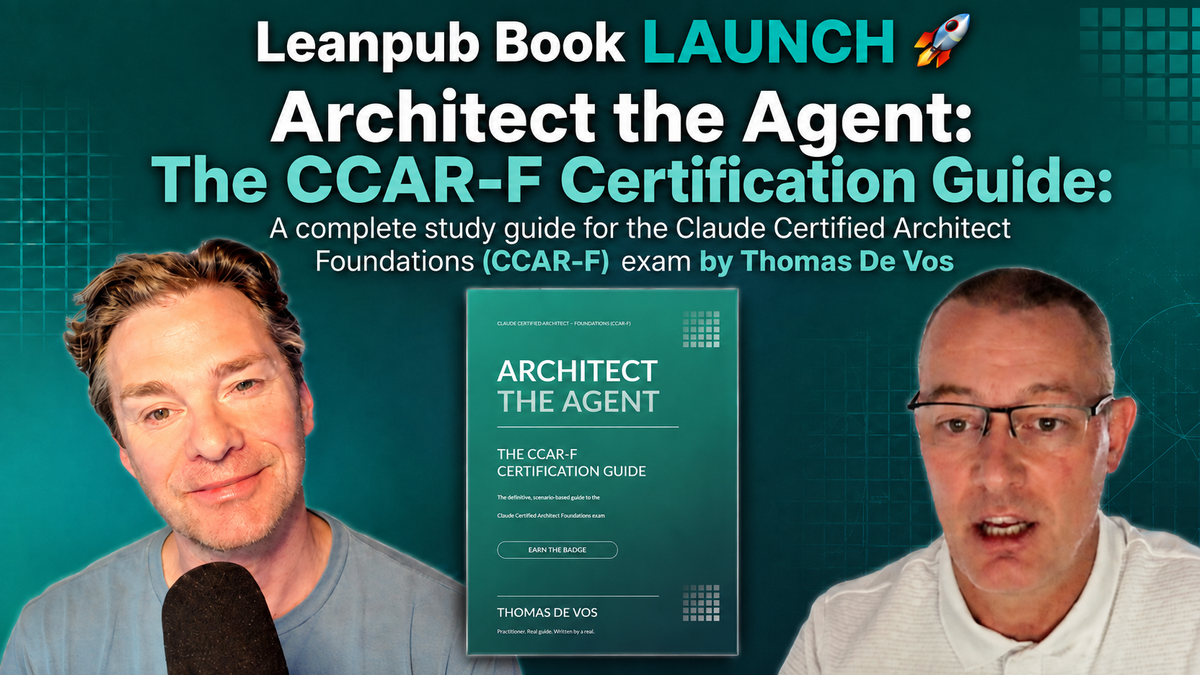
Book Launch The Claude Certified Architect Foundations (CCAR-F) exam tests whether you can make the right architectural call under pressure, not whether you can recite definitions. This guide is built for exactly that. It covers all five exam domains, agentic architecture, tool design and MCP, Clau...
Welcome to the Leanpub Launch video for Architect the Agent: The CCAR-F Certification Guide by Thomas De Vos! The Claude Certified Architect Foundations (CCAR-F) exam tests whether you can make the right architectural call under pressure, not whether you can recite definitions. This guide is built for exactly that.
It covers all five exam domains, agentic architecture, tool design and MCP, Claude Code, prompt engineering, and context management, and teaches each one the way the exam asks about it: through realistic scenarios with plausible wrong answers.
Every chapter opens with a failure worth understanding, builds the theory behind it, and closes with a hands-on build and a scenario quiz. A recurring "Why the Other Answer Fails" section trains the one skill the exam really rewards, seeing which architectural principle a tempting distractor quietly breaks.
Inside you get two full practice exams with a complete answer key, an appendix that explains the reasoning behind every question, a domain-by-domain glossary and flashcards, and clean original figures for the ideas that are easier to see than to read.
Written by Thomas De Vos, an AI lead Architect at HCLTech AI Labs, the book is reconciled against Anthropic's official exam guide, so you study what is actually tested and skip what is not. It is an independent study guide and is not affiliated with or endorsed by Anthropic.
Thomas De Vos builds AI agents for banks, which mostly means finding out where they break before a regulator does.
He is the Global Financial Services AI Lead at HCLTech AI Labs, a role he took on this year, and also heads AI Engineering for EMEA.
Before that he spent eleven years in financial services technology, working on fraud analytics and machine learning systems that had to keep running whether or not anyone was watching. He comes from a software engineering background, which is where he picked up most of the habits that still matter: read the failure log, write the test, do not trust anything you have not seen run.
A demo proves the model can do it once. Production is the argument that it will do it a thousand times, and that you can prove which time it didn't.
He writes the books he wanted to read when he started putting agents into production. They cover Claude Code, agent security, and the Anthropic certification path, and they all carry the same bias: a demo is not a system, and the boring parts (permissions, evals, audit trails, cost) decide whether anything survives contact with a real bank.
He is Belgian, lives in the UK, and holds unreasonably strong opinions about checklists.