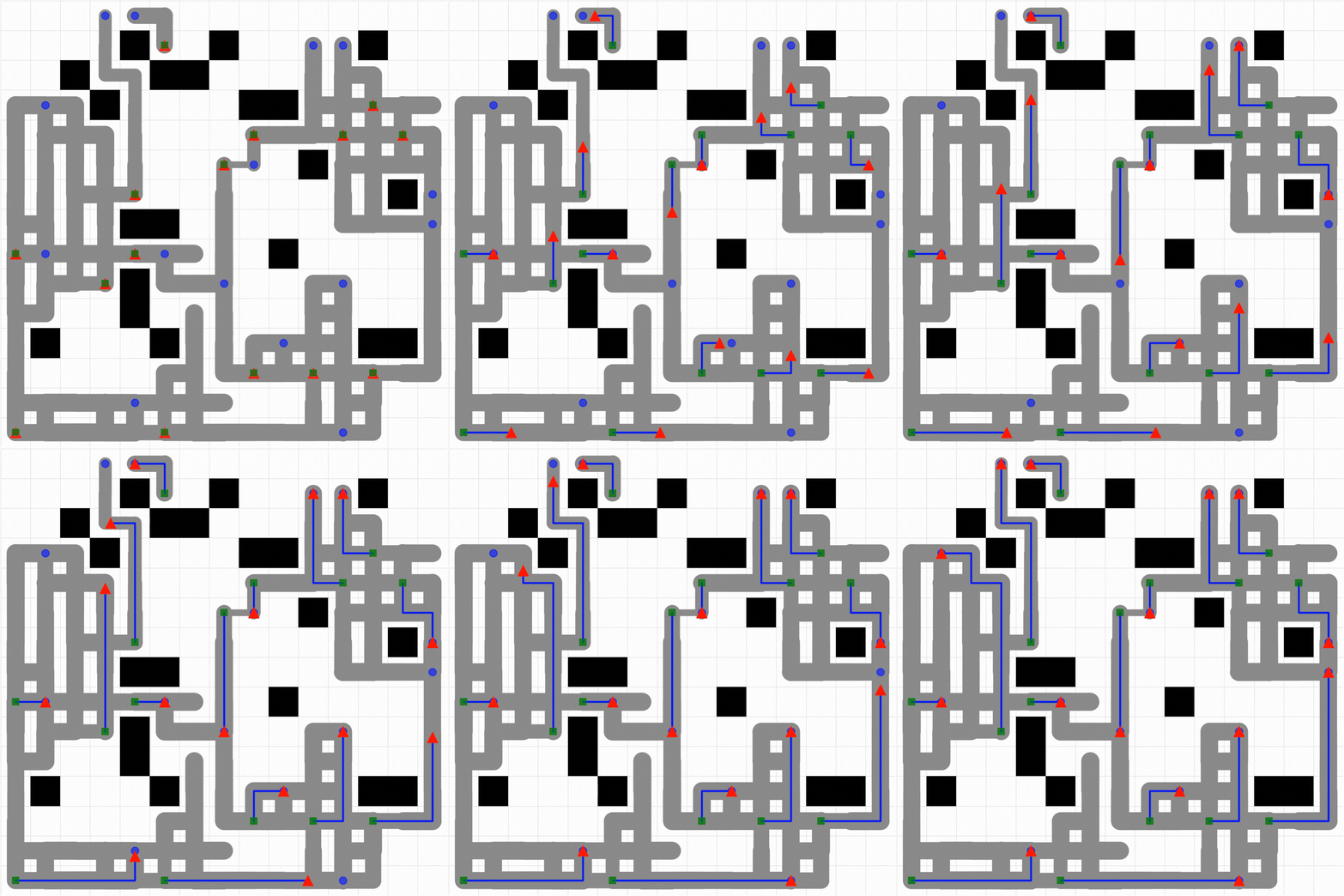
Amazon Robotics operates over a million robots across more than 300 warehouses worldwide. Inside a single warehouse, thousands of robots share the floor, moving inventory for order fulfillment and stock replenishment. Finding efficient, collision-free robot paths to their destinations is therefore essential for smooth operations.
Let us formulate the underlying multiagent pathfinding (MAPF) problem a bit more precisely. Consider a typical warehouse layout as a W x H rectangular grid. At each time step, a robot can make one of five choices: move north, east, west, or south, or wait. These choices must be coordinated to avoid collisions. Over a planning horizon of T time steps, finding optimal robot paths involves approximately n = 5WHT binary decision variables, giving 2*<sup>n</sup>* possible combinations before accounting for feasibility constraints. Finding optimal paths that minimize the total move cost or arrival time without collisions is NP hard in general and can become computationally intractable even for moderate numbers of robots.
In a paper we presented at this year’s International Conference on Machine Learning (ICML), we show that physics offers a way around this intractability: plan trajectories as if the robots were particles of gas. Modeling the robots as a cold, lazy gas, whose particles spend only the minimum effort to reach their destinations, yields optimal, minimum-energy paths. This is equivalent to treating trajectory planning as an optimal-transport problem. It yields optimal paths, but computing them may take too long for real-time deployment.
Modeling the fleet as a hot gas, whose particles jitter randomly along the way, yields trajectories that are computationally faster but potentially suboptimal. As the temperature drops to zero, however, the jittery hot-gas paths settle onto the lazy-gas ones. Our approach uses a Schrödinger bridge — a hot-gas model — to efficiently approximate the solution to an optimal-transport problem — the cold-gas model.
Optimal transport
To develop the formal connection, let us travel back to 1781 in France to meet Gaspard Monge, the father of differential geometry. Monge was looking for the most efficient way to transport excavated dirt to military fortifications. His studies gave rise to the optimal-transport problem, which asks how to transport resources from a set of sources to a set of destinations while minimizing cost, such as distance traveled or work done.
Monge’s sources were the locations containing dirt. His formulation required all mass at each source location to be transported to one destination, producing a deterministic transport map. Although intuitive, Monge’s original formulation is a difficult nonlinear optimization problem with a potential combinatorial explosion in discrete settings. Finding an optimal map is therefore technically challenging and, in some settings, impossible.
Roughly 150 years later, Soviet mathematician Leonid Kantorovich relaxed this restriction by allowing mass from one source to be split among multiple destinations. His key insight was that this relaxation converts a difficult optimization over transport maps into a linear program, a class of problems for which highly efficient computer algorithms were subsequently developed. Kantorovich received the Nobel Memorial Prize in Economic Sciences for his contributions to the theory of optimum allocation of resources.
Optimal transport connects two mass distributions, also known as marginals, through minimum-cost transport plans. This two-marginal formulation represents only the initial and final configurations and the cost of transporting between them, not the intermediate paths or collisions along those paths. Formulating MAPF as optimal transport therefore requires a multistage approach, because robots generally cannot move from their starting locations to their destinations in a single time step; their locations must also be represented at every intermediate time.
We develop this connection in detail in our paper, using multimarginal optimal transport (MMOT), which extends optimal transport to a sequence of marginals. In other words, the additional marginals represent robot locations at intermediate times in MAPF, allowing motion to be modeled across both space and time.
In the case of anonymous MAPF problems, where any robot can go to any destination, a key result we prove in the paper is the following:
| The MMOT formulation solves the combinatorial anonymous MAPF problem to optimality with a runtime of O(n<sup>1.68</sup>) seconds in practice and with a theoretical upper bound of roughly O(n<sup>3</sup>). Formally speaking, we achieve this by carefully preserving the total unimodularity of the underlying constraint matrices. |
*(red triangles)*move to destinations

*(blue circles)*without collisions.

*(1/2)*

*(red triangles)*move to destinations

*(blue circles)*without collisions.

*(2/2)*
We next provide a brief explanation of total unimodularity (TU). Consider the decision variables in a transport plan as a vector or a point in a high-dimensional space, with each coordinate specifying how much mass is transported from one grid cell to another in a single time step. The set of all feasible plans forms a geometric object called a polyhedron. Total unimodularity guarantees that every corner of this polyhedron has integer coordinates. Since a linear objective attains its optimum at a corner of the corresponding feasible polyhedron, a linear program (LP) provides optimal and integer solutions in polynomial time. Without total unimodularity, a linear program may return a fractional solution; for example, it may send half of a robot along one route and half along another.
Going back to the scale of Amazon warehouses, a square 150 × 150 grid with 1*,125 robots has 3.*4 million decision variables over a planning horizon of T = 30. Our TU-preserving MMOT provides optimal robot trajectories from their starting locations to their destinations in 478 seconds. By contrast, the non-TU, NP-hard formulation often fails to find even a single feasible solution in 12 hours.
Finding an optimal solution in 478 seconds, however, might still be impractical. A natural question is whether we can improve the solver’s runtime by accepting a slightly suboptimal solution. It is not generally clear how to formulate such a tradeoff in clean technical terms, which leads to our next contribution.
Gases hot and cold
The path to answering this question begins, unexpectedly, not with robots or linear programs but with Erwin Schrödinger and a cloud of hot gas in 1931 Germany. Schrödinger asked, Given the observed distributions of gas particles at two different times, what was the most likely evolution between them?
The emphasis here is on most likely: hot gas particles diffuse randomly, through Brownian motion, rather than following deterministic paths. This “hot gas” characterization contrasts with classical optimal transport, which can be modeled as “lazy gas” diffusion, in which particles expend only the minimum work needed to reach their destinations.
It turns out that the temperature of the gas provides the technical lever needed to traverse the spectrum from lazy gas (optimal but potentially longer runtimes) to hot gas (computationally faster but suboptimal trajectories).
To relate Schrödinger's gases back to MAPF, we devised a probabilistic Schrödinger bridge between the initial and final robot configurations. Instead of selecting a deterministic set of paths, the bridge casts robot transport as a shadow, i.e., the most likely way for the robot mass to flow from one state to another.
In our paper, we show that this is equivalent to an entropic relaxation of the MMOT problem. The amount of entropy added is analogous to the gas temperature and controls how much randomness is added to the robot trajectories. This allows us to extend a very fast method called Sinkhorn iterations to solve for the shadow.
Because the shadows are probabilistic, they divide each robot’s mass across possible destinations in space and time. Since individual robots can’t split apart, we can’t execute this plan directly.
The shadow, however, tells us where the optimal paths concentrate; that is, it reveals the important corridors. We can recover integrality by removing those decision variables where the mass is small or robot travel is less likely from the MMOT.
| Scalability: In practice, the Schrödinger pipeline (shadow plus integral projections) scales nearly linearly, O(n<sup>1</sup><sup>.</sup><sup>15</sup>), versus O(n<sup>1</sup><sup>.</sup><sup>68</sup>) for the direct MMOT solver. In raw numbers, for our fullfillment-center-scale 150 x 150 grid with 1,125 robots, we reduce the runtime from 478 seconds to 67 seconds, while staying within 6.5% of the optimal trajectories. |
Looking ahead
We’re developing extensions to labeled MAPF problems, where each robot has a fixed destination, and lifelong MAPF, where robots handle continuous streams of tasks. The connection between optimal transport and multirobot coordination opens a rich design space, offering opportunities to combine principled linear and integer programs with learning-based approaches like DeepFleet, imitation learning, and everything in between.