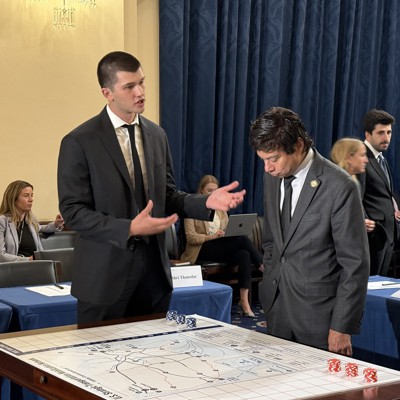
Representatives weighed responses to simulated Chinese cyberattacks on U.S. infrastructure during a tabletop exercise centered on a Taiwan crisis. #
Members and staffers from the House Homeland Security Committee and the House China Select Committee were put through a simulated Taiwan crisis Tuesday that tested how U.S. officials might respond to AI-backed cyberattacks targeting transportation and logistics networks needed to deploy American forces.
The Center for Strategic and International Studies hosted the event to give lawmakers a window into the trade-offs and uncertainty that would shape the U.S. response to a fast-moving conflict involving China and its implications in American cyberspace.
Among those participating were Republican Reps. Eli Crane of Arizona, Michael Guest of Mississippi and Michael McCaul of Texas, along with Democratic Rep. Shri Thanedar of Michigan and Puerto Rico Resident Commissioner Pablo José Hernández, also a Democrat.
The scenario begins with China launching a massive military exercise around Taiwan in the summer of 2027, leaving U.S. officials unsure whether Beijing was being coercive, imposing a de facto blockade or preparing for a full invasion of the island, per a readout provided to reporters just before the simulation began. Beijing avoids using the term “blockade” but the moves effectively quarantine Taiwan, the summary says.
Lawmakers are then told that U.S. intelligence analysts suspect Chinese hackers had begun targeting ports, freight rail systems, airports and other transportation networks that could be used to move U.S. forces and supplies. Some of the attacks cause immediate disruptions, while others appear designed to preserve access that could be leveraged later.
Participants also have to decide which networks to defend first, how closely to coordinate with private sector critical infrastructure operators and whether moving U.S. forces would deter China or further escalate the crisis.
Cyber “is always going to be a leader in any kinetic war,” McCaul told participants before reporters were asked to leave the war game room so lawmakers and staff could participate more candidly.
The exercise notably included a smattering of AI-related attacks involving stolen credentials and interference with logistics and routing systems. AI is also used in one attack scenario for a misinformation campaign, per the readout. The final scenario involved a prompt injection, in which attackers try to trick an AI system into following malicious instructions instead of its intended safeguards.
“This committee has been briefed extensively on our latest AI capabilities, Anthropic in particular, the Mythos model, and the amount of destruction that Mythos can do if it’s in the wrong hands,” McCaul said, referring to the powerful cyber-focused AI model unveiled in early April. “And we know China is three to five months behind us. That’s not very long, in my judgment.”
Current and former officials have long warned that China could disrupt U.S. military deployments by digitally sabotaging the largely private-sector ports, railways, airports and other infrastructure used to move troops and equipment overseas. Advanced AI tools, broadly, can help hackers work faster, carry out more parts of an attack automatically and target more systems at once.
The war game scenario mirrors longstanding concerns surrounding Volt Typhoon, a Chinese government-backed hacking group that U.S. officials say has spent years quietly burrowing into American critical infrastructure. The hackers are believed to be positioning themselves inside sectors such as communications, energy, transportation and water systems to disrupt them during a future conflict, including one over Taiwan.
China claims Taiwan as part of its territory and seeks to bring the self-governing island under Beijing’s control. Its major role in producing advanced computer chips makes it strategically important to both China and the United States.
U.S. spy agencies assessed earlier this year that China is not planning to invade Taiwan in 2027. While Beijing has repeatedly refused to rule out using force, the intelligence community said it believes China still prefers to achieve unification without military action.