AMD local inference has come a long way recently, thanks to projects like radiance. I’ve been successfully running Qwen3.8-Flash-Next (FP8, with 4-bit IQ4 experts) on four Radeon RX 9070 XTs and 256 GB of RAM for large NL-to-SQL workloads, at around 220 tokens/s for a single session and 500-600 with eight at once. For this task, model quality is critical. Inference engines like Strata fit big models on consumer hardware by quantizing them to 2-3 bits per weight and, for single requests, by default even skipping some of a token’s experts when they aren’t on the GPU; I wanted to see whether this machine could run a much bigger model as it was released: DeepSeek-V4.1-Flash, with its original MXFP4 experts.
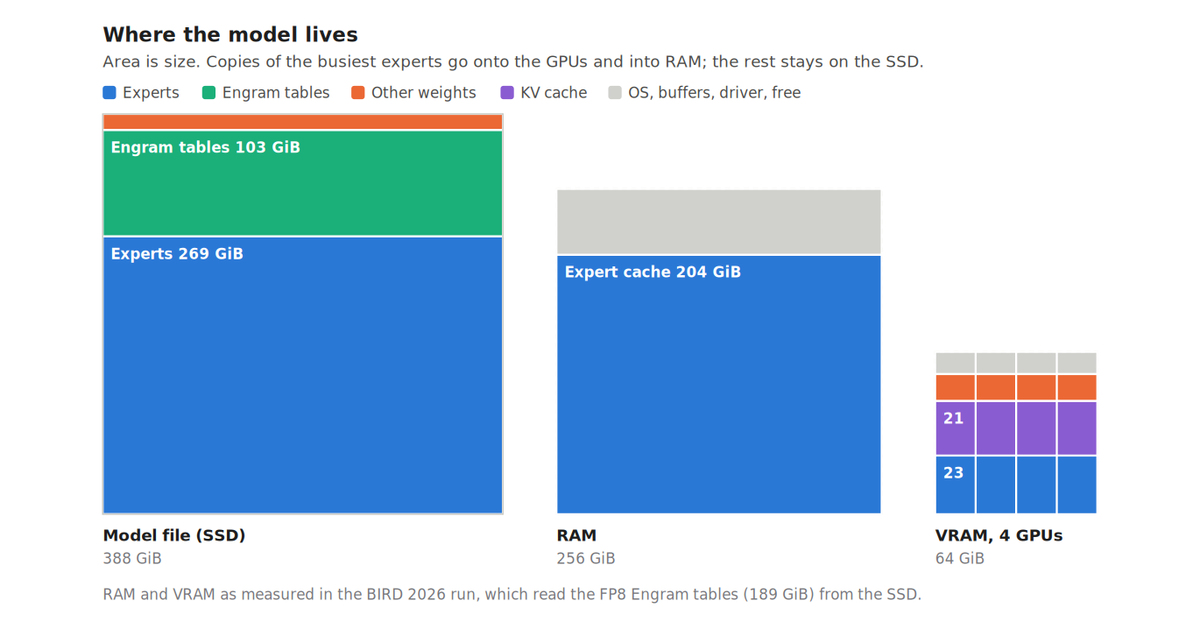
At 416 GB it is far bigger than the GPUs’ 64 GB of VRAM, so most of it has to come from RAM or the SSD. With only a few requests, each expert copied to a GPU is used for just one or two tokens, and one request at a time gives 25-35 tokens/s. But its compressed KV cache needs only about 10 MB per GPU for a 1,000-token request, so hundreds of requests fit at once. The obvious experiment: keep raising the batch size until something breaks. With a few tweaks, it went further than expected: with all 500 questions of the BIRD text-to-SQL benchmark at once, the box generates 228 output tokens per second (about 360 at its peak, measured over 10 seconds) and finishes the job in 3.5 minutes. On BIRD’s 2026 revision, whose prompts ask for reasoning before the SQL, it generates 155 tokens/s for 39 minutes.
| Original BIRD, at once | Generating, tok/s | Whole job, tok/s | Wh per 1k tokens |
|---|---|---|---|
| 1 | 34 | 14 | 12.8 |
| 8 | 59 | 33 | 5.0 |
| 64 | 79 | 46 | 3.5 |
| 256 | 164 | 108 | 1.72 |
| 500 | 228 | 151 | 1.29 |
| BIRD 2026, at once | Generating, tok/s | Whole job, tok/s | Wh per 1k tokens |
|---|---|---|---|
| 1 | 25 | 21 | 8.6 |
| 8 | 37 | 35 | 4.1 |
| 64 | 53 | 50 | 2.9 |
| 256 | 101 | 94 | 1.83 |
| [**500**](#timeline-2026) | **155** | **137** | **1.34** |
| [*1,534 (dev, continuous)*](#timeline-continuous) | *197* | *154* | *1.20* |
“Whole job” includes prompt processing. The last row: BIRD’s larger dev set in the same prompt format, fed through 512 slots (chart). Power (GPUs + CPU) ranges from 520 to 700 W across the batch sizes, so 500 at once needs six to ten times less energy per token than one at a time.
The answers hold up against the API deployments of the same model. BIRD, the text-to-SQL benchmark, has two versions of its 500-question mini-dev set: the original from 2024 and a 2026 revision with corrected reference answers and official prompts:
| Who runs the model | Original accuracy | cost | BIRD 2026 accuracy | cost |
|---|---|---|---|---|
| This box, DeepSeek-V4.1-Flash | 61.8% | €0.012 | 50.6% | €0.13 |
| DeepSeek API | 59.8% | €0.031 | 50.8% | €0.22 |
| DeepInfra | 60.2% | €0.015 | 47.2% | €0.12 |
| Wafer | 60.2% | €0.021 | 49.0% | €0.16 |
| Other models | ||||
| Qwen3.8-Flash-Next, this box | 67.2% | €0.005 | 32.4% | €0.025 |
| Claude Haiku 5.5 | 62.0% | €0.10 | 53.4% | €0.28 |
| GPT-6 Luna | 55.8% | €0.063 | 43.0% | €0.17 |
This box’s cost is the electricity of its GPUs and CPU (from their own sensors; RAM, board and power supply losses come on top) at an assumed €0.30/kWh. API costs were billed through OpenRouter on 16 November 2026, at $1.12 per euro. All runs with thinking off and temperature 0, except Haiku and Luna, which ran at their default sampling because they don’t accept temperature 0.
The two BIRD versions tell different stories about Qwen. On the original benchmark it clearly beats DeepSeek-V4.1-Flash, while on the revision it falls from 67.2% to 32.4%. Every other model loses about 9 to 13 points on the revision; Qwen loses 35. One explanation could be that some models know the original set too well; the revision’s new prompts and answers may also play a part.