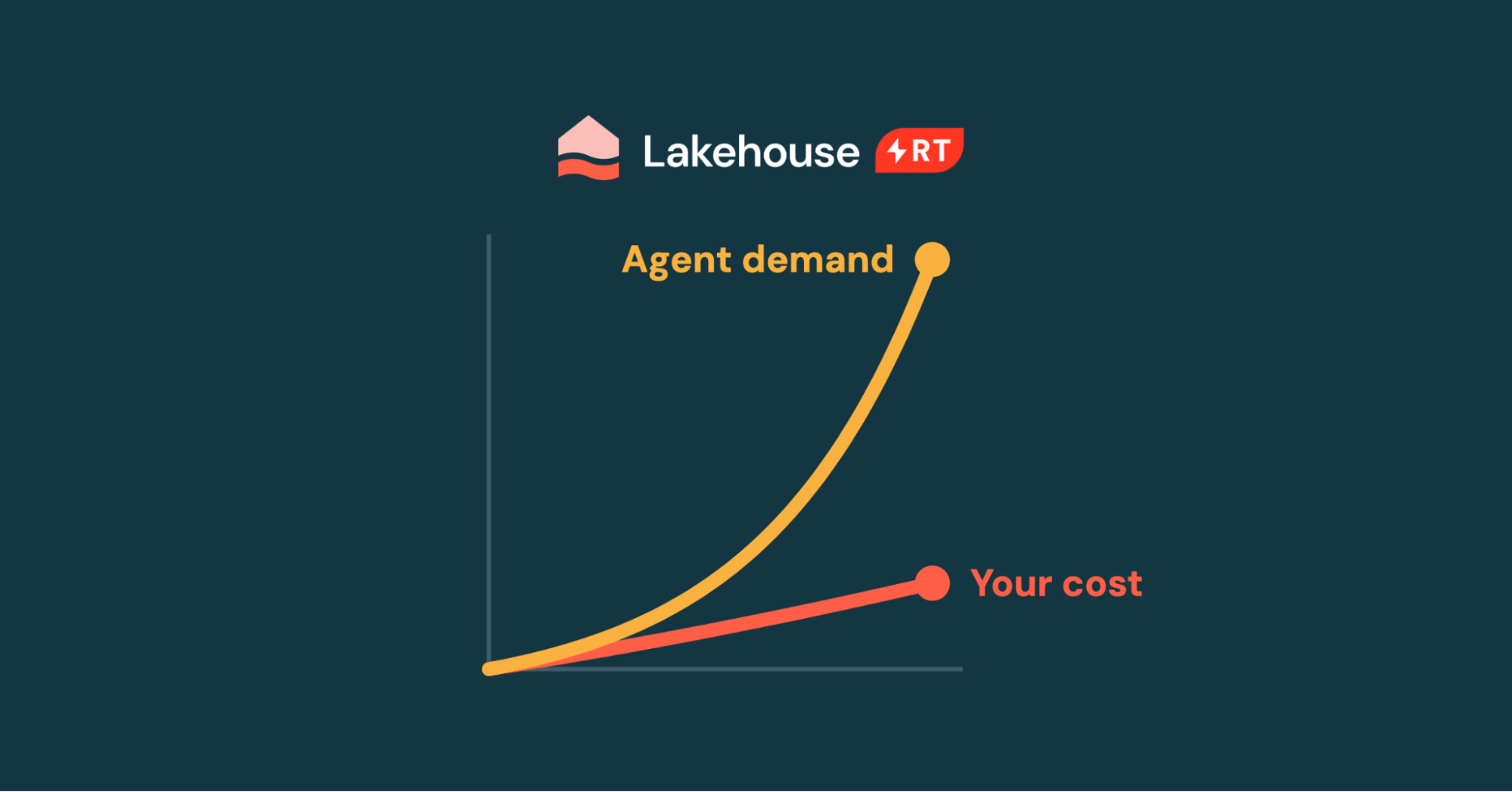
AI agents can multiply your query volume. Lakehouse//RT keeps your bill from multiplying with it.
by JooHo Yeo and Kaitlin Baumgardner AI agents are pushing the limits of data warehouses. A human analyst might run a few dozen queries in an afternoon. An agent can run hundreds per second, around the clock. And with growing demand for use cases like customer-facing dashboards that refresh in milliseconds and applications with embedded analytics, real-time workloads are quickly becoming a standard part of how businesses use data.
Most data warehouses were designed for human-scale query volume, not the sustained concurrency agents generate. And even when a warehouse can deliver low latency, the bill grows as fast as demand: 10x the queries could easily mean 10x the cost.
We built Lakehouse//RT not only to serve real-time workloads directly on the lakehouse, but to do so without growing your costs at the same rate as your queries.
Most data warehouses scale capacity in step with demand: more queries, more compute, more cost. That works well for many analytics workloads, where query volume tracks the number of people asking questions. Real-time workloads are different. When AI agents and thousands of concurrent users all need answers in milliseconds, query volume can grow far faster than headcount, and cost grows with it.
Real-time workloads are also often spiky. The usual way to handle that is to overprovision: add capacity in large blocks and keep it running so latency holds up at peak. You end up paying for idle compute most of the day.
Lakehouse//RT flips the equation. Instead of scaling cost with demand, it scales efficiency. Its engine is architected to serve dramatically more queries on the same resources, so when demand doubles (or increases tenfold), your infrastructure keeps pace without a proportional spike in spend.
Lakehouse//RT achieves this by taking a different approach in four areas:
Organizations will not be able to outspend the demand curve. The only sustainable path is a system that does more per unit of compute.
Concurrency is where real-time costs usually grow fastest. Traditional warehouses can only run so many queries at once, the rest wait in line or trigger more capacity. Serving hundreds of agents then means running several clusters just to keep response times steady. That's true even when most of those queries are small lookups that don't need the horsepower.
Lakehouse//RT is designed to run far more queries side by side on each warehouse. In our launch blog we shared that we can deliver sub-100 millisecond latency at 12,000 queries per second, and we’re only getting better from here.
Each query also finishes quickly, so capacity frees up sooner for the next one. The same peak fits on far less compute, and the agents still get answers in milliseconds.
Customers are experiencing this on real-world workloads. Aurasell moved from several clusters at 200 queries per second to one small Lakehouse//RT warehouse sustaining more than 250 QPS, executing queries 4-5x faster while reducing costs by 10x.
Keep reading for more customer success stories!
Say you hire a contractor. One charges $20 an hour and takes 10 hours. Another charges $22 an hour and finishes in five. The first costs $200 and the second costs $110. You pay for the finished job, not the hour.
Compute works the same way: your bill is rate times runtime. Lakehouse//RT is built to finish real-time queries fast, including the steps around execution like planning, routing, and returning results. Each query holds compute for less time. Across millions of agent queries a day, that adds up.
Every warehouse eventually needs more capacity as traffic grows. What matters is the size of each step.
Traditional warehouses typically scale by spinning up whole copies of themselves. On a Large warehouse, that's another Large warehouse spinning up. While cluster-level scaling works well for steady analytics workloads, real-time demand is spikier. When a burst needs only a fraction of a cluster, adding a whole cluster means paying for capacity you don't use until the burst passes.
Lakehouse//RT can flexibly add capacity, even one node at a time, whatever t-shirt size you select. Real-time demand rarely arrives in cluster-sized blocks. A spike in agent traffic might need 10% more capacity, not 100%, and Lakehouse//RT can add a step that size instead of doubling.
Scaling in small steps without hurting latency is easier said than done. It's what Lakehouse//RT was designed for, and it lets capacity grow in step with demand instead of ahead of it.
Real-time used to mean bolting a separate serving layer onto your warehouse, such as Apache Druid, Apache Pinot, or a cache. That meant always-on infrastructure, a second copy of your data, sync pipelines, and engineers to keep it all consistent.
Lakehouse//RT queries governed lakehouse data directly, so as volume grows there's no second stack growing alongside it.
Aurasell's AI-native go-to-market platform runs agents that prospect, manage pipeline, and coach reps around the clock. Those agentic workflows depend on high query throughput, and Aurasell wanted real-time performance without moving or indexing data into an external system. With Lakehouse//RT, the team serves that workload directly in Databricks from a single small cluster.
"High query throughput is critical for our agentic workflows at Aurasell. Before Lakehouse//RT, reaching 200 queries per second required us to spin up several separate clusters, which added complexity. With Lakehouse//RT, a single small cluster easily sustained over 250 QPS while executing queries 4-5x faster. Beyond the 10x improvement in infrastructure and cost efficiency by consolidating clusters, the biggest win is architectural simplicity; we get the real-time performance we need directly in Databricks without having to move or index our data into external systems." – Srinivas Bandi, CTO, Aurasell
VisionHeight is a pre-attack intelligence platform that maps adversary infrastructure across the public internet in real time. Their previous real-time layer ran on Apache Pinot with always-on EC2 clusters running 24/7. After switching to Lakehouse//RT's serverless model, VisionHeight saw a cost reduction of more than 90%. On their heaviest query, Lakehouse//RT delivered sub-second response times, nearly 3x faster than Pinot. The entire migration took three days.
"Once we got Lakehouse//RT, it was very fast. No extracting data out, no maintaining infrastructure, and about a 90% cost reduction. It all just works in Databricks now." – Nitsan Daniel, CTO and Co-founder, VisionHeight
Read the full case study here*.*
nOps manages more than $5 billion in annual cloud spend for hundreds of customers, powering real-time dashboards where enterprises track exactly where their money goes. Their real-time query layer previously ran on Apache Druid, requiring a separate always-on cluster and 40TB of duplicated data synced from their lakehouse. After migrating to Lakehouse//RT, nOps cut infrastructure costs by more than 6x while eliminating the duplicated data entirely. Because Lakehouse//RT queries data directly where it lives, the migration required no data copying, no new ingestion pipelines, and no new infrastructure.
"Anyone would know that trying to move over 380 terabytes of data around to different platforms is a nightmare, and it's expensive. With Lakehouse//RT, we get real-time capabilities with zero change to the underlying data." – Jordan Stein, Director of Engineering, nOps
The wave of AI and user demand isn't coming; it's here. Query volumes will grow by orders of magnitude. The question isn't whether you can afford real-time performance. It's whether you can afford not to have a system built for efficiency at scale.
Lakehouse//RT gives you:
Lakehouse//RT is available in beta today. Spin up a new Lakehouse//RT warehouse and start testing your most demanding real-time workloads.
Subscribe to our blog and get the latest posts delivered to your inbox.