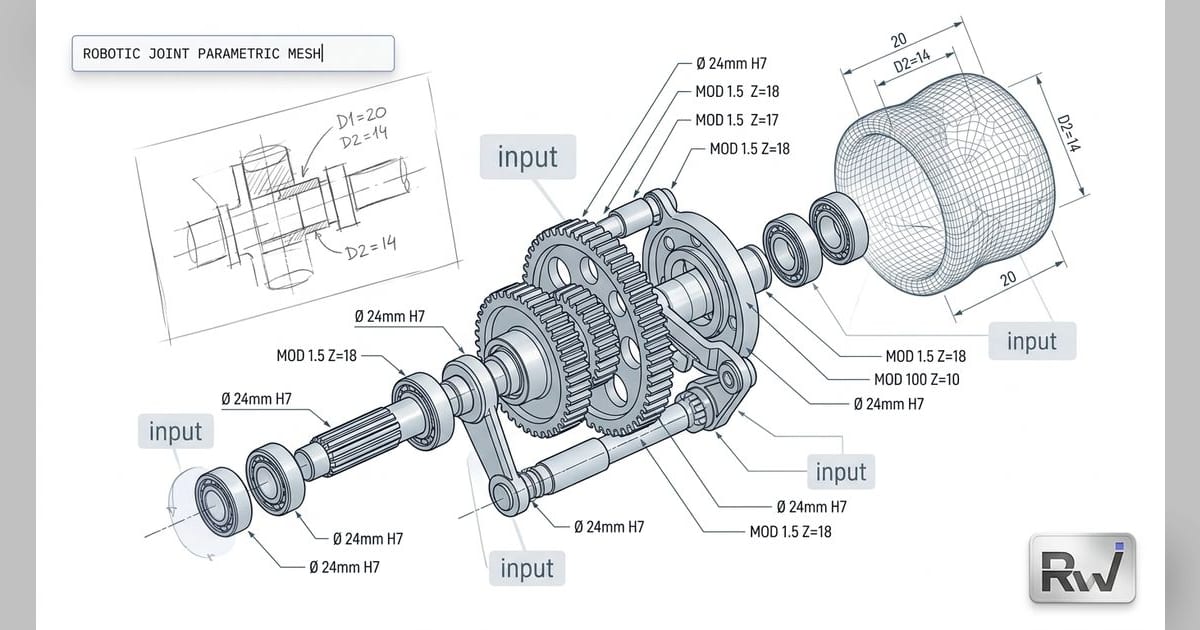
Kyrall is entering the AI-for-hardware race with a promise aimed at a specific pain point: generated 3D models that remain editable as parametric CAD, rather than one-off meshes that collapse under engineering work.
Kyrall's public site says users can provide text, sketches, images, mesh inputs or files and get back a "fully functional, parametric CAD" model that can be refined through parameters, edge and face selection, and follow-up prompts. The site shows outputs and exports labeled GLB, STL and STEP, and examples such as a hollow cylinder with 50mm height and 2mm wall thickness, a T-joint bracket for 2020 aluminum extrusion, and a parameter panel with adapter height, base bolt diameter and bolt spacing values.
The important word in Kyrall's pitch is "parametric." In mechanical design, the useful artifact is the editable history, dimensions and constraints that let an engineer change a hole diameter, extend a bracket, preserve a relationship between features, and pass the model into the next stage of design, simulation or manufacturing. Kyrall is trying to sell AI as a way to remove the clicking from CAD, while preserving the design logic that makes CAD valuable.
Where it fits in CAD workflows
Kyrall positions the product closer to engineering CAD than to visual 3D generators. The homepage pitches high-level prompts and uploaded context that result in an editable parametric model, not a static mesh. That matters because many AI 3D tools focus on visualization or quick prints; Kyrall is aiming at engineers who need models that survive design changes and export to STEP.
Kyrall offers a browser editor and an API. The API pitch is straightforward: call Kyrall from a backend or internal tool to automate CAD workflows. The public documentation page is live at kyrall.com/documentation, though the site does not disclose endpoint details, quotas or guarantees on the public-facing page. If Kyrall proves useful inside engineering teams, the highest-value uses will likely be embedded into quoting, design, variant generation and manufacturing-prep systems.
Pricing is public. Adoption metrics are not.
Kyrall's site lists a free Starter plan with 10 generations, an online model editor, segment selection and assemblies. The Premium plan is listed at 20 EUR per month when billed monthly, or 16 EUR per month on annual billing, and includes unlimited generations, API access, Knowledge Graph and Context Manager. Enterprise pricing is custom, with advanced integrations, custom workflows, compliance alignment and dedicated onboarding.
The adoption trail is thinner. Kyrall's site does not name customers, publish user counts, disclose revenue, show production manufacturing case studies or provide benchmark data for success rates.
Manufacturability is the claim to test
Kyrall's sharpest claim is manufacturability. The homepage says it takes users "from concept to manufacturable model" and that it creates functional parametric CAD rather than static meshes. That promise raises the questions hardware teams will ask: which CAD kernel Kyrall uses, how constraints are represented, how assemblies scale, how generated parts handle tolerances, how versioning works, what data retention terms apply, and how often the system produces geometry that downstream tools reject. Kyrall's website does not answer those questions.
Kyrall is entering a market where the language is moving faster than the proof. Ragnar advertises AI CAD generation from text and images with STEP and STL export. PartWork.ai pitches true parametric CAD geometry and B-rep solids for CNC machining and 3D printing.
Kyrall's opening is that engineers do not need another pretty mesh generator. They need a model they can change after the demo ends. If Kyrall can make the generated feature tree reliable, the boring parts of CAD become a software automation problem. If it cannot, it becomes another AI tool that produces impressive first drafts and hands the cleanup back to the engineer.