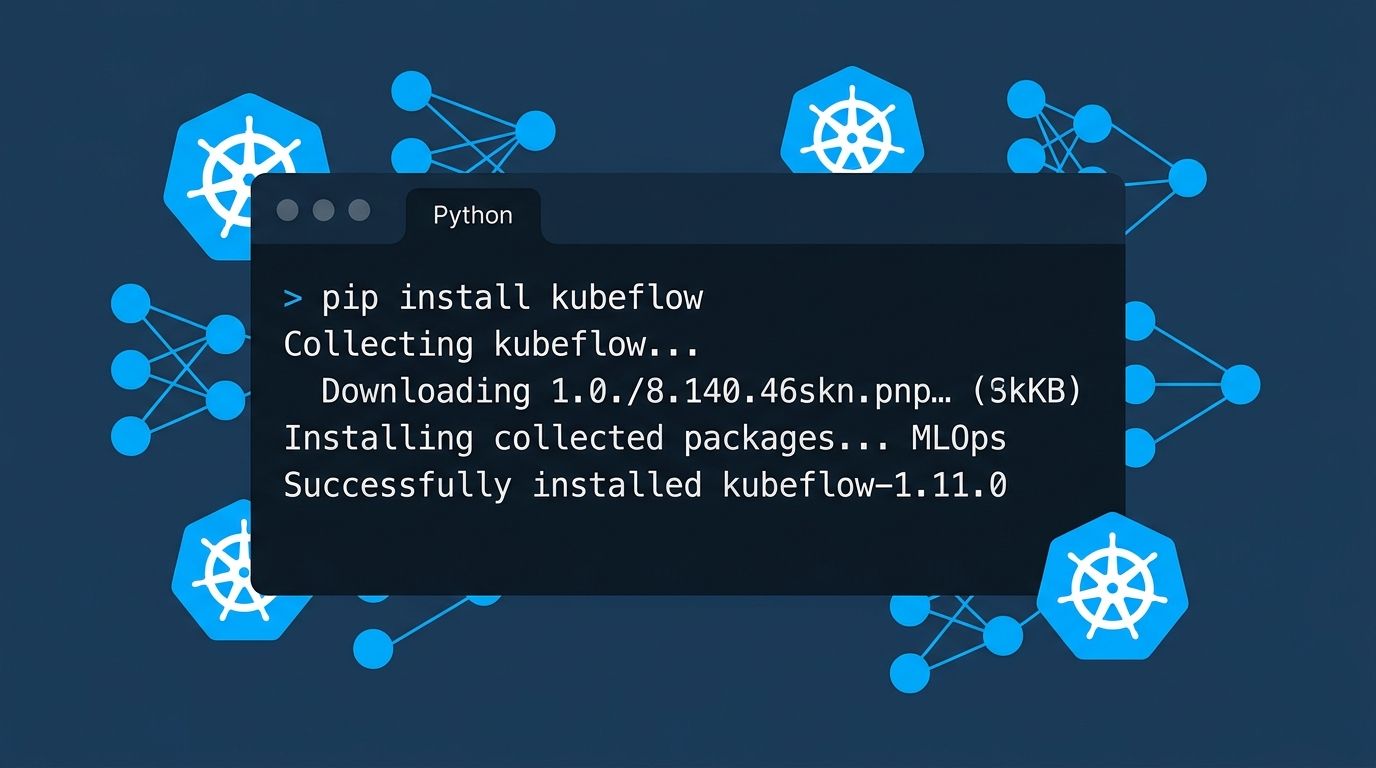
Kubeflow 1.11 landed at KubeCon Japan this week with one sentence that shifts the MLOps conversation: pip install kubeflow
. For the first time in the platform’s eight-year history, ML practitioners can submit distributed training jobs, run hyperparameter searches, and fine-tune Llama 3.2 — all without writing a line of YAML or understanding how Kubernetes CRDs work. That is not a UX polish. It is a rethink of who Kubeflow is actually for.
The YAML Wall Just Fell #
The Kubeflow team’s SDK-first push has been building across a few releases, but 1.11 is where it lands as a complete story. The unified TrainJob API replaces the old framework-specific CRDs — no more separate PyTorchJob, TFJob, or MXJob definitions. Platform engineers define TrainingRuntime
and ClusterTrainingRuntime
resources once; data scientists consume them through Python without touching cluster configuration.
More practically: there is now a local execution mode. You can run and debug a training job on your laptop, iterate on the code, then point the same client at a production cluster when you’re ready to scale. The gap between “Python script on my machine” and “distributed job on Kubernetes” is closed by the SDK, not by the developer’s Kubernetes knowledge.
Fine-Tuning Llama 3.2 With Fewer Lines Than a Config File #
The TorchTune integration is worth singling out because it solves a workflow that previously required significant infrastructure wiring. Kubeflow 1.11 ships pre-configured ClusterTrainingRuntime
resources for Llama 3.2 (1B and 3B-Instruct) and Qwen 2.5, with LoRA, QLoRA, and DoRA fine-tuning methods included. HuggingFace and S3 dataset initializers handle data .
from kubeflow.trainer import TrainerClient

client = TrainerClient()
client.train(
    runtime="llama-3.2-lora",
    dataset="hf://datasets/tatsu-lab/alpaca",
    num_epochs=3,
)
Point it at a dataset, pick a runtime, set epoch count. Kubeflow schedules the distributed training job. Compare that to the YAML manifests this required eighteen months ago and the improvement is stark.
Hyperparameter Tuning Without the YAML Ceremony #
The new OptimizerClient
brings the same philosophy to Katib experiments. Previously, hyperparameter tuning meant authoring Katib Experiment CRDs in YAML — a non-trivial document with search algorithm configuration, trial specifications, and metric collector setup. Now:
from kubeflow.optimizer import OptimizerClient
from kubeflow.optimizer.types import Search, Objective
from kubeflow.trainer.types import TrainJobTemplate, CustomTrainer

client = OptimizerClient()
job_name = client.optimize(
    trial_template=TrainJobTemplate(trainer=CustomTrainer(func=train)),
    search_space={
        "learning_rate": Search.loguniform(1e-5, 1e-1),
        "batch_size": Search.choice([16, 32, 64, 128]),
    },
    objectives=[Objective(name="accuracy", type="maximize")],
)
best = client.get_best_results(job_name)
The client launches trials in parallel against your resource constraints, tracks metrics across experiments, and surfaces the optimal parameters. From notebook to hyperparameter search in minutes, not hours of configuration.
KServe and Production Inference #
KServe 0.15.2 adds multi-node inference support using Ray-based serving runtimes, which matters for models too large for a single GPU node. vLLM is updated to v0.8.1+ with reasoning model support, tool calling, embeddings, and reranking. KEDA integration enables event-driven autoscaling, so inference capacity scales with actual request load rather than static replica counts. 4-bit quantization via bitsandbytes lands in the Hugging Face runtime.
Two Breaking Changes You Cannot Skip #
Before upgrading any production Kubeflow installation, there are two mandatory steps.
Back up your database. The Gorm database backend upgrade in Pipelines 2.15.2 runs an automated index migration for anyone upgrading from pre-2.15.0. This migration does not support rollback. A failed upgrade without a backup means a potentially unrecoverable database state.
Handle the MinIO to SeaweedFS transition. SeaweedFS is now the default object store, replacing MinIO. If you have existing pipeline artifacts stored in MinIO, back them up and restore them after switching. MinIO manifests still exist in the distribution, but the Kubeflow team has flagged they may be removed in a future release — so if you depend on MinIO, plan the migration now rather than later.
CNCF Graduation and What It Signals #
Kubeflow has formally applied for CNCF graduation at KubeCon Japan. The project joined CNCF at the Incubating level in July 2023 — graduation would put it alongside Kubernetes, Prometheus, and Envoy at the top tier of production-ready cloud native projects. For enterprises evaluating MLOps platforms, graduation changes the procurement conversation.
The Discovery Problem #
The SDK is a genuine step forward. The harder problem is that many teams who evaluated Kubeflow two or three years ago — decided it was too complex, too YAML-heavy, too Kubernetes-native — are not watching the project closely enough to know this release exists. The platform improved. The developer community’s mental model of Kubeflow may not have caught up.
If your team runs AI workloads on Kubernetes and ruled out Kubeflow for complexity reasons, the 1.11 release notes are worth an hour of your time. The OptimizerClient docs and Trainer v2 documentation are good entry points. The KubeCon Japan announcement covers the community roadmap, including Notebooks V2 and Kale 2.0 which are coming next.
The YAML wall fell. Whether teams notice is a different question.