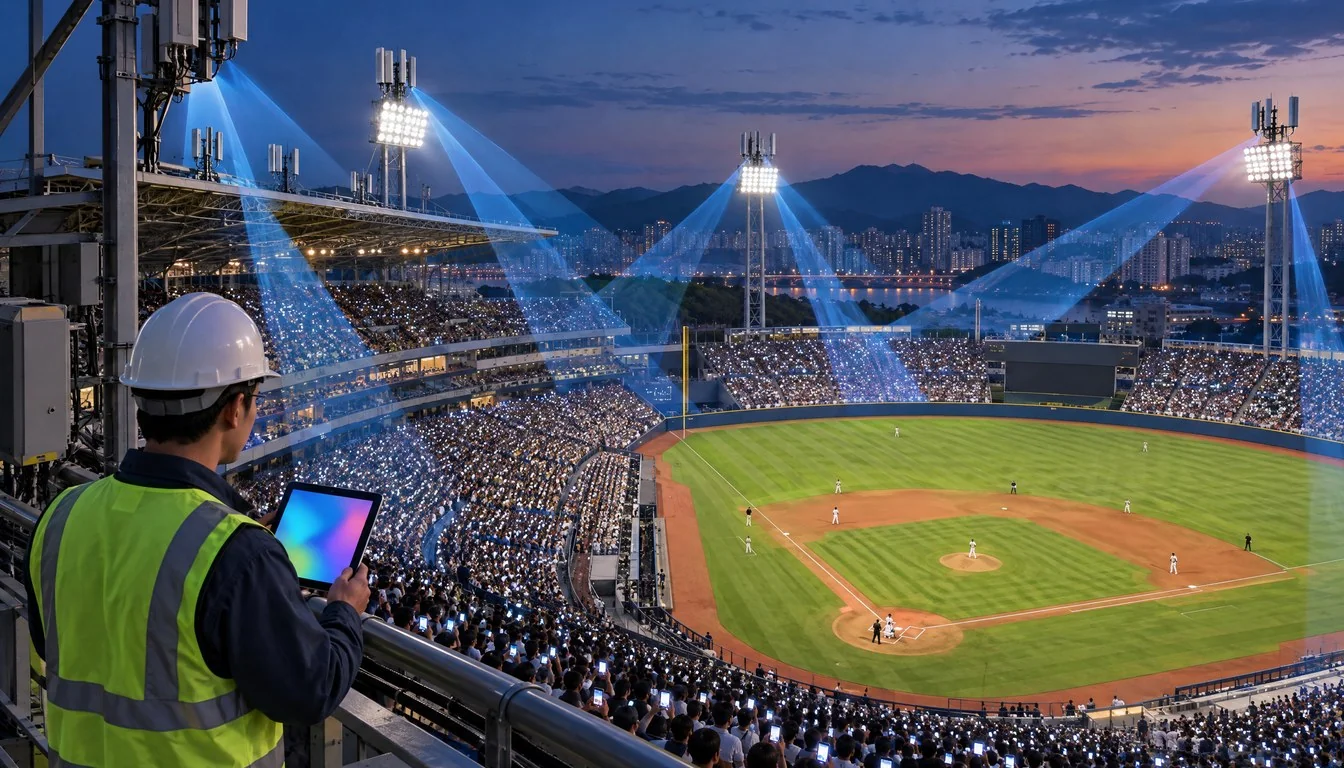
KT and Samsung Electronics have turned a baseball park into a live lab for self-driving mobile networks. According to The Korea Times, KT said on Monday, November 2, 2026, that the two companies verified autonomous wireless network operation technology at KT Wiz Park in Suwon, Gyeonggi Province, using a digital twin platform called AI Cell Twin. The headline results: traffic imbalance between base stations improved by up to 34%, and the load piled onto specific base stations dropped by up to 16%.
The KT Samsung AI Cell Twin trial ran for about three months starting in July, and it covered KT Wiz Park home games. The software generated network-operation options, tested them in a virtual copy of the network, then pushed the chosen plan to the real thing. No human had to guess which setting would hold up when thousands of fans opened video apps at the same moment.
This matters beyond Korea. Every operator on earth fights the same battle inside arenas, stations and festival grounds, where demand arrives in a spike and vanishes just as fast. Samsung is pushing on the handset side too, as our look at Samsung’s Galaxy S27 Pro display plans shows, but this trial targets the network those phones depend on. Below, we break down what was announced, what the numbers mean, what remains unproven, and why gamers should care.
Don't miss new tech stories on Google
Add Shattered once in the Google app and our stories show up in your news suggestions.
What KT and Samsung Announced on Nov. 2 #
The KT Samsung AI Cell Twin announcement came from KT, which The Korea Times describes as Korea’s second-largest mobile carrier. Samsung Electronics acted as the technology partner. Several Korean outlets carried the story the same day, including the Herald Business, Seoul Economic Daily, MoneyToday, The Asia Business Daily, Financial News and Edaily. All of them report the same core figures, which gives the story unusually consistent footing for a company-sourced announcement.
Here is the confirmed picture. The technology is described as autonomous wireless network operation. It relies on AI Cell Twin, a digital-twin platform that recreates the live radio network in a virtual environment. The test location was KT Wiz Park, the baseball stadium in Suwon. The trial lasted roughly three months from July, and the technology was applied during home games. Reports say the AI-generated settings could adjust antenna beam direction and width.
The companies also said they plan to keep testing during the fall baseball season and to consider uses beyond stadiums. That last phrase is the only forward-looking commitment in the reports. It is not a commercial launch notice, and no outlet reports a price, a rollout date or a customer-facing product.
How the AI Cell Twin Works #
A digital twin is a software model of a real system that behaves like the original closely enough to run experiments on. In this case, the real system is a cluster of cell sites around a stadium, and the experiments are changes to how those cells share the crowd. Because the twin is virtual, engineers can try a risky idea without dropping a single fan’s video stream.
Step one: the AI proposes options
According to the reports, the AI analyzes the network and generates candidate operating options. Digital Today and The Korea Times both say the system weighs several inputs together: how users are distributed, how they use data, the state of the network, and the quality users actually perceive. That last input matters. A cell can look healthy on a technical dashboard while its users still stare at a buffering wheel.
Step two: the twin checks the plan
Each candidate gets tested inside AI Cell Twin before anything touches the live network. The Korea Times reports that the companies built the twin and trained the AI on wireless network data collected at KT Wiz Park. It also reports that the twin’s predictions closely matched what the real network later showed. The companies did not publish an accuracy figure, so treat “closely matched” as a qualitative claim until they do.
Step three: the winner goes live
The selected plan is then applied to the real wireless network. The reports describe settings that can shift antenna beam direction and width, which steers coverage toward or away from busy zones. When one base station gets swamped, the plan sends some of that traffic to neighboring stations. The sequence looks like this in simplified form:
1. Collect network data from the stadium cells
2. Rebuild the network inside the digital twin
3. AI generates candidate operating options
4. Twin simulates each option and scores the result
5. Best option is applied to the live network
6. New live data feeds back into step 1
That list is our illustration of the reported flow, not a published architecture diagram. KT and Samsung have not disclosed model types, update intervals or how many cells took part.
Why a Baseball Stadium Is a Hard Test #
Stadiums punish networks in a way that city streets rarely do. Tens of thousands of people squeeze into a small footprint, and they all behave alike at the same moments. They arrive together, they film a home run together, and they leave together. Reports say video viewing and content sharing during games drive the sharpest surges.
The Korea Times notes that traffic swings sharply as spectators enter and exit, watch video and share content. That pattern creates uneven load. A few base stations near popular seating sections run hot while their neighbors idle. Operators call this a traffic imbalance, and fixing it is the whole point of the trial.
Baseball adds a wrinkle. The sport has long s between plays, which gives fans time to pick up their phones. A pitching change or a rain delay can move thousands of people onto their devices at once, and no schedule predicts it. A rule-based system tuned for average conditions struggles here, because the crowd rarely behaves like an average.
The setting also gives the companies repeatability. A team plays a long home schedule, so engineers get many game days to compare. The reports confirm the technology ran across KT Wiz Park home games, though they do not give a game count or the dates of individual matches.
The Numbers: 34% and 16% in Context #
Two figures anchor the story. Digital Today leads with the 34% improvement in traffic balance between base stations. MoneyToday leads with the 16% reduction in load on the most heavily used stations. Both numbers carry the phrase “up to,” which means they describe the best result observed, not an average across all games.
| Metric | Reported result | How outlets frame it |
|---|---|---|
| Traffic imbalance between base stations | Improved by up to 34% | Best-case gain, not an average |
| Load on specific base stations | Reduced by up to 16% | Peak load on the busiest stations |
| Trial length | About three months from July | Covers KT Wiz Park home games |
| Location | KT Wiz Park, Suwon | Single stadium |
| Adjustable settings | Antenna beam direction and width | Reported by outlets, no full parameter list |
| Next phase | Fall baseball season testing | Uses beyond stadiums under consideration |
Read the two metrics together and a pattern emerges. The 34% figure says the load spread more evenly. The 16% figure says the worst-hit stations got relief. A network can balance better without cutting peak load much, and the reverse can happen too, so having both numbers is useful. The gap between them (34 versus 16) is not a contradiction. They measure different things.
The reports do not say what baseline the gains are measured against. Was it the previous manual tuning, a static configuration, or the same stadium without any optimization? That choice changes how impressive the numbers look. Without a published baseline, the figures prove the system works but cannot rank it against other methods.
What the Results Do Not Say #
Company announcements invite careful reading, and this one leaves several gaps. The reports give no user-facing metrics such as download speed, video start time or dropped-session rate. They give no sample size and no confidence interval. They list no network-generation specifications and no counts of cells or antennas involved.
| Claim | Status in the reports |
|---|---|
| Traffic imbalance improved up to 34% | Confirmed by multiple outlets |
| Peak base-station load cut up to 16% | Confirmed by multiple outlets |
| Trial ran about three months from July at KT Wiz Park | Confirmed |
| Fall season testing planned | Confirmed as a plan |
| Commercial launch or permanent deployment | Not reported |
| Prices or customer plans | None reported |
| Exact game dates and cell counts | Not reported |
| Throughput or latency gains for users | Not reported |
That table is the honest summary. The trial worked on the metrics KT chose to publish. Whether fans noticed a difference on their phones is a separate question the announcement does not answer. Operators often pick network-side metrics first, because they are easier to measure and tend to move before user-side metrics do.
What the Executives Said #
Two named executives spoke in the coverage. We paraphrase their remarks here and link each to the outlet that reported it.
Jung Jin-guk, a vice president and head of the Next Generation Communications Research Center at Samsung Research, said the companies built technology that applies optimized solutions to a live network only after checking them in a digital twin, as The Asia Business Daily reported. His framing stresses the verify-first step. The point is that the AI does not experiment on paying customers.
Lee Jong-sik, an executive director and head of the Future Network Lab in KT’s network division, said the trial confirmed that AI Cell Twin-based autonomous operations are feasible for commercial networks, according to Digital Today. He added that KT intends to build an autonomous operations network that reacts ahead of changing conditions. Note the careful wording. Feasibility is a finding, and a launch is a decision. Lee described the first and made no announcement of the second.
Both statements point in one direction. Samsung wants credit for the AI and network tooling, and KT wants the operational proof from a real carrier network. Each company gets something to show customers and investors, which explains why the news landed on the same day in so many outlets.
How This Differs From Rule-Based Automation #
Mobile networks have used automation for years. Most of it follows fixed rules: if a cell passes a load threshold, trigger a preset action. The Korea Times contrasts the new technology with conventional automation that relies on preset rules or single performance indicators. By contrast, the AI Cell Twin approach weighs several factors at once and tests its answer before acting.
| Approach | How it decides | Safety check before going live | Weak spot in a crowd |
|---|---|---|---|
| Manual engineering | Staff tune settings by hand | Experience and past events | Slow, cannot track minute-by-minute swings |
| Rule-based automation | Preset thresholds and single indicators | Rules written in advance | Rules miss unusual crowd patterns |
| AI with digital twin (KT and Samsung trial) | AI weighs user distribution, usage, network state and perceived quality | Options tested in a virtual copy first | Depends on twin accuracy, which is unpublished |
The table reflects how the outlets describe each method, not a head-to-head test. KT and Samsung did not report a side-by-side run against rule-based tools. So the claim that the AI beats older automation is an inference from the design, not a measured result.
Competitive Landscape: Carriers and Vendors #
Network automation is a crowded race. Every large radio vendor and most big carriers pitch some version of AI-driven optimization, and each wants proof from a live network. A stadium trial with published percentages is the kind of proof that sells. It gives sales teams a story that a pilot in a quiet suburb never could.
For Samsung, the win is about vendor standing. The company competes for radio contracts against established names, and our breakdown of Ericsson versus Nokia growth in Q3 2026 shows how tight that market is. A live reference with a domestic carrier strengthens Samsung’s pitch to other operators who want automation without extra risk.
For KT, the angle is service quality and cost. Autonomous tuning could cut the manual work behind operating dense sites, and a better crowd experience helps in a market where subscribers compare carriers closely. KT has not said it will save a specific amount, and the reports give no cost figures at all.
The KT Samsung AI Cell Twin trial also fits a wider industry conversation about moving to the next network generation. Operators are asking suppliers for hard data before they commit, a theme we covered in our report on NGMN’s request for vendor proof on 6G migration. A published trial with real numbers answers that demand better than a slide deck does.
Historical Context: From Manual Tuning to Autonomous Networks #
Early mobile networks relied on engineers who drove around with test gear, adjusted antennas by hand and rewrote parameters after complaints. Over time, vendors added self-organizing features that handled simple jobs such as neighbor lists and basic load balancing. Those tools helped, but they followed rules written by people who could not foresee every situation.
The next step brought machine learning into the loop. Instead of fixed thresholds, models learned patterns from traffic data and suggested changes. The weakness was trust. Carriers hesitated to let a model rewrite live settings, because a bad guess can knock out service for thousands of people. Digital twins attack exactly that problem by letting the model fail safely in simulation first.
The KT and Samsung trial sits at that stage. It does not claim a fully hands-off network. It claims a pipeline in which AI proposes, a twin verifies, and the system applies. Industry people often describe the end goal as an autonomous network, one that adjusts itself with minimal human steering. Lee’s remark about building a network that responds proactively to changing conditions points at that goal, though the trial itself covers one stadium.
Why Gamers and Esports Fans Should Care #
Gamers feel network congestion before anyone else. A crowded cell can add lag, stretch ping and stall a download in the middle of a match. Mobile esports events, live-streamed tournaments and packed venues all stress the same radio resources that baseball crowds do. If AI Cell Twin-style tuning works at a ballpark, the same idea could eventually help any venue where players and fans cluster.
Cloud gaming raises the stakes. Those services stream video from a data center and depend on steady throughput and low delay, so an uneven radio network hurts them quickly. If you play over a mobile connection, our ranking of the best cloud gaming services explains which platforms handle weaker links best. Better network balancing at the carrier level only helps those services further.
Korea also hosts a lively games industry calendar. Events such as GAME DAYS 2026 in Seoul, which opens Nov. 9, will bring large crowds with phones in hand. The KT trial did not target gaming, and the reports mention nothing about game traffic. Still, venue connectivity is a shared problem across sports and gaming, and the solutions overlap. For more coverage of the platforms and services behind play, browse our gaming section.
Market Impact for Carriers and Samsung #
No outlet reports a financial impact, so any market read is analysis. The most direct effect is reputational. KT gets a case study that shows AI operating on a live network, and Samsung gets a reference for its network business at a time when vendors fight for each deal. Neither company disclosed contract values, rollout budgets or revenue targets tied to the trial.
The deeper business logic is about cost per gigabyte. Dense sites cost money to build and to run. If software can squeeze more usable capacity from existing cells by balancing load, operators may delay adding hardware in some spots. The reported 16% drop in peak station load hints at that headroom, though the companies never framed it as a capital saving.
Investors will want proof at scale. A single stadium is a favorable environment because it has predictable events, known layouts and high stakes. Dense city centers, subways and rural areas pose different problems. The market will watch for evidence that the same approach holds when crowds are less regular and data is messier.
Risks and Open Questions #
Several questions will decide how far this technology travels. First, how accurate is the twin over time? A virtual model must stay in sync with a real network that changes whenever crews add equipment or tweak settings. The Korea Times says predictions closely matched real data, but a three-month window is short.
Second, what happens at the edges? A system that handles ordinary game nights may struggle in an emergency, a power cut or a sudden surge from breaking news. Operators need guardrails and human override paths. The reports say nothing about fail-safes, so we do not know how the system behaves when the AI is wrong.
Third, who owns the data and the model? Training an AI on live network data raises privacy and governance questions. The reports describe data collected at the stadium but give no detail on how it is anonymized or retained. Regulators in many countries care about this, and carriers will need clear answers before wide rollout.
Fourth, vendor lock-in. A twin built around one supplier’s equipment may not port easily to another. Operators that run mixed networks will ask whether AI Cell Twin works across brands. Neither company has addressed that.
Five Predictions for the Fall Season and Beyond #
These are our analysis, not reported facts. Treat them as informed bets that could change as KT and Samsung release more data.
- Fall results will come with a bigger crowd test. The companies said they will keep testing during the fall baseball season. Postseason-style attendance would stress the system harder than the summer games did, so expect any new figures to show how well the gains hold up.
- Expect a baseline disclosure. Once other carriers and analysts ask what the 34% and 16% are measured against, KT and Samsung will likely publish a clearer comparison to keep credibility.
- Non-stadium pilots come next. The companies said they are considering uses beyond stadiums. Arenas, concert halls, transit hubs and festival grounds are the natural next candidates because they share the crowd pattern.
- User-experience metrics will join the story. Network-side numbers sell to engineers. Marketing teams will want proof that fans saw faster video or fewer drops, so look for speed or quality-of-experience data in future updates.
- Rivals will answer with their own twins. Competing vendors and carriers already tout AI optimization. A public stadium trial raises the bar, and similar field results from other camps would not be a surprise.
What to Watch Next #
The next signal for the KT Samsung AI Cell Twin work arrives with the fall season data. Seoul Economic Daily and other outlets report that the companies plan to continue testing in the autumn. Any follow-up release should tell us whether the up-to-34% gain repeats, shrinks or grows under heavier crowds.
Watch for four specific items: a named baseline, a count of cells involved, user-side quality measures, and the first non-stadium location. If those four appear, the story shifts from an interesting trial to a credible product path. If they do not, the technology stays a promising lab result.
The takeaway: KT and Samsung showed that an AI can propose network changes, test them in a twin and apply them on a live network during real games, with reported gains of up to 34% in traffic balance and up to 16% in peak station load. They did not show a commercial launch, a price or a user-speed gain. The fall season will tell us how much of this holds up.
FAQ #
What is AI Cell Twin?
AI Cell Twin is a digital-twin platform that recreates a real wireless network in a virtual environment. KT and Samsung used it to test network-operation options before applying the chosen one to the live network.
Where did the KT and Samsung test take place?
The trial ran at KT Wiz Park in Suwon, Gyeonggi Province. It lasted about three months starting in July and covered KT Wiz Park home games.
What results did the companies report?
Traffic imbalance between base stations improved by up to 34%, and the load concentrated on specific base stations fell by up to 16%. Both figures are best-case results, according to the reports.
What network settings did the AI adjust?
Reports say the AI-generated settings could adjust antenna beam direction and width. The coverage does not list other parameters.
Is this technology available to KT customers now?
No report says so. The companies described a trial and a feasibility result. They have not announced a commercial launch, permanent deployment, price or customer plan.
Will the test continue?
Yes. KT and Samsung said they plan to keep testing during the fall baseball season and to consider applications beyond stadiums.
Does this affect mobile gamers?
Not directly yet. The trial focused on baseball crowds, and the reports do not mention game traffic. Better load balancing in crowded places could help any latency-sensitive app over time, but that remains our analysis.