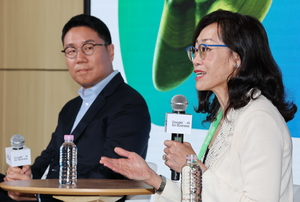
Korean companies are moving beyond artificial intelligence pilot projects and embedding the technology into their core operations, the heads of Google Korea and Google Cloud Korea said Tuesday.
"Korea was often described as a global test bed during the shift from desktop to mobile," Brandon Yoon, country managing director of Google Korea, said at the event Google AI for Business 2026 in Seoul.
"In the AI era, it has become a battleground where the world's leading players compete head-on. What happens here can become a reference point for other markets."
Yoon said Korea has evolved from an early adopter into a market where global AI companies compete to prove real-world business value.
The event combined Google's annual Google Marketing Live conference with Google Cloud's AI Live and Labs, reflecting the growing convergence of marketing, enterprise technology and AI.
Ruth Sun, managing director of Google Cloud Korea, said Korean companies are shifting from AI experimentation to enterprise-wide deployment while demanding measurable returns on investment.
Sun highlighted Samsung Electronics as a leading example. Employees are using Gemini Enterprise, Google's workplace AI platform, to boost productivity, with the companies now developing customized AI agents for more complex tasks.
"We're seeing employees move beyond searching for information to proactively solving problems," Sun said.
CJ Olive Young is also deploying Gemini Enterprise across merchandising, marketing and store operations. Employees without coding expertise are building AI tools to analyze market data, while store staff use text, image and voice inputs to manage inventory.
Yoon said Korean companies are not satisfied with off-the-shelf AI models.
"They want to combine them with their own data, expertise and workflows to create capabilities competitors cannot easily replicate," he said.
He added that Korean workers generally view AI as a productivity tool rather than a threat to jobs.
Yoon said AI is reshaping consumer behavior. According to data presented at the event, 76 percent of Korean consumers use AI-powered or multimodal search to discover products, but 75 percent later return to conventional search before making a purchase.
"AI can accelerate the early stages of research, but getting an answer is not the same as being ready to buy," Yoon said.
yeeun@heraldcorp.com