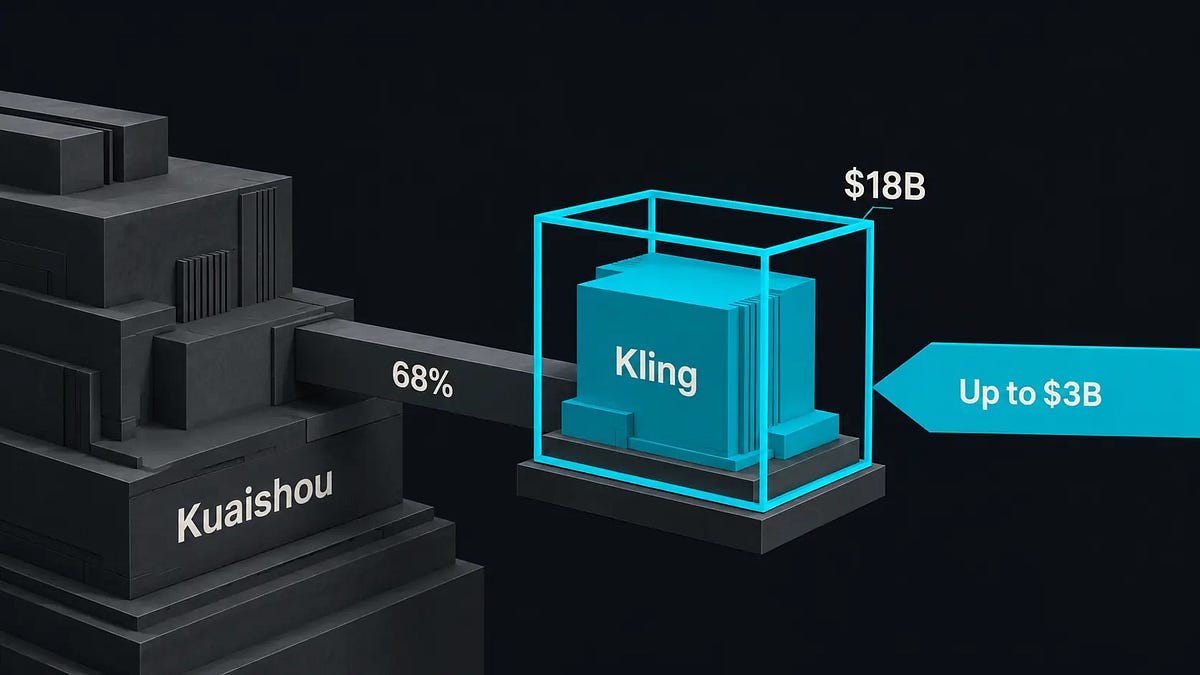
Kuaishou retained 68% control, shifted part of Kling’s funding burden to outside investors, and put a potential $18bn price on an AI unit that generated less than 1% of the parent’s revenue.
On July 2, Kuaishou Technology, the short-video platform that competes with ByteDance’s Douyin in China, filed a notice on the Hong Kong Stock Exchange. Its AI video generation unit, Kling, had secured approximately $2.8bn in investor commitments, with the round able to expand to a ceiling of roughly $3bn within a 60-day window. If fully subscribed, the post-money valuation would reach approximately $18bn. The round drew 34 investors, including Tencent, Alibaba Cloud, and Baidu.
English-language coverage settled quickly on a familiar frame: record AI funding, China’s answer to Sora, Baidu, Alibaba and Tencent united against ByteDance. Reuters led with the investor list. Bloomberg emphasized the valuation. The Wall Street Journal noted the planned Hong Kong IPO.
These frames capture fragments of the transaction but miss its structural logic. Kuaishou did not sell a stake in a hot startup. It carved out an internal business unit, gave it a separate valuation, brought in outside capital to share the funding burden, and retained control of the asset while continuing to consolidate its financial results. The transaction is closer to a structured corporate finance operation than a venture round.
The distinction matters. Kling generated approximately Rmb 1.1bn ($162m) in revenue in 2025 while posting a net loss of roughly Rmb 1.9bn ($279m). It ended the year with negative net assets of Rmb 9m. Kling generated more than Rmb 650m in revenue in Q1 2026, up over 300% year on year. Revenue in March alone implied an annualized run rate of approximately $500m. At a post-money valuation of $18bn, investors priced Kling at roughly 36 times its March exit run rate. Unit economics remain unproven. Roughly 70% of Kling’s revenue comes from consumer subscriptions, a segment exposed to pricing competition from ByteDance’s Seedance and Alibaba’s HappyHorse.
The 36x multiple reflects a bet on trajectory, not profitability. Investors are pricing rapid reported revenue growth and betting that viable unit economics will follow. The risk is straightforward: a subscription-heavy revenue base could prove vulnerable if competing products offer comparable output at materially lower prices. That vulnerability is compounded by geography. Over 70% of Kling’s revenue comes from overseas markets, according to Chinese industry reports, precisely the territory where ByteDance is deploying Seedance through its global distribution infrastructure.
This raises an obvious question. Kuaishou held Rmb 117.7bn in available funds at the end of Q1 2026, according to its quarterly filing. Immediate liquidity alone therefore does not explain why the company sought outside capital for Kling. The financing served a broader purpose.
The answer points toward a structural problem at the parent-company level and a change in Tencent’s exposure to Kuaishou that has received limited attention in English-language coverage. Both help explain why this financing was structured as a controlled carve-out.
If the mechanics of how Chinese tech companies separate AI businesses for independent valuation are new to you, this is a preview of what Hello China Tech does three times a week: reading China’s AI, chip, robotics, and EV sectors from primary sources most English coverage never touches. Subscribe free to get every new analysis as it publishes.