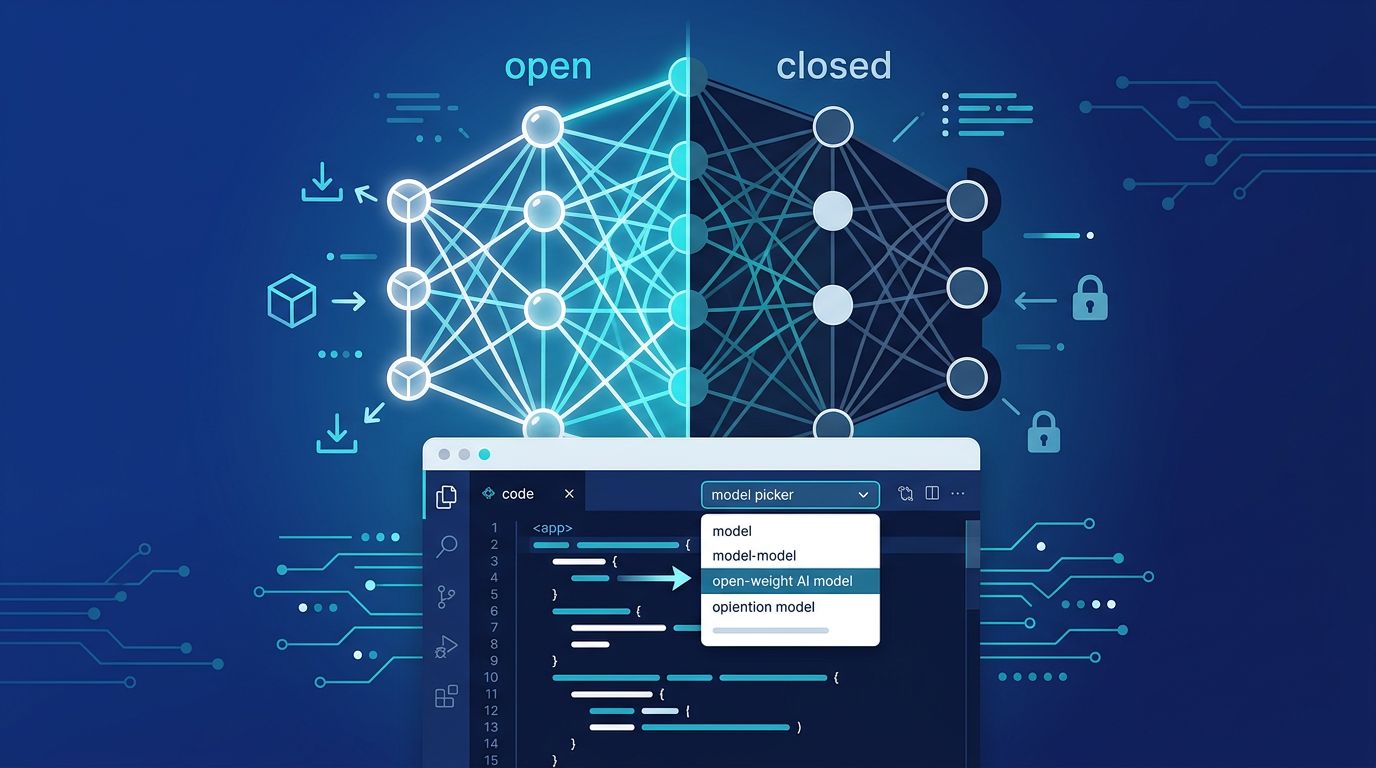
GitHub Copilot’s model picker added something new on July 1: Kimi K2.7 Code, Moonshot AI’s open-weight coding model, is now generally available for Pro, Pro+, and Max subscribers, and expanded to Business and Enterprise plans on July 7. It is the first open-weight model in the picker — meaning it is the first model in Copilot whose full weights are publicly downloadable, inspectable, and auditable. That distinction matters more than the benchmark numbers.
What Changed and How to Get It #
If you’re on a Copilot Pro, Pro+, or Max plan, Kimi K2.7 Code is available now. Open the model picker in VS Code 1.127.0 or newer — or in Visual Studio 17.14.6, JetBrains IDEs, Xcode, Eclipse, or GitHub Mobile — and select it. No additional configuration required. Business and Enterprise subscribers face an extra step: the model is off by default for those tiers. An admin must navigate to GitHub Admin Panel → Settings → Copilot → Policies and enable Kimi K2.7 Code before anyone in the organization can select it. GitHub explicitly recommends that administrators review open-weight models against their security, compliance, and data-governance requirements before enabling access. That advisory is unusual — no other model in the picker carries it.
Why Open-Weight Changes the Conversation #
Every other model in Copilot’s picker — GPT-5.5, GPT-5.6 Sol/Terra/Luna, Claude Fable 5, Gemini Omni, MAI-Code-1-Flash — is a black box. You know roughly how those models behave, but you cannot inspect the weights, you cannot run them locally, and you cannot audit what the model “knows.” Kimi K2.7 Code is different: the full ~595 GB of weights live on Hugging Face under a Modified MIT license and can be downloaded today.
Even though GitHub hosts the model on Microsoft Azure — meaning your prompts still route through Copilot’s infrastructure — the underlying model is auditable. An enterprise team can spin up the same weights in a controlled environment, test behavior against their specific codebase, and build that evidence into their AI governance documentation. That is a meaningfully different trust posture than “we reviewed the vendor’s compliance certificates.”
GitHub’s own rollout reflects this distinction. The Business and Enterprise admin gate, combined with the explicit recommendation to review governance implications, signals that GitHub sees open-weight models as a different category — not just another option in a dropdown.
The Cost Math (With One Important Caveat) #
K2.7 Code is billed at provider list pricing under Copilot’s usage-based system. At $0.95 per million input tokens and $4.00 per million output tokens — with cached input dropping to $0.19 per million — it sits well below the premium tier models:
| Model | Output ($/1M tokens) | vs. Kimi K2.7 |
|---|---|---|
| Kimi K2.7 Code | $4.00 | baseline |
| Claude Sonnet 4.6 | ~$15.00 | ~3.75× |
| Claude Opus 4.8 | $25.00 | 6.25× |
| GPT-5.5 | $30.00 | 7.5× |
| Claude Fable 5 | $50.00 | 12.5× |
The 12× figure versus Fable 5 on output tokens is real. But there is a caveat worth running before you redesign your cost model around it: K2.7 Code has always-on thinking mode that cannot be disabled. Every request is a reasoning request. That increases output token usage compared to a non-thinking equivalent. Run your cost calculation against thinking-enabled workloads, not raw pricing tables, before assuming a 12× saving translates directly.
For high-volume agentic pipelines where tasks are repetitive and context is reused (hitting the prefix cache at $0.19/M), the economics are compelling. For infrequent, one-off tasks, the cost difference between Copilot models rarely matters enough to optimize around.
What Kimi K2.7 Code Actually Is #
Kimi K2.7 Code uses a Mixture-of-Experts architecture with approximately 1 trillion total parameters, but only 32 billion activate per token. The model has 384 expert subnetworks; a learned router selects 8 per token plus 1 shared expert. Multi-Head Latent Attention (MLA) compresses the key-value cache, which is how the model reaches a 256K token context window without the memory overhead that would typically accompany it. Weights are stored in INT4 via quantization-aware training, with attention remaining in BF16.
In practical terms: you get the representational breadth of a trillion-parameter model at roughly the serving cost of a 32B dense model. That is the MoE value proposition, and it explains the pricing.
On benchmarks: the honest position is that independent numbers do not exist yet. No third-party results from SWE-bench, Terminal-Bench, or LiveCodeBench have been published. All available data comes from Moonshot’s proprietary test suites. K2.7 Code scores 81.1% on MCPMark (tool-call performance) and shows a ~30% reduction in reasoning-token overhead versus K2.6. It trails GPT-5.5 and Claude Opus 4.8 on raw quality by most credible estimates. If maximum reasoning depth is the primary requirement, the premium tier models still hold the edge.
When to Use It — and When Not To #
K2.7 Code is a strong choice for agentic multi-step coding tasks where tool-call reliability matters, high-volume repetitive pipeline work where cost compounds quickly, environments where weight auditability is a documented governance requirement, and long-context tasks where a large repository in a single prompt is necessary.
Stick with other models when you need maximum reasoning depth on a novel architectural problem, when your organization has not yet reviewed open-weight governance requirements, or when you need the lowest possible latency on simple completions — MAI-Code-1-Flash handles that better.
The Broader Signal #
Copilot’s model picker now spans five labs: OpenAI, Anthropic, Google, Microsoft, and Moonshot AI. That is the broadest competitive set any major managed coding tool has offered under a single subscription. Open-weight models were available before this moment — you could run Kimi K2.7 via Ollama, OpenRouter, or a self-hosted vLLM setup — but they required infrastructure work. They were not one click away inside VS Code.
That gap closing is what makes this worth paying attention to. When open-weight models reach the model picker in tools that 30+ million developers already use, they stop being an infrastructure project and become a realistic default consideration. The question is no longer whether open-weight models can compete. It is whether your team has a policy for when to use them. Business and Enterprise organizations now need one.