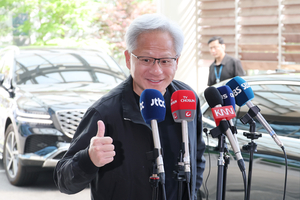
Seoul National University in talks with Nvidia to establish joint-research lab
The Korea Advanced Institute of Science and Technology said Friday it is expanding its research partnership with US chip giant Nvidia through two major initiatives spanning physical artificial intelligence and agentic AI.
The cooperation includes a $300 million joint research program, aimed at developing next-generation AI technology tailored to the Korean language and domestic industries, according to one of the top tertiary education institutes here.
“This collaboration marks the beginning of a strategic partnership combining world-class AI research capabilities with advanced AI infrastructure,” KAIST President Bae Choong-sik said.
The announcements come amid President Lee Jae Myung's visit to San Francisco to attend the AI Summit where he met with Nvidia CEO Jensen Huang on Saturday. It also follows Huang's June visit to Seoul, where he had said he "brought four gifts for South Korea," including AI research facilities.
$300 million push for agentic AI
KAIST said it will establish the Nvidia-KAIST Joint AI Research Lab at its Kim Jaechul Graduate School of AI to conduct research on next-generation agentic AI technologies specialized for the Korean language and Korea’s industrial ecosystem.
Agentic AI is a semi- to fully autonomous artificial intelligence system that can accomplish a specific goal with little to no human interference.
KAIST said the partnership is part of its long-term effort to secure core AI technologies for Korea and strengthen the country’s industrial competitiveness.
Under the initiative, Nvidia’s full-stack AI technologies and its Nemotron family of open models will be combined with KAIST’s research expertise.
The collaboration is set to involve a total of $300 million over a five-year period, with AI computing resources worth $50 million to be provided annually. Researchers participating in the joint lab will have access to Nvidia’s latest AI computing infrastructure through its domestic cloud partners.
The lab will support at least 10 KAIST researchers each year, with each researcher offered an internship opportunity at Nvidia. The company also plans to recruit outstanding KAIST researchers for full-time positions.
Physical AI research center
In a separate announcement Sunday, KAIST said its department of mechanical engineering will work with Nvidia to establish an Nvidia AI Technology Center on campus specializing in physical AI.
NVAITC is Nvidia’s global research program through which the company works with universities, governments and industry partners on AI research, education and deployment.
The new center, called the Human Physical AI NVAITC, will be centered around KAIST’s Human Physical AI Research Center and conduct joint research in areas including wearable robots, humanoids and digital twin technologies.
The KAIST research center studies how humans move in physical environments and maintain balance, with the aim of applying those mechanisms to AI and robotics.
A key objective of the partnership is to develop what KAIST calls a Human Motion Foundation Model, a generative AI model designed to learn, predict and reproduce human movement.
KAIST said it has formed a steering committee with Nvidia to oversee the program, with research results to be evaluated every six months.
The partners also plan to hold an annual symposium bringing together experts in the field and operate a student ambassador program offering KAIST students lectures and mentoring from Nvidia specialists.
Meanwhile, Seoul National University also said Saturday it was in talks with Nvidia to host an NVAITC facility on its campus.
seungku99@heraldcorp.com