Data is suggesting that the Jevon’s Paradox might be holding true with AI.
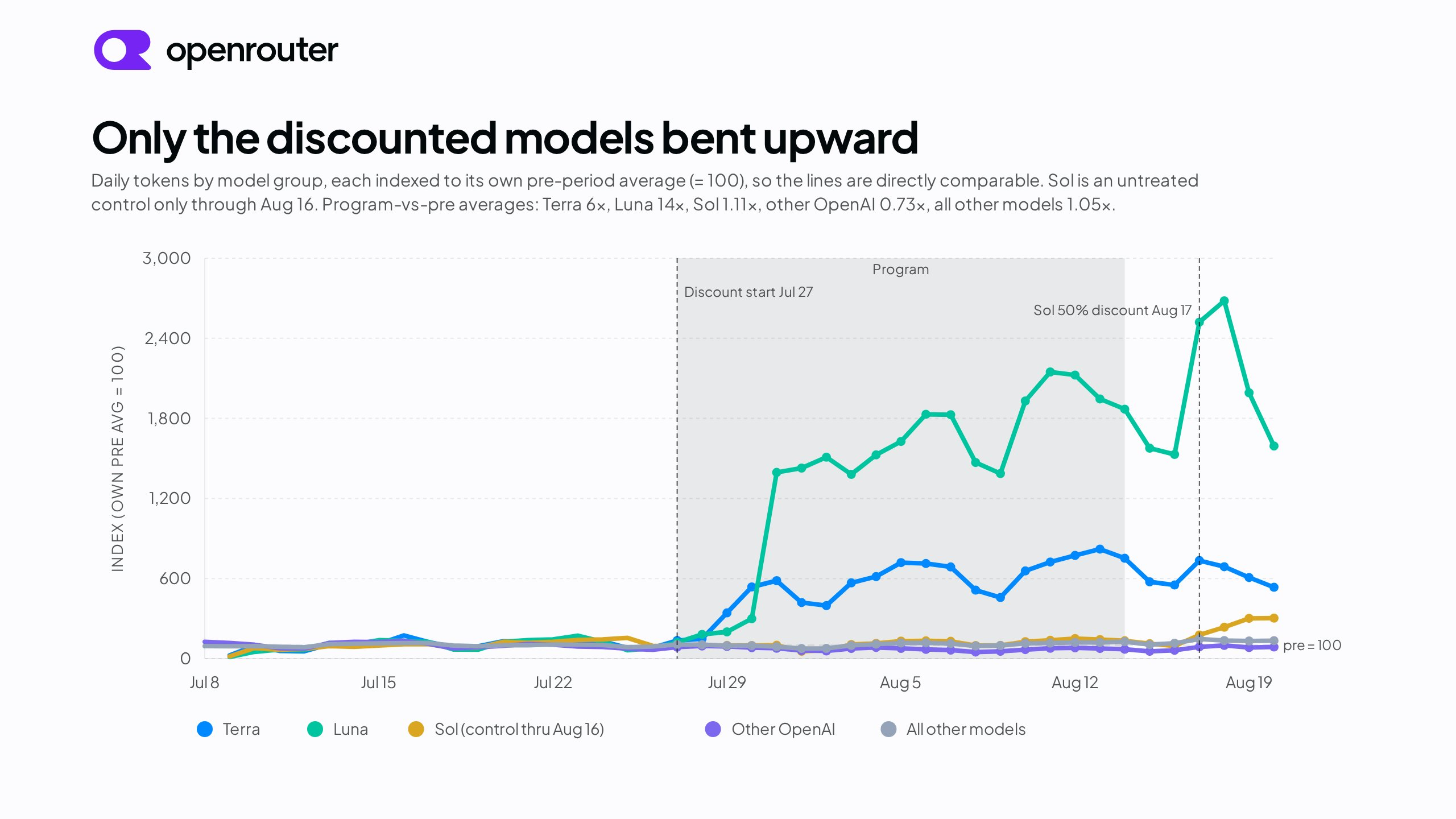
OpenRouter, the platform that routes AI traffic across hundreds of models for developers and businesses, has published usage data from the window around OpenAI’s price cuts to GPT-5.6 Terra and Luna in late July. The numbers are not subtle. Luna’s daily token volume grew 13.8x over its pre-discount average once the new pricing kicked in. Terra grew 5.6x. A third model, Sol, which OpenAI did not touch until three weeks later, moved only 1.1x over the same period and served as an unplanned control group for the comparison.
OpenRouter frames this as evidence for Jevons Paradox, a 19th century economic observation that has aged strangely well for a term coined to describe coal consumption in Victorian England. William Stanley Jevons noticed that as steam engines became more efficient at burning coal, total coal consumption in Britain went up rather than down. The intuition that efficiency should reduce resource use turned out to be backwards in practice, because cheaper access to a resource pulls in uses that were not economical before, and those new uses outweigh whatever savings show up per unit. The paradox has since been applied to everything from home energy efficiency to highway lanes, and it now has an AI chapter.
The mechanism in this case is straightforward. When OpenAI cut Luna’s price by 80% and Terra’s by 20%, the cost of running a given workload through either model dropped sharply. That should, in a naive accounting, mean the same amount of work costs less money and total spend should fall or stay flat. What appears to have happened instead is that developers who had been holding back on volume, routing selectively to cheaper alternatives, or avoiding certain workloads altogether because of cost, started running much more through Terra and Luna once the price dropped. The chart accompanying OpenRouter’s post shows the two models bending sharply upward right around the discount date, while Sol and a basket of other models barely move off their pre-period baseline.
What makes the OpenRouter data more useful than a typical price-cut anecdote is the control group built into the timeline. Sol stayed at full price through August 16, which means its usage curve over that stretch reflects whatever organic growth and market movement was happening anyway, independent of any discount. Sol’s index sat close to 100 the entire time Terra and Luna were climbing into the thousands, which is about as clean a natural experiment as you get from a commercial platform that was not designed to produce one. When OpenAI did eventually cut Sol’s price by 50% on August 17, its line moved too, spiking well above its own baseline within days.
OpenRouter’s breakdown of where the extra volume came from is arguably the more interesting part of the release. Some of the growth was substitution, tokens that would have gone to older OpenAI models like GPT-5.5 shifting over to the now-cheaper Terra and Luna. That is the effect most people expect from a price cut, existing demand relocating to the cheaper option. But OpenRouter says that was not the majority of the increase. Most of the added volume was described as net new usage plus share taken from competing model providers entirely, meaning developers who were not previously heavy OpenAI users on the platform started routing meaningful traffic to Terra and Luna specifically because the economics changed. That is the Jevons signature: the discount did not just reallocate existing consumption, it expanded the total pool of consumption.
The retention data adds a second layer worth sitting with. Users who adopted Terra or Luna during the discount window largely kept using them after the promotional pricing period ended, according to OpenRouter, and daily average token volume in the post-discount period actually came in higher than during the discount window itself. OpenRouter attributes a chunk of that to a small number of very large accounts scaling their usage further rather than a broad base of users all increasing modestly. Whales, in other words, did a lot of the post-discount heavy lifting. That detail matters for anyone trying to model how durable this kind of demand response actually is, since a curve driven by a handful of large accounts behaves differently than one driven by thousands of small ones.
It is worth stepping back on why Jevons Paradox keeps resurfacing as a lens for AI economics specifically. Every generation of model releases has arrived with some claim about doing more with less, whether that is inference cost per token, compute efficiency, or intelligence per dollar. OpenRouter has tracked this kind of efficiency-per-dollar positioning before, and the pattern across the industry has been that falling unit costs have consistently preceded higher aggregate spend rather than lower total spend, because cheaper tokens unlock use cases, like running an agent through dozens of retry loops or processing entire codebases instead of single files, that were previously too expensive to justify. GPT-5.6 itself was pitched at launch around exactly this kind of tiering logic, with Sol, Terra and Luna built to let developers route work by depth and cost rather than treating one model as the only option.
There is a broader competitive backdrop here too. OpenRouter’s own data has shown US model providers losing share on the platform over the past year as cheaper alternatives from Chinese labs gained ground, and price has been one of the clearest levers any provider has to win back developer attention within that shifting mix. A demand curve this elastic gives OpenAI a reason to keep cutting rather than holding the line on margin, at least for the tiers where volume responds this aggressively.
None of this means unit economics stopped mattering. It means the relationship between price and total spend is not the one that intuition suggests, and OpenRouter now has a fairly clean dataset showing it in real time rather than as a theoretical aside. Whether that pattern holds as more providers respond with their own cuts, and whether the whale-driven retention proves durable over a longer stretch than three weeks, is the next thing worth watching.