Jeff Dean (@JeffDean), Sanjay Ghemawat, Oriol Vinyals, and Quoc Le have left Google to launch Discovery Loop, an AI research operation built to automate the repetitive cycle of proposing, running, and evaluating experiments, Wired reported on August 5.
The departures pull four researchers with unusually deep ties to Google's technical foundations into a new public-benefit corporation. Dean and Ghemawat each spent nearly 27 years at Google, where their collaborations included MapReduce, Bigtable, and core search infrastructure. Dean also cofounded Google Brain, helped design TensorFlow and Pathways, and served as Google's chief scientist with a leadership role on Gemini. Vinyals led deep-learning research at Google DeepMind and worked on Gemini and AlphaStar. Le, a founding member of Google Brain, worked on neural architecture search and AutoML-Zero, an effort to evolve machine-learning algorithms from basic mathematical operations.
Discovery Loop came together within weeks, according to the founders' account to Wired. The four are longtime colleagues and friends who vacation together, and the initial division of responsibility appears informal. Asked who would run Discovery Loop, Dean told Wired, "I think I'm the CEO."
That looseness reflects how early Discovery Loop is. At the time of Wired's prelaunch interview, the founders had not hired employees or leased an office. Discovery Loop's website now says it intends to build a lean, in-person team.
Discovery Loop will experiment on itself first
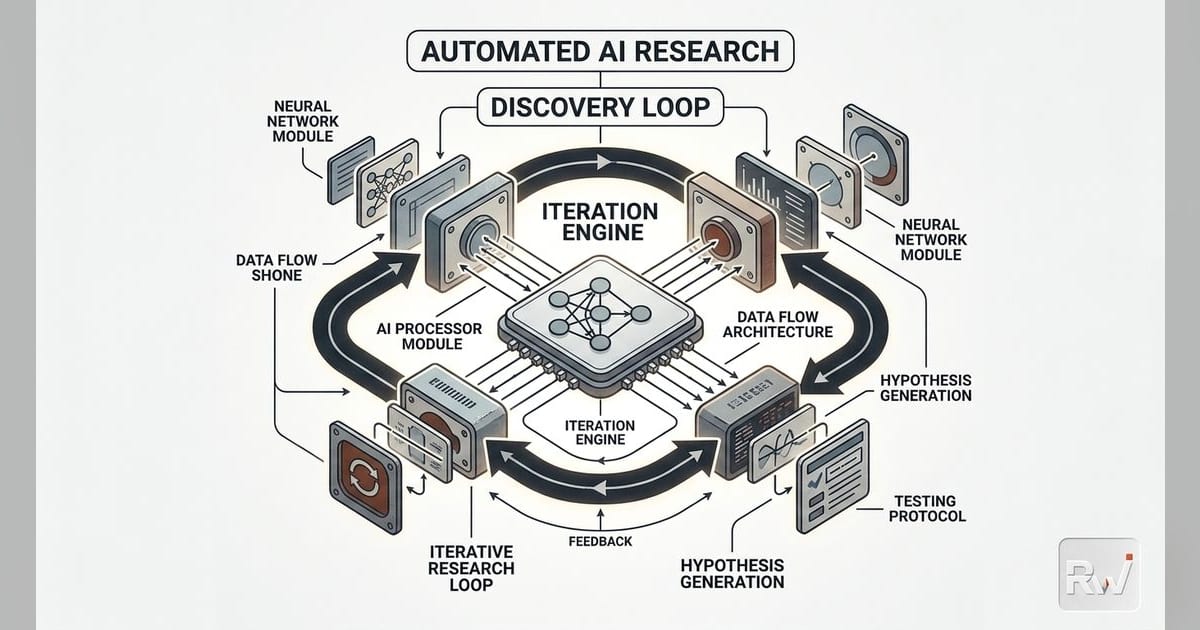
Discovery Loop's starting point is machine-learning research rather than a physical laboratory. The founders plan to build systems that generate possible experiments, implement the code needed to test them, evaluate the results, and use those results to select the next experiment. Discovery Loop says the infrastructure could eventually run thousands of these loops in parallel.
The first customer will be Discovery Loop itself. The founders intend to direct the automated loops toward improving their own models and research tools, then carry the resulting software into fields such as chip design, biology, drug discovery, and materials science.
That sequence gives the founders a controlled place to test the premise. Machine-learning experiments produce measurable outcomes and can often run entirely in software, avoiding the equipment, materials, safety controls, and long timelines involved in wet-lab science. Successful internal work could also improve the system that conducts the next round of research, creating the compounding effect behind Discovery Loop's name.
Le has raised the possibility that the process could uncover alternatives to the transformer architecture. Vinyals identified idea generation as a central technical problem, telling Wired that current models remain weak at proposing useful new directions. Discovery Loop initially expects humans and AI systems to develop ideas together, with deeper automation as the longer-term goal.
The founders' work at Google does not establish that automated experimentation can reliably produce original scientific findings.
Google keeps an economic and computing tie
Google will take an equity stake in Discovery Loop, provide computing resources for its first year, and remain a cloud partner.
The arrangement preserves a route back to the work. Google loses four senior builders during an expensive competition for AI researchers, while retaining equity exposure, cloud revenue potential, and a technical relationship with Discovery Loop. The founders gain access to the computing capacity required to run large numbers of experiments before they have built independent infrastructure.
Khosla Ventures and Radical Ventures also invested, alongside other firms. Radical Ventures managing partner Jordan Jacobs is expected to join Discovery Loop's board.
The investments back a team whose members worked on several of Google's core systems and AI projects. Dean and Ghemawat helped create systems that allowed Google to process and store information at global scale. Vinyals and Le spent their careers advancing models that learn sequences, play complex games, and search for better machine-learning methods. Discovery Loop combines those specialties around a single proposition: scientific work can be represented as a repeatable computing system and accelerated accordingly.
Automated research already has competitors
Discovery Loop enters a field with working prototypes and heavily financed teams. Sakana AI's AI Scientist generates research ideas, writes code, runs experiments, analyzes results, and drafts papers.
Autoscience is similarly building automated machine-learning research tools. Other groups, including FutureHouse, Lila Sciences, and Periodic Labs, are pursuing AI-assisted scientific discovery or autonomous experimentation, with some placing greater emphasis on biology and physical laboratories.
Discovery Loop's initial focus on improving machine-learning systems separates its first step from companies assembling robotic laboratories. The founders are betting that research automation should begin where experiments are cheap to repeat, outcomes can be scored, and the underlying tools can help improve themselves.
The hardest technical test will be deciding which experiments deserve to run. Generating code and dispatching compute can increase the volume of trials. Scientific progress still depends on useful hypotheses, valid evaluation methods, and resistance to plausible but incorrect conclusions. Vinyals' emphasis on idea generation puts that problem inside Discovery Loop's stated research agenda rather than treating it as solved.
Dean previewed the thesis publicly on July 25 at Y Combinator's Startup School, describing an automated scientific method to an audience of roughly 6,000 people. Discovery Loop had already been organized, though he did not identify it from the stage.
The move follows a broader migration of senior AI researchers toward smaller institutions where they can control research agendas and capital allocation. On August 5, RuntimeWire also reported that Yann LeCun joined the newly launched 224 Ventures, another example of an established researcher moving outside the structure of a dominant technology company.
Dean's bet carries a fitting continuity. He spent decades turning difficult computing tasks into reusable infrastructure that thousands of engineers could operate at scale. Discovery Loop applies the same systems instinct to the practice of research itself. The founders now have to show that scientific judgment can scale with the machinery around it.