The market is telling us that we should be 3x more productive with AI.
What if that productivity gain is just an AI working 24 hours a day while a human works eight?
OpenAI published the math behind its 3x claim. In mid-August, its research staff logged 3.14 agent-workdays<sup>1</sup> for every 8-hour human shift.<sup>2</sup> The typical researcher ran four agents in parallel.
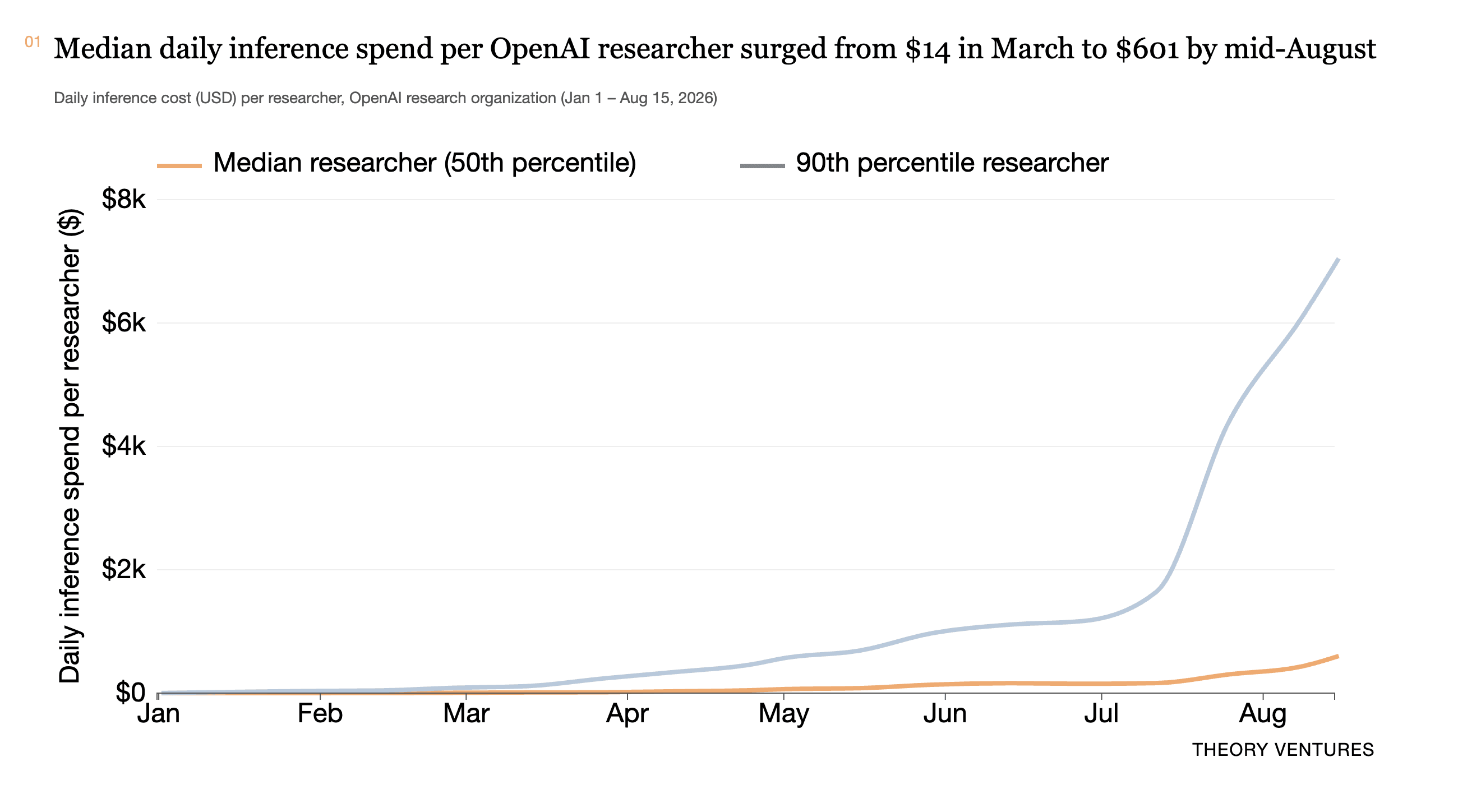
That machine shift comes with an industrial price tag. In late March, the median OpenAI researcher spent $14 a day on inference. By mid-August, that bill climbed past $600 a day : a 40-fold surge in under five months.<sup>2</sup> At the top end, the 90th percentile researcher burns through more than $7,000 a day, an annualized run-rate of $2.5m.
At $2.5m a year per seat, inference behaves like heavy factory tooling. But it comes with a financial twist : it is pure OPEX.
Auto plants buy welding robots with capex. They run night shifts to amortize machinery that depreciates whether used or idle. AI systems invert that math. Inference is metered operating expense. With no physical tooling & no graveyard-shift wages, a company can run machines overnight on pure variable cost.
The 3.14 workday ratio is not three times smarter thinking. It is one engineer supervising three shifts of machine runtime while only being awake for one.
Yet unlike an auto welding robot, this digital assembly line has a massive defect rate. Over half of the successful four-to-eight-hour tasks in the last six months still needed human intervention ; the lab is candid that “the overall pace of progress likely won’t keep pace with these specific metrics.”2
A 40-fold surge in compute spend bought three times the work-hours. But with a supervisor still untangling more than half the runs, the engineer’s day shifts from creative architecture to walking the plant floor & clearing machine jams.
Why run the machines through the night if the defect rate is so high? Fear & ambition.
If your peers field four agents around the clock, logging off is falling behind. The rush of a superpower paid for by your employer is intoxicating. When you get a tireless digital workforce on someone else’s balance sheet, you never turn the factory off.

For forty years, a programmer needed only a MacBook & an eight-hour shift. Today, a top OpenAI researcher commands four parallel agents, burns through $2.5m a year in compute, & spends the morning fixing machine errors from the night before. This explains the quiet frustration spreading across software engineering today.[3](#fn:3)
The market hears 3x productivity & expects creative miracles. The engineer gets stuck untangling a 50% scrap rate from robots that ran all night.<sup>4</sup> The market calls it a 3x leap in productivity. A CFO would just call it paying for a second & third shift. For now, that is the honest price of a machine that never sleeps. The real question is when the second & third shifts start to out-yield the first.
OpenAI reports 3.1 agent-workdays; we round to 3.14 for the irony, since a ratio of 3.14 agent-workdays to one human workday is, fittingly, a pie, not a numerator. ↩︎ 2. OpenAI: Research acceleration : The view inside OpenAI↩︎↩︎↩︎ 3. Stack Overflow Developer Survey : Closing the AI Trust Gap : 84% of developers use AI tools, but trust has fallen to 29%, with 66% citing code that is “almost right, but not quite” & 45% reporting that debugging AI-generated code takes more time than writing it manually.↩︎ 4. The yield math : an 8-hour human shift leaves 16 overnight hours (two extra shifts of machine runtime). With OpenAI disclosing that more than half of 4-to-8-hour tasks require human intervention, the autonomous yield is ~50%. Two machine shifts at 50% yield equal one effective shift of finished output. That yields ~2x delivered work while logging 3x the raw shift runtime. ↩︎