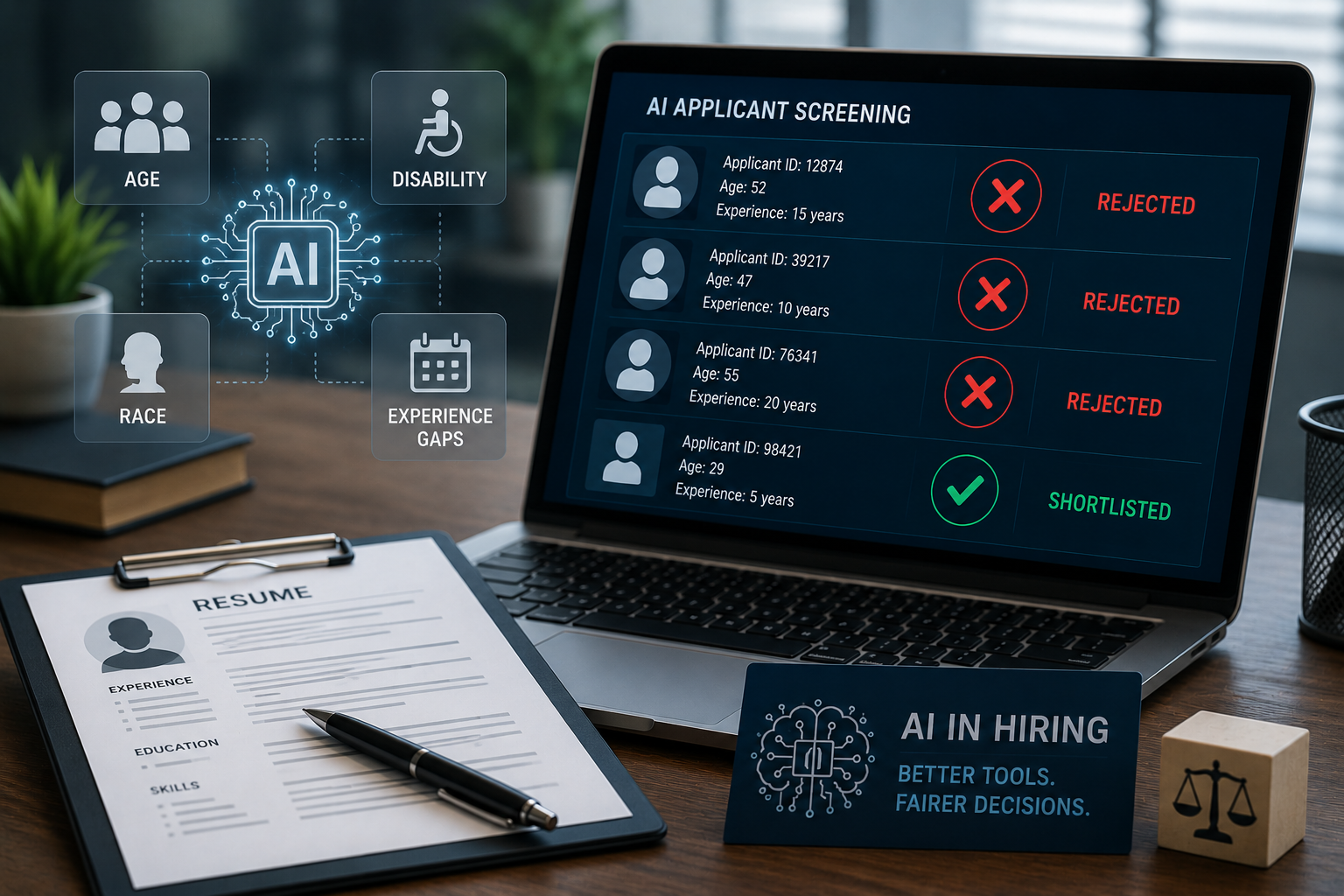
Workday faces a class-action lawsuit over alleged AI-driven discrimination in hiring, raising questions about accountability and fairness in recruitment technology. #
Imagine applying for hundreds of jobs, only to be rejected before a human ever reads your CV. Now imagine discovering that an artificial intelligence (AI) hiring tool may have screened you out because of your age, race or disability.
That question lies at the centre of a landmark lawsuit against HR software company Workday, a case that could reshape how employers use AI in recruitment and determine whether technology providers can also be held responsible for discrimination.
The Workday Lawsuit #
Workday is facing a proposed class-action lawsuit in the United States over claims that its AI-powered recruitment tools unlawfully screened out older applicants, Black candidates and people with disabilities.
The case was brought by Derek Mobley, a Black man over the age of 40 who says he has anxiety and depression. Mobley alleges he applied for more than 100 jobs through employers using Workday's recruitment platform but was repeatedly rejected, often within hours and sometimes overnight.
Workday denies the allegations, arguing that employers, not its software, make the final hiring decisions.
However, a federal judge has allowed key discrimination claims to proceed, making the case one of the first major legal tests of whether a company providing AI-powered hiring software can be held liable under US anti-discrimination laws. The ruling does not determine that Workday discriminated against applicants. Instead, it means the claims are substantial enough to be examined in court.
The outcome could have significant implications not only for Workday but for the wider recruitment technology industry.
How AI Hiring Tools Work #
Many employers use Applicant Tracking Systems (ATS) to help manage large volumes of job applications. While not every ATS uses AI, many modern recruitment platforms incorporate AI-powered features that analyse, rank or recommend candidates.
Typically, these systems extract information from CVs, compare it with a job description and identify applicants whose qualifications, skills and experience most closely match the role. Some platforms also analyse written responses, online assessments or recorded video interviews to assist recruiters during the hiring process.
Supporters argue these systems improve efficiency by helping employers review thousands of applications more quickly. Critics, however, warn that automated tools can reinforce existing biases if they rely on historical hiring data or poorly designed algorithms.
Can AI Become Biased? #
AI is not inherently biased, but it can produce discriminatory outcomes depending on the data it is trained on and how it is used.
For example, if an employer has historically hired mostly younger workers from similar backgrounds, an AI system trained on that data may learn to favour applicants with comparable characteristics, even if it is never explicitly instructed to do so. Bias can also arise indirectly through seemingly neutral information, such as graduation dates, employment gaps, postcodes, universities attended or career histories. While these factors do not explicitly reveal a person's race, age or disability, they can act as proxies that disproportionately disadvantage certain groups.
For this reason, experts argue that employers should regularly audit AI recruitment systems to identify unintended discriminatory outcomes rather than assuming automated decisions are objective.
What the Law Says #
Using AI in recruitment is not illegal. However, employers remain legally responsible for ensuring hiring decisions comply with anti-discrimination laws. In the United States, federal law prohibits discrimination based on race, colour, religion, sex, national origin, age and disability. In the UK, the Equality Act 2010 protects applicants from discrimination on grounds including age, race, disability, sex, religion and sexual orientation.
The European Union's AI Act also classifies many AI systems used in employment and recruitment as 'high-risk', meaning they are subject to stricter requirements around transparency, risk management and human oversight because of their potential impact on people's rights and employment opportunities.
The Workday case is also testing whether software providers themselves, rather than only employers, can be held legally accountable when AI-assisted hiring allegedly produces discriminatory outcomes.
Why the Case Matters #
As AI becomes increasingly embedded in recruitment, the Workday lawsuit raises broader questions about accountability.
If an algorithm influences who receives an interview and who is rejected, who should bear responsibility if discrimination occurs? Should liability rest solely with the employer using the software, the company that developed it, or both? The answers could shape future regulation of AI hiring systems and influence how businesses deploy automated recruitment tools worldwide.
For job seekers, the case also highlights the growing role technology plays in modern hiring. While many employers still involve human recruiters throughout the recruitment process, automated screening is becoming increasingly common. Ultimately, the lawsuit is not just about one software company. It is about ensuring that as AI transforms recruitment, efficiency does not come at the expense of fairness, transparency and equal opportunity.
© Copyright IBTimes 2025. All rights reserved.