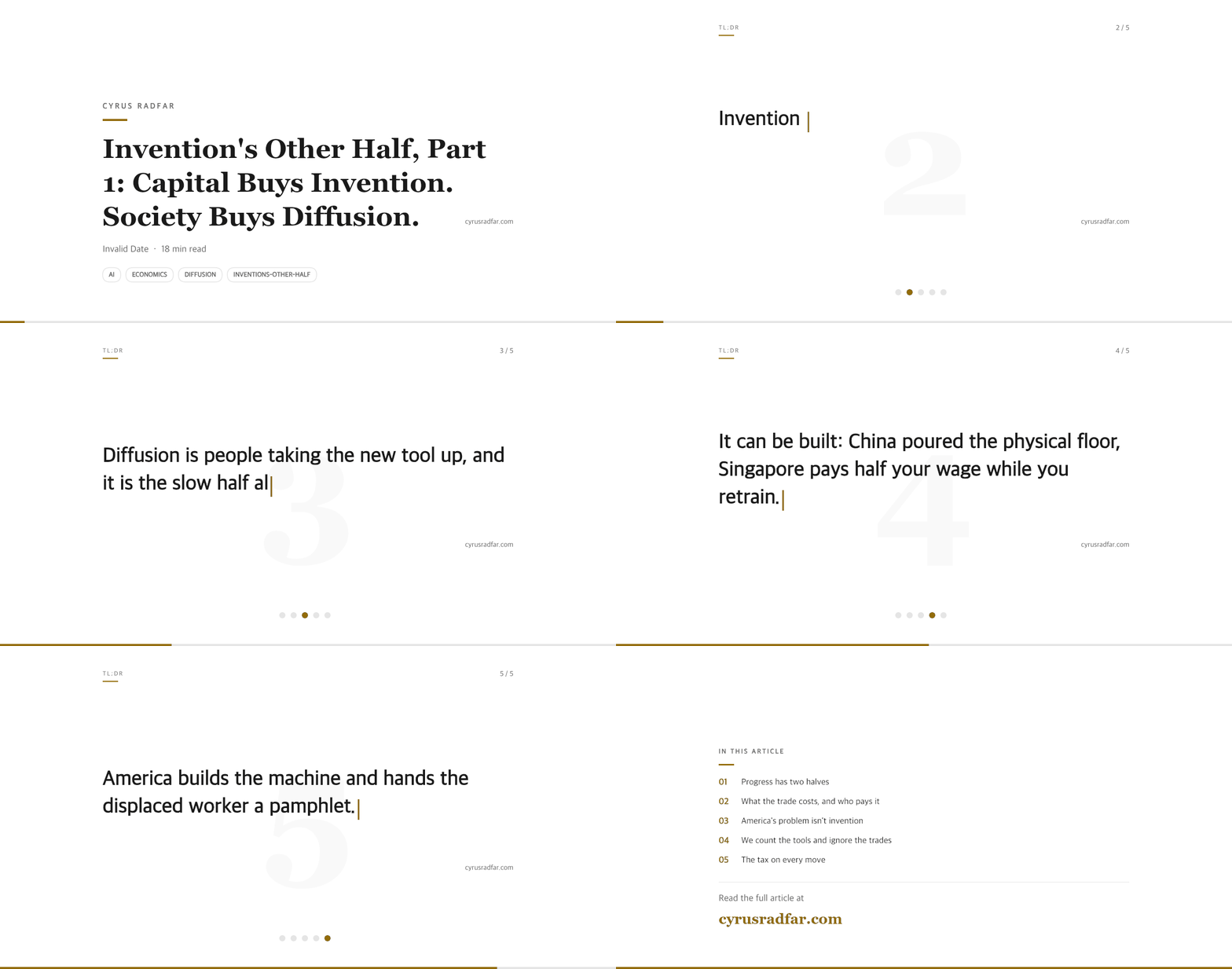
Shawn K is a software engineer, or he was. Twenty years in, a computer-science degree, the kind of resume that used to guarantee a callback. In April 2024 his job went away, into a market thinning under AI. He sent more than eight hundred applications and got fewer than ten interviews, some screened by an AI agent. Today he delivers DoorDash and sleeps in an RV. He looked hard at retraining, a new certificate or a commercial driver’s license, and walked away from both, because of what they cost just to begin.
In 2025 the four largest American technology companies spent more than $380 billion building the machines that made his skills cheap. That is compute and data centers, the physical layer capital is very good at paying for. If you stacked that much in hundred-dollar bills, the pile would rise past the orbit of the International Space Station. It’s fair to say the “system” funded the machine. But we never funded the using of it. Not for Shawn K, not for the four in five firms that still don’t touch AI, not for an economy that can find maybe 1.4 percent of its working hours saved.
Progress has two halves #
We often mistake the two halves of progres for one. We design Hyperloops and mag-lev trains, but we can’t get them built and installed in our cities. There are two ways a new thing reaches a person, and the difference is who has to change. Some things you carry home and keep, and you are exactly the person who walked in the door. You buy a refrigerator, a phone, and that is the whole transaction. No one has to become someone else for them to work. That is why the market can walk that kind down to everyone. The other kind requires you to change and that ability to change requires flexibility.
The power loom took the handweaver’s trade. The model takes the major daily task of programming from developers. You only get to the far side of it by becoming someone you are not yet. The first is a tool, and a tool is ownable: you can patent it, fund it, and capture the returns, which is why private capital floods it. The second is a trade, and a trade is not ownable, because nobody holds the title to it but the person living it. Capital often deserts it and pays the “next generation” to learn the new tool as their modus operandi. The machine that makes a trade cheap is financed to the moon. The person it makes cheap may not be financed at all.
Why is the person not financed at all? Because we can measure the machine and we cannot measure the person. Patents, R&D, the capex number that crossed $380 billion, a scoreboard built for the tool. The person learning a new trade does not appear on it anywhere, so no one funds them. And then the ledger does something stranger still: it takes the debt that pins them in place, the mortgage that stops the move, and books it as wealth. We count the machine and ignore the person. We count the person’s debt as their wealth. That mis-booking runs the whole way through, and it starts with the question: why is the person not financed at all?
That second half has a name. Diffusion is the spread of a new idea or tool through the people who could use it, and it is never automatic. It runs on a population’s capacity to absorb the new: the schooling to understand it, the time and money to learn it, the security to bet a career on it. And a cushion deep enough to survive a bad month while you do. A workforce that is exhausted, indebted, and stretched thin takes up the new slowly, however good the tool. Nobody learns a new trade on an empty stomach with a note past due.
The best evidence is a measurement, and it comes with a caution about where it points. The Organization for Economic Co-operation and Development (OECD) has tracked the productivity of frontier firms against everyone else. Over a decade the two pulled apart. The frontier grew its productivity at roughly 2.8 percent a year, while the laggards, the rest of the economy, crawled along near 0.6. That gap is between firms, not between people, and it is consistent with more than one story: superstar firms, market power, a workforce adopting slowly. But it is exactly the divergence you would expect if the machine that used to carry a good idea from the firms that had it to the firms that didn’t is seizing up, inside the market itself. The tools keep coming. The trades are being taken faster than the next ones are being taught.
Slow diffusion is the norm. As any marketer can tell you, requiring a behavior change is the death-nail of many go-to-market motions. The economic historians settled this a long time ago. Nathan Rosenberg and Joel Mokyr both showed that diffusion was always the slow half. Electricity is the classic case. Paul David found that it took something like forty years for the electric dynamo to show up in factory productivity, and the holdup wasn’t the machine. Factories had been built around a single central steam engine turning overhead shafts. The gains only arrived once managers tore the whole layout up and rebuilt the plant around one motor per machine. And once the engineers, managers, and workers who could run that new arrangement existed. The bottleneck was the factory, and the people who had to become something different to run it.
Two things are new.
The scale of capital we’re now pointing at the machine is unprecedented: that single-year sum, from four companies. And the bottleneck has moved down a floor. It used to be the manager who could take a decade to rebuild a factory. Now it is a forty-two-year-old who has to rebuild their career this quarter, with bills that don’t while they do it. The lag is old. The person standing inside the lag, with a mortgage and a degree they’re still paying for, is new.
In the nineteenth century the natural-ice trade employed something like ninety thousand people. Men sawed ice off New England lakes, packed it in sawdust, and shipped it as far as Calcutta. Then mechanical refrigeration arrived and took the trade apart. By 1914 artificial ice had passed natural ice in volume. By 1950 four out of five American homes had a refrigerator. Even this clean case took two generations, the same slow diffusion as the dynamo.
And refrigeration only reached people where the power reached first. In the unelectrified countryside natural ice kept being cut and sold until after World War Two. The breakthrough traveled down the wires, not over the men it had displaced.
There is a case that threatens this one, and it deserves a straight look. The smartphone reached about 85 percent of that exact American population in a single decade, with no public program of any kind. By the rule above it is not the kind this series is about: buying a phone destroys no one’s trade, and owning it turns nobody into someone else. The ice harvester is the other kind, and their case is the honest price. Their trade was taken, the cost was externalized, and the replacement reached the electrified, not them. They are the cost of the hard kind.
What the trade costs, and who pays it #
Diffusion is structural and can be built.
China built the bottom floor, the physical one. A driver plugs in and walks away with range in minutes. Behind that ordinary moment sits the infrastructure: 12.82 million charging points by the end of 2024, and 277 gigawatts of solar added in that single year. That solar is roughly the size of the entire US utility-scale fleet, built while we were still arguing about permitting. The physics of a battery is the same in Shenzhen and in Cleveland. China just poured the concrete and standardized the grid (why cars charge five times faster there). What I’m taking from China is the priority it put on diffusion, not the regime that set it. China bought that speed at a real price. Producer prices fell for thirty-eight straight months, something like four hundred EV makers have died in the shakeout.
Singapore built a floor and, crucially, made it survivable. It pays half your wage, up to about S$3,000 a month, for as long as two years, while you retrain full-time. The courses it is tied to are mapped to sectors that are actually hiring. Roughly 555,000 people pass through it in a country of six million. There’s no clean causal study proving it works. It rides on a one-party developmental state, one that can forecast a sector without fifty legislatures in the way.
Absorptive capacity is necessary, not sufficient. India spent decades minting world-class engineers in its public technical institutes. For years the main thing they diffused into was Silicon Valley, not Indian prosperity, until the economy opened in the 1990s. Build the people and skip the open market, and the capacity just sits there.
America’s problem isn’t invention #
America does not have an invention problem. On R&D intensity and on the quality that comes out of our labs, we are still at or near the top; on gross spending, China has pulled ahead of us. Either way, the constraint was never discovery. America makes tools as well as anyone on earth. What it has never built is the crossing for the trade the machine takes.
We built one layer of this once, on purpose. In 1936 about ninety percent of American farms had no electricity. Investor-owned utilities had wired the profitable places and then stalled at around eleven percent of farms. That is the debated part, and it deserves a straight answer. The private companies had been electrifying farms slowly before the Depression. Historians argue over whether they would have finished on their own. What is not debated is that a federal lender changed the cost curve. The Rural Electrification Administration loaned cheap money to farmer cooperatives, and the cooperatives, owned by the people they served, strung their own lines. By 1950 roughly 80 percent of farms had power. Note what it was: credit, poured at the ground, into an organization of the people who needed it. We knew how to finance the floor. The crossing for the trade we never built.
The refrigerator is the payoff. You buy one and it sits quietly in your electrified kitchen, a “tool” in the easy sense, no one has to change for it to work. But it is downstream of a floor: a grid a federal lender underwrote, and a federal loan for the appliance itself, so that demand existed from the first day. The thing you own relatively cheaply was paid for by a crossing America built on purpose and then, when the frontier moved from wires to trades, stopped building.
Deep DiveWould the private utilities have finished the grid? #
The honest answer is that the historians still argue about it. By 1936 about nine in ten farms had no power, and investor-owned utilities had wired the profitable places and then stalled at around eleven percent of farms. The utilities priced rural lines at about $2,000 a mile and judged the payoff too thin. Neufeld’s account of the power market points to a subtler reason. The big holding companies had consolidated, and felt little pressure to claim sparse territory, expecting to expand into it later. That is the case that the private firms would have finished eventually, just slowly, and on their own timetable.
What is not debated is what the REA actually did. It lent at two to three percent to farmer co-ops. It cut the cost of a rural mile to under eight hundred dollars, through engineering and bulk purchase. And, crucially, it lent for the wiring and the appliances themselves, so there was demand for the power from day one. The economists Lee, Miguel and Wolfram argue that appliance financing is exactly what made US rural electrification succeed where similar programs abroad stalled. Almost all the loans were repaid, defaulting at under one percent. The floor got built, on purpose, out of public credit, and the loans came back.
The obvious fix, “just retrain people,” has a bad track record. Trade Adjustment Assistance, the closest thing America has run, paired retraining with income support, and the rigorous evaluations found it moved earnings about zero. The gold-standard randomized trial of the Workforce Investment Act found the same for classroom training. One caveat before we read too much into that: these are not the case of just handing someone a check. They are voucherized courses with thin navigation. What they tell you is that generic classroom training, dropped on a displaced worker with no matched job at the end, does not restore their earnings.
So what has worked?** Sector-specific programs like Project QUEST in San Antonio raised earnings 15 to 20 percent, and the gains held for years. What separates the two is the whole crossing: income to survive the gap, and a trade waiting on the other side of it. Singapore builds the crossing. America basically hands out a pamphlet and says “good luck.”
When the GM plant in Janesville, Wisconsin closed, the town retrained. The workers who retrained ended up less likely to have steady work than the ones who didn’t. Two-thirds of them never finished. One of them, Matt Wopat, took a transfer four and a half hours away. He became a weekday ghost, sleeping apart from his wife and daughters, because they couldn’t sell a house worth less than its mortgage. One town, one story. The dislocated-worker literature is genuinely mixed: some of the best of it, Jacobson, LaLonde and Sullivan’s work on community-college retraining, finds modest positive returns. Retraining works when a job waits on the other side. Poor fit explains most of the failures.
And the towns where retraining was never the point tell the same story from the other side. Across hundreds of trade-exposed local labor markets, the economists Autor, Dorn, and Hanson found that when the work left, the displaced didn’t follow it. Out-migration barely budged. The places stayed depressed for a decade and more, and there was no job to diffuse into. The people who most needed to move were precisely the ones who couldn’t, and the missing way across was only half of it. The missing destination was the rest.
Interstate migration in America has fallen by roughly half since the early 1980s. Some is the country aging, some is people moving less because moving stopped paying off. What the averages wash out is the shape underneath. Mobility has collapsed hardest for the people a local shock hits hardest, the ones who most need to move and can least afford to. We hand them the course. We never build the door.
Doesn’t all this support, the allowances and the transitions, freeze a labor market, the way Europe’s job protections supposedly did? No, and the distinction is the entire game. Singapore fires freely. So does Denmark. They protect the worker’s crossing to the next job. Job protection freezes the old. The crossing enables the new. Blur those two and you’ve argued the good kind out of existence along with the bad.
We count the tools and ignore the trades #
We measure invention obsessively: patents, R&D, the Global Innovation Index, a whole instrument panel for the tool. We barely measure trades at all. Economists do clock pieces of it: the adoption lags, the frontier-versus-laggard gap, the OECD’s own mobility and adult-skills measures. But those live in separate technical journals. They count firms and countries rather than people, and nobody has pulled them into a single number a policymaker could steer by. The pieces all exist. The assembly does not. And what gets measured gets funded. So I started to build the assembly, in the finale of this series.
The harvesters got no retraining, no safety net, no transition of any kind. That cost was paid in full by the ninety thousand, and recorded nowhere. The machine that took their trade, we financed to the moon. The debt that keeps the person who replaces them, or the family who can’t sell the house, from moving, we count as strength. We count the machine and ignore the person. We count the person’s debt as their wealth. That is the mis-booking, and the tax on every move is where it lands.
The tax on every move #
Diffusion runs through a few channels: the freedom to switch jobs, to move, to retrain. Any of them can clog, for more than one reason. But watch what actually stopped these two. Shawn K walked away from retraining because of what it cost just to begin.
The Janesville family couldn’t move on a house worth less than the mortgage against it. Those are two different gates: one is the price of entry, the other is the weight of a payment already made (sunk cost). They are not the same mechanism. What they share is that a fixed claim on a person’s money stood between them and the next thing. Of everything that freezes a person in place, debt-service is the one that is measurable, the one our scoreboards often count as strength.
Debt is the tax on every move. It leaves your income untouched on paper while raising the price of every door the crossing asks you to walk through. A fixed payment simply makes quitting, moving, and starting over higher risk than you can spare. Capital, across the table, can wait a decade for an invention to pay off. The indebted worker can’t wait a quarter.
Look at who we have been talking about. Not a country. A man in an RV. A family that couldn’t sell. Ninety thousand ice harvesters, whose cost was recorded nowhere. The question was never how America is doing on average. It is how many people inside it can no longer move.
Next: The Flexibility Tax, on why the debt that funds today’s spending freezes tomorrow’s move.