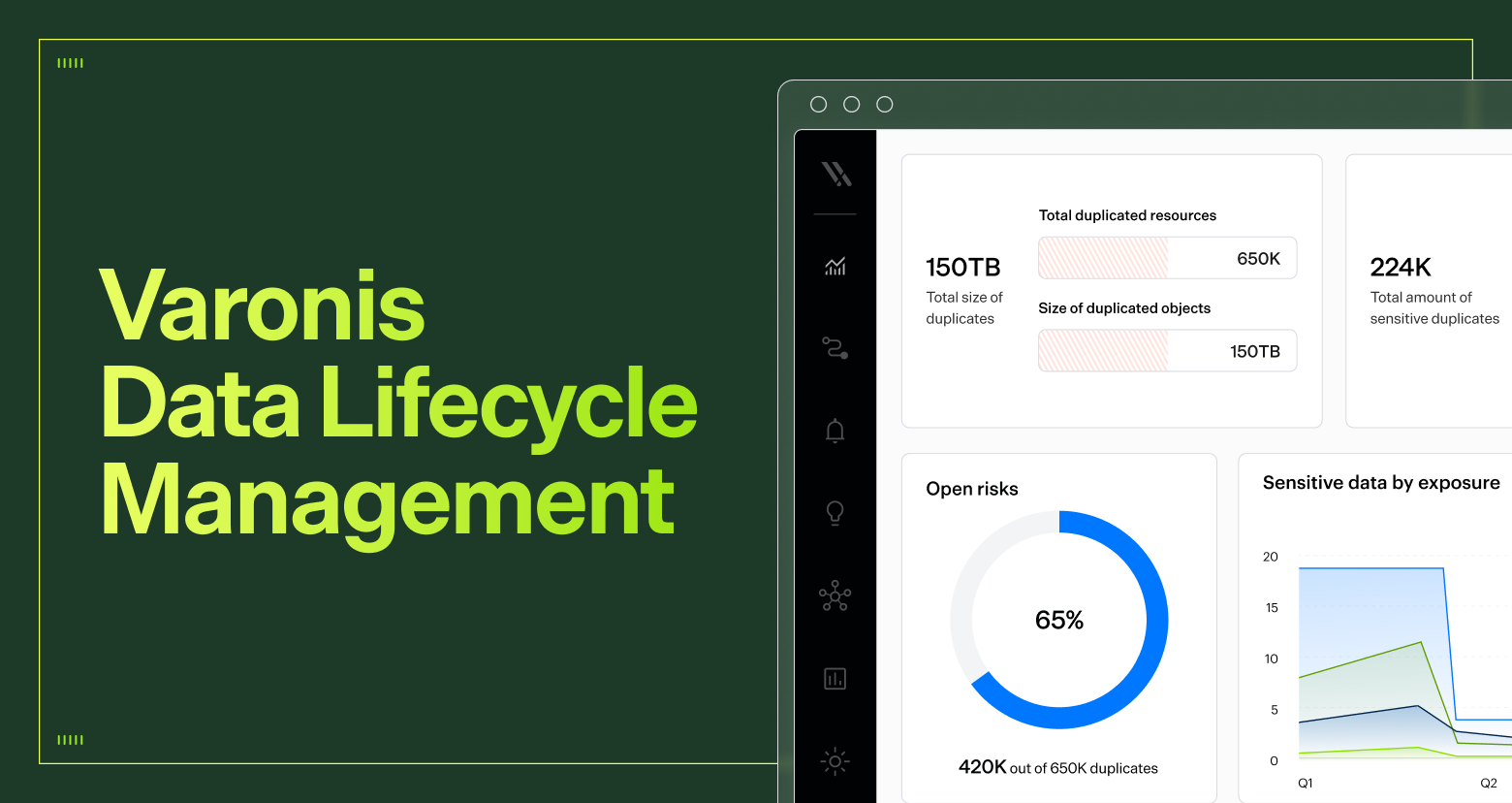
Varonis Data Lifecycle Management (DLM) is a new capability that automatically finds and quarantines redundant, obsolete, and trivial (ROT) data across your entire data estate. Cut storage costs, improve AI outputs, and reduce risk, effortlessly.
ROT: The data you should not have #
For the average enterprise, data volumes grow by 30% to 40% each year, and that growth is accelerating due to AI. Every modern business is creating mountains of data, but few have an automated way to remove data when it’s no longer useful. As a result, at least 30% of enterprise data is ROT, which leads to problems such as:
Wasted storage costs: Industry estimates put storage costs at more than $650,000 per petabyte a year, before backup and replication, meaning you spend almost $200,000 per petabyte per year storing data that shouldn't exist.
Degraded AI quality: AI processes and analyzes all the data it can access, including ROT. That means data that shouldn't exist gets to shape your AI's actions and responses.
Elevated risk: Sensitive ROT data scattered across shares, drives, and forgotten data stores widens the blast radius of a breach. Data kept past its retention window can lead to fines under GDPR, CCPA, HIPAA, and other regulations.
Varonis Data Lifecycle Management: The power of automation #
With Varonis DLM, you can automatically find ROT across every data source, as well as enforce governance, retention, and residency policies. DLM is built on the Varonis Data Security Platform (DSP), which already helps thousands of customers understand and control their data.
Varonis DLM also shows you which data should and shouldn't exist across your data estate. Since the context around sensitivity, permissions, and activity already lives in Varonis, the platform not only finds ROT but also acts on it.
Legacy lifecycle tools find data that might be ROT and then rely on data owners to manually review lists of hundreds or thousands of deletion candidates, one record at a time. Only Varonis knows what's stale, overexposed, duplicated, or past its retention window, and quarantines it automatically.
Unified ROT visibility
One dashboard shows the full scope of ROT data across every connected platform. View total ROT volume, duplicate clusters, stale files and folders and data past its retention window. Filter by platform, classification category, sensitivity, data source, file type or owner.
Prioritize ROT based on potential cost savings and risk: See what's driving storage spend and exposure, so you can prioritize cleanup efforts and keep track of progress.
Surface ROT hiding in plain sight: Aggregated visibility flags stale and aged data even when hidden inside active folders.
The ROT dashboard shows cost savings potential along with compliance risk areas. Duplicate volume on one side, sensitive and regulated data on the other.
Full data context
Knowing how much ROT you have is important, but it’s not enough to know what to do about it. Varonis DLM adds the context you need to make informed decisions. For example, you can drill into any duplicate group and see which copy is the original, which is most recent, where copies are across different platforms, and whether they are sensitive, overexposed, or past retention.
Detect every duplicate, not just the readable ones: Find the duplicates and ROT that classification can’t read, such as media files, installers, DLLs, and archives.
Act based on the full lifecycle of data: Varonis tracks how long each data record has gone untouched and how old it is, so you know exactly what's safe to remove.
Drill into any duplicate group to see the original, where copies live, and which are stale, sensitive, or overexposed.
Complete lifecycle automation
Out-of-the-box policies govern duplicates, staleness, and retention, all fully configurable to your scope and logic. When data violates a policy, Varonis automatically moves it to a secure quarantine. The automation is fully reversible, and Varonis deletes nothing until you're sure.
Turn classification into enforcement: Don’t just label expired data — act on it. Retention policies map classification categories to legal windows, like financial and PCI over seven years old, PII and GDPR over two years old, PHI over six years old, and education data over five years old. #
Remediate without risk: Quarantine the duplicates you don't need and choose which copy to keep, such as the original or the most recent. Every action is reversible, so cleanup never breaks something you need.
Configurable, out-of-the-box policies for duplicates, staleness, and retention with fully reversible quarantine.
A security project that pays for itself #
Most security spending is insurance you pay for and hope you'll never need. Varonis DLM is the exception: Not only does it deliver security and compliance outcomes, but it also cuts storage and backup costs. Varonis DLM is powerful because it's built on the Varonis DSP, so every lifecycle decision is driven by AI classification, complete permissions mapping, and full activity history on every data record, all correlated in real time across your whole environment.
The combination of classification, permissions, and activity is what allows Varonis to know "this is stale, overexposed, duplicate, past its retention," rather than "this might be ROT." Varonis automated remediation capabilities automatically quarantine ROT rather than having to rely on data owners for cleanup. Other solutions may be able to classify data, but only Varonis has the context to act on it automatically, safely, and at scale.
Schedule a free Varonis Data Risk Assessment to see how much ROT is hiding in your environment and find out exactly how much you could save.
Ready to stop paying to store risky, unwanted data?
See Varonis in action: Schedule a
DSP demoto see how Varonis finds, prioritizes, and quarantines redundant and obsolete data across your environment.
Find out how much ROT you're storing: Varonis' free
Data Risk Assessmentshows exactly what data is stale, duplicated, or past retention — and what it's costing you to keep.