ai_decide is a native Databricks AI Function that makes fast, low-cost decisions for model routing, document processing, agent evaluations, and more.
by Jane Zhang, Matthew Ding and Archika Dogra
Today, we’re launching a new Databricks AI Function ai_decide that makes fast decisions over your governed data.
We see a lot of teams use LLMs for tasks that do not require complex reasoning and text generation. Which category does this support ticket belong to? Does this document need human review? Which model should handle this prompt?
These questions power many of our customer’s high-scale enterprise workflows from processing millions of documents to controlling real-time app logic. However, using LLMs for these smaller, structured decisions means paying for additional latency and cost that compounds at enterprise scale. A decision model like TypeSafe AI's Jev closes that gap: instead of generating text, it takes unstructured input and a set of questions and returns decisions and their probabilities directly.
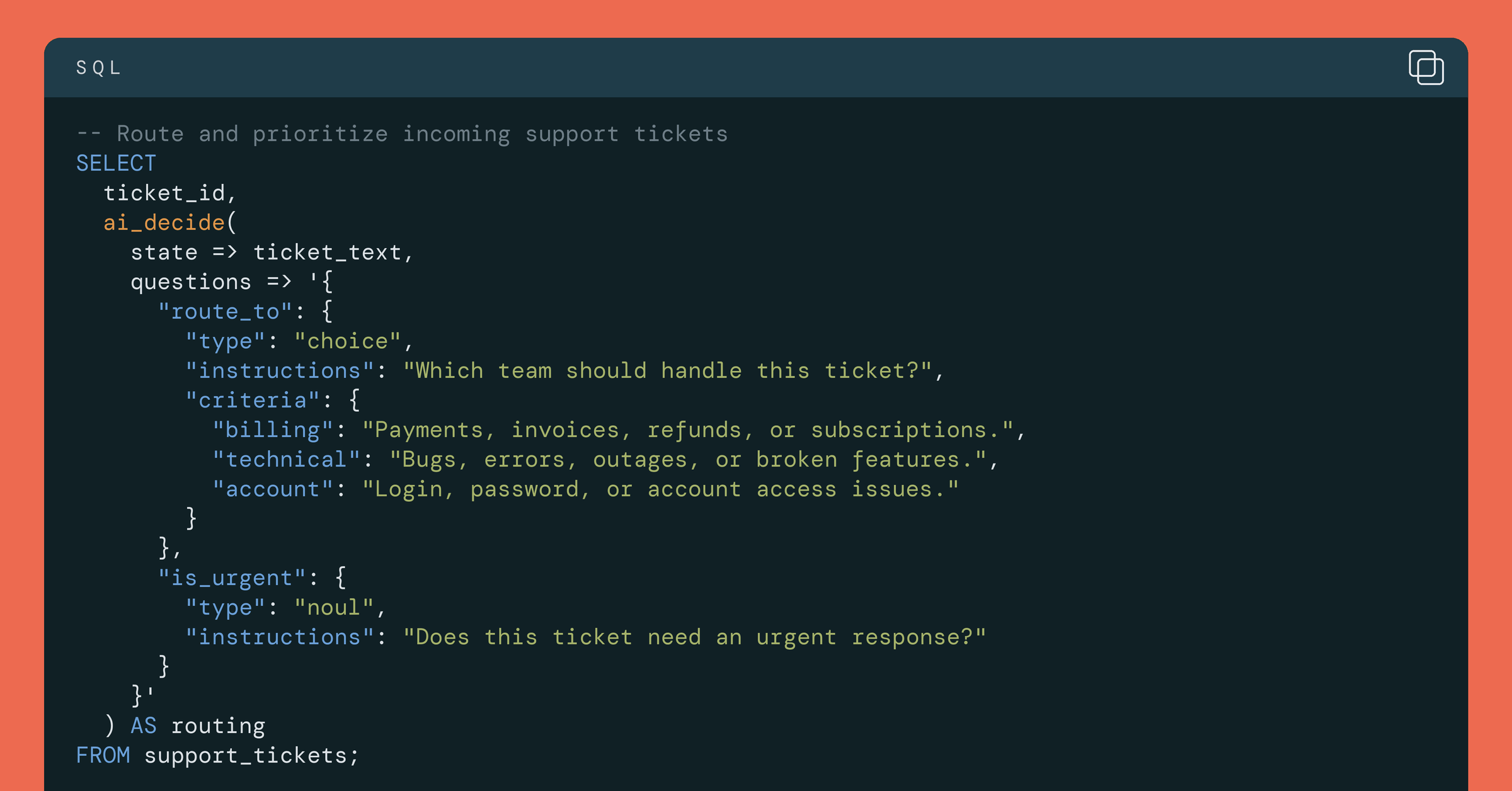
ai_decide is a new Databricks AI Function powered by a decision model. It evaluates one or more questions against text in a fraction of a second, and for each question, it returns either a probability, a choice from named criteria, or a score on an ordered scale. Because ai_decide is optimized for fast decisions, it yields lower latency and cost than an LLM on similar tasks.
ai_decide today
ai_decide is now available on Databricks in Beta. Call it from SQL to make structured decisions at scale on your data or through the REST API for real-time applications and agents. For teams already building with the TypeSafe AI API, the ai_decide function is directly compatible.
Not sure where to start? If you have unstructured data and need to classify it, score it, or decide what happens next, ai_decide is a good fit. Here are a few use cases you can try today:
You receive thousands of product reviews each month. Customers describe everything from confusing setup instructions to incorrect billing charges.
With ai_decide, you can tag each review with its primary issue and whether the customer is looking to return the product in one SQL query. Aggregate those tags by product and month to track recurring complaints and see which issues appear most often alongside reported returns.
Let’s say you’re a software company building an AI assistant. Your users ask the assistant to do everything from rewriting a sentence to designing a database architecture. You have several models available with different costs and capabilities and want to choose an appropriate model for each request.
Use ai_decide to determine the prompt reasoning level and difficulty. Then route the request to the corresponding model.
An example result response.answers:
Let’s say you run an online retailer with an AI support assistant. Before releasing a new version, you want to evaluate its answers against your refund policy. You have a set of customer questions, generated answers, and reference policies.
Use ai_decide as a judge to check whether an answer follows the policy and score how completely it addresses the customer’s request.
Here is an example resulting row, showing response.answers:
Because ai_decide returns a decision in a fraction of a second, it's fast enough to drive an application in real time, where each decision depends on the state of the moment before.
To demonstrate, we built a live demo of Snake, hosted on Databricks Apps. ai_decide plays the game: on every tick, the app sends the current board to ai_decide and asks, which direction should the snake move next?
Because the whole decision loop closes in a fraction of a second, you can put ai_decide behind any real-time decision an agent or application needs to make: which tool to call, which branch to take, which action comes next.
ai_decide is available now in Beta. Use it in SQL to classify, score, and make decisions across governed data at scale, or call the REST API to add fast decisions to real-time applications and agents. Beyond the managed function, there's a broad and growing ecosystem of open-weight decision models, and you can serve and run any of them directly in SQL on Databricks. See our recent open-Jev walkthrough here.
Explore the ai_decide SQL documentation or get started with the REST API.
Subscribe to our blog and get the latest posts delivered to your inbox.