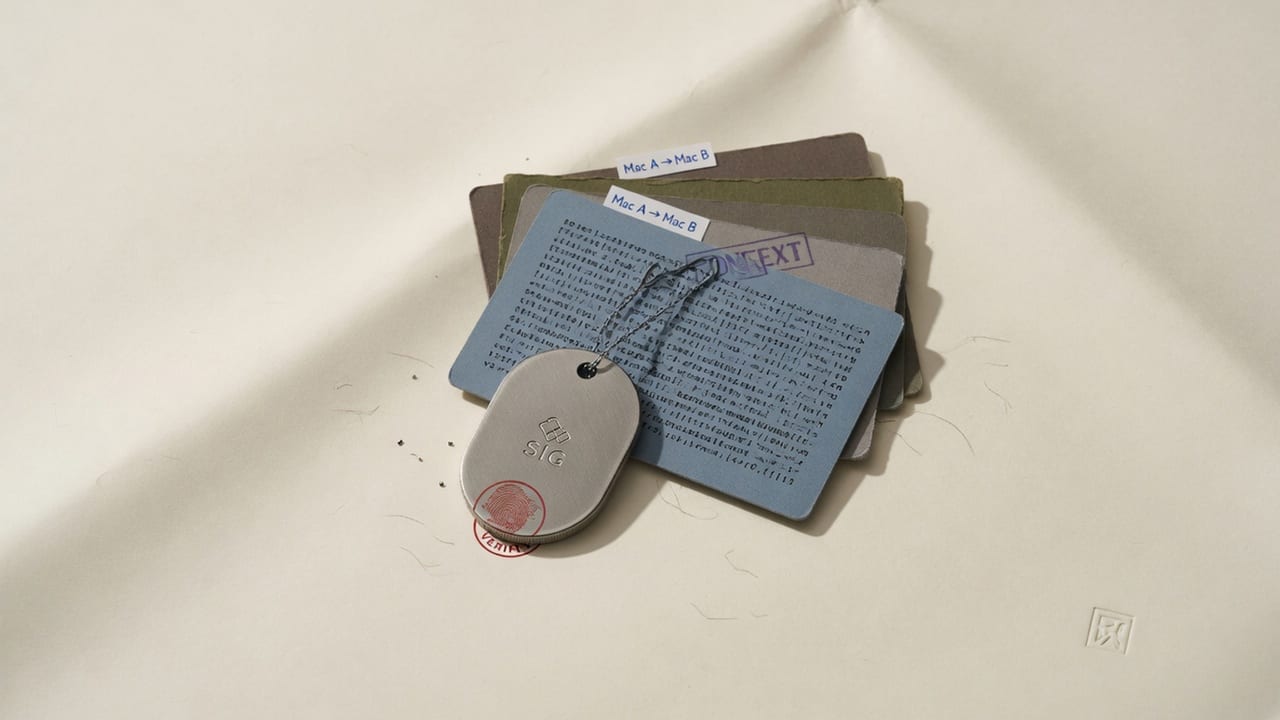
David Seaman's Intersignal said in an August 17th announcement that Braid v1.5.2 transferred signed semantic context between two local AI systems using different embedding models, a narrow physical test of Seaman's larger bet that useful machine state can move without passing through a cloud platform.
The test ran on two Apple Silicon Macs using local Ollama models. The sending machine used all-minilm:latest
, producing a 384-dimensional representation. The receiving Mac used nomic-embed-text:latest
and created its own 768-dimensional embedding after verifying the material and its provenance, according to Intersignal.
The method matters more than the change in dimensions. Braid does not try to translate one model's opaque vector coordinates directly into another model's vector space. It packages explicit semantic material with a source-model digest, provenance and a cryptographically bound source representation. The receiver verifies those records, then re-embeds the material locally when its model differs from the sender's.
That preserves a clean boundary between evidence supplied by the sender and state created by the receiver. Intersignal says the cross-model transaction passed its Phase B finality step with bridge_semantic_invention: false
, a flag intended to show that Braid had not invented an intermediate interpretation while bridging the two systems.
"The sender proves what it meant; the receiver remains sovereign over how that meaning is represented locally," Seaman said in the announcement.
A protocol built around local authority
Seaman arrived at AI infrastructure through online media rather than an established model lab. His public profile describes him as a media technologist and journalist and lists New York University in his education. In a July 14th discussion, Seaman described FULCRUM's transition into Intersignal and said local AI research had begun taking up most of his time.
Florida records show Intersignal LLC was incorporated on November 21st, 2025, with Seaman listed as its authorized member. Intersignal previously described itself as self-funded and independent of venture capital in its June 30th Braid v0.1 release.
That background helps explain Braid's fixation on provenance, receipts and control over what enters a system's memory. The protocol treats context as material that must arrive with an identity and an inspectable history. Acceptance is a decision made by the receiving machine under its operator's rules.
Braid also has a faster path for machines already using the same representation space. Intersignal ran a second test in which both nodes used the same embedding model and an identical model digest. Braid retained the authenticated 384-dimensional representation and skipped receiver-side re-embedding through a mechanism called exact_space_fast_path
.
The two paths give Seaman a simple operating rule: preserve the representation when the models match; preserve the signed meaning and let the receiver create a native representation when they do not.
Moving AI state through a camera
Intersignal also tested a transport method intended for disconnected environments. Braid divided a signed .brad
object into 30 QR frames, displayed them on one Mac and captured them with another Mac's camera. Intersignal says the receiver acquired all 30 chunks and reconstructed the object byte-for-byte.
The QR reel is another expression of Braid's design. The optical layer transports the same signed object that can travel over a local network. It does not reinterpret or re-sign the material. A receiving system can quarantine the object, verify its Ed25519 signature, check freshness and replay conditions, inspect the source-model binding and decide whether to commit it locally.
The Braid v1.5.2 download page lists research builds for Apple Silicon macOS, Windows x64 and Linux. Intersignal says it has also completed signed handoffs from macOS to Linux, macOS to Windows and Windows to Linux. Those cross-operating-system claims come from Intersignal's own testing and extend beyond the two-Mac, cross-model demonstration announced on August 17th.
Intersignal labels Braid experimental developer research software. The current Mac build is not distributed through Apple's Developer ID notarization system, so users may encounter a Gatekeeper warning and may need to authorize the individual application through macOS security settings.
The boundary of the result
The August 17th result is a company-run engineering demonstration, rather than an independent benchmark. It covers two named embedding models on two Apple Silicon machines. It does not establish reliable semantic preservation across arbitrary models, payloads, hardware or network conditions.
Production use will turn on questions that the demonstration does not answer: how meaning holds up across more distant model families, how payload complexity affects the handoff, what latency and throughput look like under load, and how the protocol behaves during adversarial or malformed transfers. The cryptographic envelope can prove where material came from and whether its bytes changed. It cannot, by itself, prove that two models interpret the same material equivalently.
Braid is entering an active interoperability debate from a specific local-first position. Anthropic's Model Context Protocol standardizes connections between AI applications and outside data or tools. Google's Agent2Agent protocol focuses on discovery, information exchange and task coordination between agents. Braid concentrates on a smaller problem: carrying authenticated semantic material between local runtimes while leaving the final representation and acceptance decision with the receiver.
Seaman's immediate task is to turn a controlled demonstration into something outside developers can reproduce and stress. The design already contains a defensible idea: portable AI memory needs a chain of custody, and a receiving system should remain free to reject or reinterpret what arrives. Braid v1.5.2 gives that idea working software and a physical test, while keeping its claims bounded to the hardware and models Intersignal actually used.