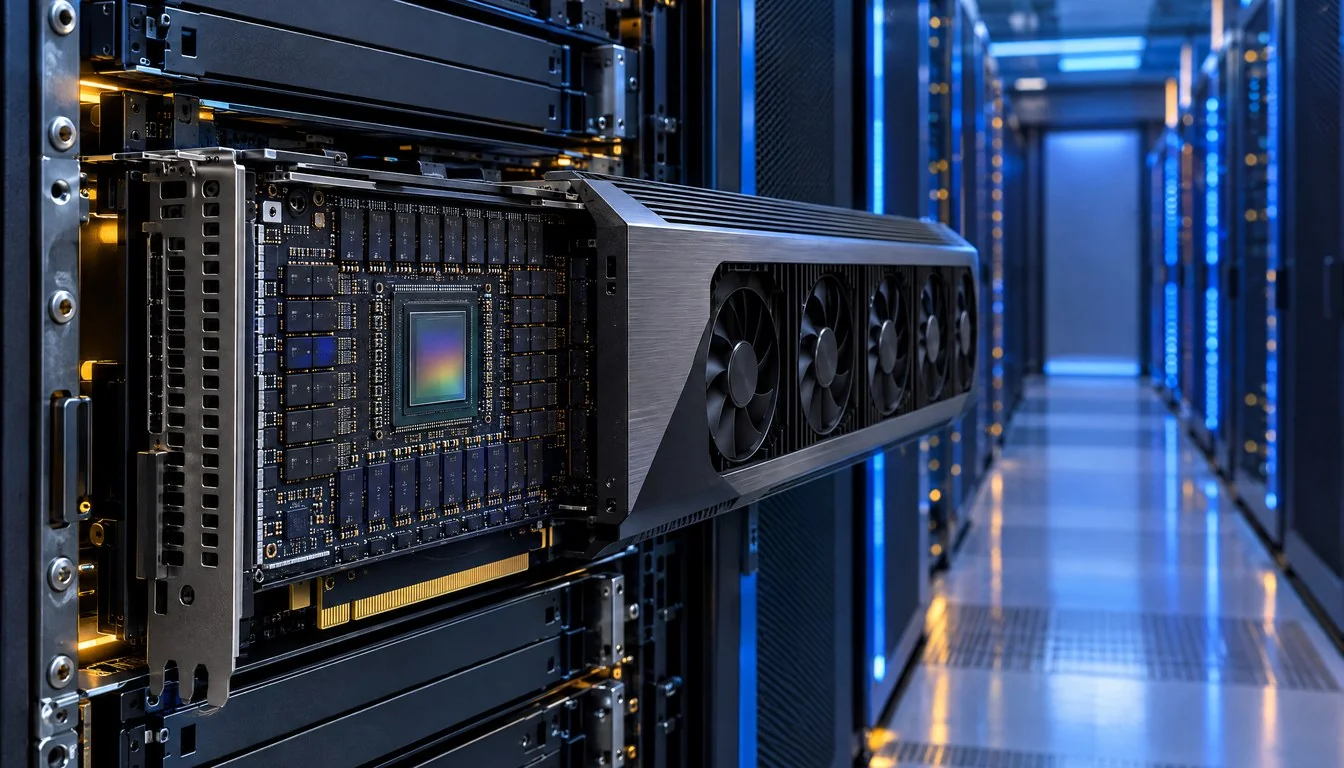
Intel put up to 480 GB of LPDDR5X on a single air-cooled AI card and bet that inference buyers care more about room than raw speed. Intel’s own product page for the Intel GPU D270 confirms the 480 GB maximum. The October 12, 2026 announcement pairs that capacity with 1.3 PFLOPS of FP8 compute, 1.5 TB/s of memory bandwidth and a 350-watt power envelope.
The memory choice is the real story. Most rival accelerators pair their compute with stacked HBM, which is fast, expensive and scarce. Intel chose a slower, cheaper memory type and stacked far more of it. The company renamed its Crescent Island project as the Intel GPU D-Series at the Open Compute Project Global Summit, and the LPDDR5X vs HBM debate has dominated the hardware conversation since.
The trade-off is easy to state and hard to judge. LPDDR5X gives capacity. HBM gives bandwidth. Which one wins depends on the workload, and Intel has not yet published a benchmark that settles it. The facts below separate what Intel confirmed from what the marketing implies, then set the card against Nvidia and AMD.
Don't miss new tech stories on Google
Add Shattered once in the Google app and our stories show up in your news suggestions.
Intel’s D-Series Skips HBM for 480GB of LPDDR5X #
The D-Series is built on Intel’s Xe3P architecture and aims at sustained, memory-intensive AI inference. That means long-context workloads, large language models and many concurrent users sharing the same hardware. Intel does not pitch it as a training part or a gaming card, and it does not pitch it as a rival to the biggest rack-scale systems.
Three design decisions define the product. First, it uses LPDDR5X instead of HBM, which lifts the capacity ceiling to 480 GB per card. Second, it ships as a standard PCIe card with air cooling, so it fits into servers that already sit in racks today. Third, it caps power at 350 watts, a figure that ordinary data-center power and cooling plans can absorb without redesign.
That combination makes the D-Series a different kind of product from the flagship parts that grab headlines. It targets the buyer who already owns air-cooled servers and wants to add inference capacity without rebuilding a floor for liquid cooling. Whether that buyer exists in large numbers is the open commercial question, and the answer will take several quarters to emerge.
Intel also made one status point clear. Customer sampling is underway with server OEMs, ODMs, neoclouds and independent software vendors. The company gave no launch date and no price, so the D-Series is a sampling-stage product family today, not something a buyer can order.
What Intel Confirmed at OCP on October 12 #
Intel revealed the name and specifications at the Open Compute Project Global Summit. The same event carried a wave of rack-scale news from Nvidia and AMD, and CRN’s roundup of six big OCP announcements shows how crowded the week was. The three chipmakers’ open AI rack pitches all landed together. Intel’s contribution was a quieter one: a card meant to slot into existing infrastructure rather than redefine it.
The confirmed facts, as Intel and the reporting around the announcement describe them, are short enough to list.
- Intel formally named the accelerator formerly code-named Crescent Island as the Intel GPU D-Series on October 12, 2026.
- The architecture is Xe3P, and the target is long-context, concurrent LLM inference.
- Intel states up to 1.3 PFLOPS of FP8, 1.5 TB/s of memory bandwidth and up to 480 GB of LPDDR5X at 350 W.
- The form factor is an air-cooled PCIe card, with systems scaling to eight GPUs.
- Intel says one card supports models up to 300 billion parameters, and an eight-GPU system supports more than 1 trillion.
- Customer sampling is underway. No price or general-availability date has been announced.
Intel has a long record at OCP and used the summit to say so. Its own newsroom notes 116 contributions to the project since 2011. The D-Series fits that open-infrastructure story, since a standard PCIe card is the most open form factor a server maker can ask for.
| Specification | Intel figure (Oct. 12, 2026) | What it signals |
|---|---|---|
| Architecture | Xe3P | Inference-first design, not a gaming derivative |
| FP8 compute | Up to 1.3 PFLOPS | Modest per card, built to scale by adding cards |
| Memory bandwidth | 1.5 TB/s | The limit on single-stream token speed |
| Memory capacity | 160 GB on Intel’s card, up to 480 GB on partner designs | The headline differentiator |
| Memory type | LPDDR5X | Cheaper and less supply-constrained than HBM |
| Power | 350 W, air-cooled PCIe | Fits existing racks |
| Scale-out | Up to 8 GPUs per system | Intel claims more than 1 trillion parameters |
| Price and availability | Sampling, no price, no date | Buyers cannot plan a purchase yet |
The 160GB Versus 480GB Question #
The 480 GB figure needs a qualifier, and Intel’s own footnotes supply it. One footnote states that an Intel-branded PCIe card carries 160 GB of LPDDR5X, while the design lets partners build ODM-branded cards with options up to 480 GB. Jon Peddie Research reached the same reading in its October 14 write-up and treated 480 GB as a ceiling, not a universal spec.
That distinction changes how buyers should read the launch. A card that ships with 160 GB competes on a different footing than one with 480 GB. The reference card is likely to serve as the evaluation part, and the large-memory partner designs are where Intel’s capacity argument lives. Until partners name their products, nobody can say how many 480 GB cards will reach the market or what they will cost.
The qualifier also exposes a tension in Intel’s own claims. The company says a single card can serve a model with up to 300 billion parameters. At FP8, one byte per parameter, such a model needs about 300 GB for weights alone. That fits a 480 GB part with room left for the KV cache. It does not fit the 160 GB reference card unless the model drops to a lower precision. The claim is plausible, but it applies to the partner configuration, a reading we draw from the arithmetic rather than from anything Intel stated.
Intel’s comparison material adds another hedge. Its footnote says performance projections against Nvidia’s RTX Pro 6000 rest on public information and Intel internal analysis dated February 2026, and that the memory comparison is made at comparable bandwidth. That is a capacity argument, not a speed one. One third-party comparison, reported but not confirmed by Intel, lists 480 GB for the D-Series against 144 GB for AMD’s Instinct MI350P and 96 GB for the RTX PRO 6000 Blackwell Server Edition.
LPDDR5X vs HBM: Capacity Against Bandwidth #
The LPDDR5X vs HBM choice is the central engineering question. HBM stacks memory dies next to the processor on an advanced package and reads them over a very wide interface. The result is enormous bandwidth in a small footprint, at a high cost and with tight supply, since HBM competes for packaging capacity with every other AI chip. LPDDR5X is the memory used in phones and thin laptops. It is cheaper, easier to source and available in large capacities, but it moves data more slowly.
Supply is part of the logic. Demand for stacked memory keeps climbing, and the production of HBM4 for Nvidia’s Rubin generation absorbs a large share of the industry’s advanced packaging effort. A product that avoids HBM sidesteps part of that queue. Intel has not said whether it expects LPDDR5X to ease its supply risk, but the design makes the argument on its own.
What 1.5 TB/s Means for a 300B Model
Autoregressive decoding is usually limited by memory bandwidth, not by compute. Each new token requires reading the active weights from memory. Take a dense 300-billion-parameter model at FP8, which occupies roughly 300 GB. One full pass at 1.5 TB/s takes about 0.2 seconds, so a single stream tops out near five tokens per second. That is our back-of-envelope ceiling for batch size one, and it ignores the KV cache.
Real deployments rarely run that way. Batching lets many requests share one read of the weights, which multiplies total throughput without improving any single user’s speed. Mixture-of-experts models read only the experts they activate for each token, which cuts the bytes per token sharply. Both techniques favor a card with plenty of memory and moderate bandwidth, and both explain why Intel frames the D-Series around concurrency rather than single-stream latency.
Where a Big Memory Pool Wins: Long Context and Concurrency
The KV cache grows with context length and with the number of live sessions. An agent that holds a long conversation, a codebase or a document set in context can consume a large slice of memory per session. A card with 480 GB can keep many such sessions resident. A card with a fraction of that must evict, recompute or spread the work across more devices, and each of those options costs money or latency.
That is the workload Intel names: long-context, concurrent inference for agents. If the bet is right, the D-Series wins on cost per resident session, even if it loses on tokens per second per user. If the bet is wrong, buyers will find that bandwidth-starved decoding makes the card feel slow in interactive products. Only independent benchmarks can tell which way it breaks.
Air-Cooled PCIe at 350 W: The Retrofit Pitch #
Cooling is the second half of Intel’s argument. Intel describes a standard, air-cooled PCIe accelerator meant to fit existing data-center infrastructure instead of demanding specialized cooling. For many enterprises, that matters more than peak FLOPS. Their facilities were built for air, their servers take PCIe cards, and their capital budgets do not stretch to a liquid-cooling retrofit.
The contrast with the high end is stark. At the same OCP event, Nvidia announced MGX 1.2 capabilities for rack-scale liquid cooling, interoperable rack interconnects and a liquid-cooled 5,000-amp busbar. Those are the building blocks of a facility designed around dense, liquid-cooled racks. Intel is selling the opposite proposition: drop a card into the server you already have.
The power math is simple. Eight cards at 350 W draw 2,800 W for the accelerators alone, before CPUs, memory, fans and networking. That is heavy for a standard server but manageable for an eight-slot inference chassis built for the purpose. Intel’s air-cooling claim is credible at that scale, though a fully loaded system will still need careful airflow design from the OEM.
Intel is not alone in chasing this buyer. AMD launched an air-cooled PCIe part, the Instinct MI350P, for enterprises upgrading existing infrastructure without a complete rack-scale redesign. The retrofit market is real enough that two of the three big accelerator vendors now address it directly, and the third has its own answer in the form of low-latency inference silicon.
Intel D-Series vs Nvidia Vera Rubin NVL72 #
A direct comparison is unfair, and Intel does not claim otherwise. The D-Series is a single PCIe card. The Vera Rubin NVL72 is a rack-scale system, described with 72 Rubin GPUs and 36 Vera CPUs, liquid-cooled and sold as an integrated unit. The two products serve different buyers and different budgets.
| Platform | Unit of sale | Cooling | Status as of Oct. 26, 2026 |
|---|---|---|---|
| Intel GPU D-Series | Single PCIe card, up to 8 per system | Air, 350 W | Customer sampling, no price or date |
| AMD Instinct MI350P | PCIe accelerator | Air | Launched July 23, 2026 |
| AMD Helios | Rack: 72 MI455X GPUs and 18 EPYC Venice CPUs | Rack-scale, not stated | Launched July 23, 2026 |
| Nvidia Vera Rubin NVL72 | Rack: 72 Rubin GPUs and 36 Vera CPUs | Liquid | Full production per Nvidia (Aug. 24), shipping via Lenovo (Oct. 12) |
| Nvidia Groq 3 LPX | Low-latency inference add-on for Vera Rubin NVL72 | Not stated | Full production per Nvidia (Aug. 24) |
Per-chip compute shows the gap. Reporting on the OCP announcements puts the theoretical FP8 throughput of each Rubin GPU in the NVL72 at 17.5 PFLOPS. Intel’s card offers 1.3 PFLOPS. Eight D-Series cards sum to 10.4 PFLOPS, which is less than one Rubin GPU. Peak numbers depend on how each vendor counts precision and sparsity, so treat the ratio as a rough scale marker, not a benchmark.
Nvidia’s platform is also far along. The company said in late August that Vera Rubin was in full production, after a July statement that production was ramping at partners including CoreWeave, Google Cloud, Microsoft Azure, Oracle Cloud Infrastructure and Nebius. The timeline behind Vera Rubin reaching full production runs well ahead of anything Intel can show for the D-Series. On October 12, Lenovo said it was shipping the NVL72 globally to cloud providers, neoclouds and AI-infrastructure providers.
Performance claims are mounting too. Nvidia reported up to 3.7 times the throughput of GB300 NVL72 on Qwen3-VL and up to 2.5 times on DeepSeek-R1 in the first MLPerf Inference v6.1 results, depending on software and test configuration. The first run is detailed in the report on Vera Rubin beating GB300 in MLPerf. Intel has published nothing comparable for the D-Series.
On October 21, Google Cloud announced A5X instances built on the NVL72 and said it plans to scale to as many as 960,000 Rubin GPUs across multiple sites. Broad availability is reportedly planned for November 2026, and no public rental price has surfaced. The A5X plan shows how fast the top of the market is moving. Nvidia has also added Groq 3 LPX, a low-latency inference architecture that works alongside the NVL72. That product speaks directly to the interactive, latency-sensitive inference that the D-Series trades away.
AMD’s Counter: Instinct MI350P, MI400 and Helios #
AMD’s newest generation is the Instinct MI400 Series, launched on July 23, 2026 at its Advancing AI event. The family splits into three products for different buyers. The MI455X targets frontier-scale training and inference, the MI430X targets sovereign AI and high-performance computing, and the MI350P is the air-cooled PCIe card aimed at enterprise upgrades. The last of those is the one that overlaps most with Intel.
AMD also launched Helios, a rack-scale solution that combines 72 MI455X GPUs with 18 sixth-generation EPYC Venice CPUs, Pensando networking and the ROCm software stack. AMD claims Helios delivers up to 30 percent more inference tokens per dollar than the competition. The EPYC half of that rack shows up in the EPYC Venice benchmark results against Xeon and Nvidia’s Vera CPU.
The MI350P is where the memory debate sharpens. One third-party comparison reports 144 GB of HBM3E and roughly 4 TB/s of bandwidth for the card, with up to 2.3 PFLOPS when using FP8 microscaling. Those figures come from a single secondary source, so treat them with care. If they hold, the MI350P offers close to three times the bandwidth and the same order of compute as Intel’s card, while Intel’s partner designs offer about three times the capacity. Each vendor picked the opposite end of the same trade.
Pricing is murky on both sides. Neither Intel nor AMD has posted an official list price for its accelerator cards. AMD did publish an estimate that reportedly puts an MI350P-based server at $327,238.40, against a public OEM list price of $265,928.24 for a server built on Nvidia’s RTX PRO 6000, dated July 16, 2026. That is a server estimate from AMD itself, not an accelerator price, and it shows how little hard pricing exists for this class of product.
AMD’s roadmap leaves no doubt that it intends to keep pace. The company says its next-generation Instinct MI500 Series arrives in 2027 and the MI600 Series in 2028. Intel has given no equivalent multi-year schedule for the D-Series, which is a gap that enterprise buyers planning multi-year purchases will notice.
Back-of-Envelope Memory Math for Buyers #
Specs on paper hide the practical limits. The table below turns Intel’s published numbers into the quantities a deployment team would actually check. Every figure is our arithmetic on Intel’s stated specifications, assuming one byte per parameter at FP8 and ignoring runtime overhead, so read the results as rough ceilings.
| Scenario | Arithmetic | Result |
|---|---|---|
| 300B model on one 480 GB card | 300 GB weights out of 480 GB | About 180 GB left for KV cache |
| 300B model on one 160 GB card | 300 GB weights against 160 GB | Does not fit at FP8 |
| 1T model on eight 160 GB cards | 1,000 GB weights out of 1,280 GB | About 280 GB left for cache |
| 1T model on eight 480 GB cards | 1,000 GB weights out of 3,840 GB | About 2,840 GB left for cache |
| Eight-card peak compute | 8 x 1.3 PFLOPS FP8 | 10.4 PFLOPS, below one reported 17.5 PFLOPS Rubin GPU |
| Eight-card accelerator power | 8 x 350 W | 2,800 W before the rest of the server |
| Dense 300B decode, batch of one | 300 GB at 1.5 TB/s | About 0.2 s per token, near five tokens per second |
Two lessons stand out. First, Intel’s trillion-parameter claim for eight cards works on paper even with the 160 GB reference card, but it leaves little room for cache, so real long-context serving would want the larger partner designs. Second, the single-stream numbers are modest. A team that builds a chat product with strict latency targets will find the bandwidth limit before it finds the capacity limit.
Developers who run models locally already know the same pattern at smaller scale, where capacity decides which models load and bandwidth decides how quickly they answer. The comparison of Nvidia and AMD GPUs for local AI shows the same capacity-first logic that now reaches the data center.
Market Impact: Memory Cost Shapes the Pitch #
TrendForce framed the divide on October 13 in a headline that says AI chip memory strategies are diverging, with Microsoft’s Maia 300 fueling HBM4 demand while Intel bets on lower-cost LPDDR5X. The LPDDR5X vs HBM split is the market story. One camp keeps buying faster, scarcer memory for peak performance. The other accepts lower speed in exchange for cost and supply relief.
For Intel, the stakes are share. The company is a small player in data-center accelerators, a position covered in the piece on the GPU market’s other 2 percent. A differentiated product with a clear reason to exist gives it a better shot than a me-too part chasing Nvidia’s flagship. The D-Series does not try to beat the NVL72. It tries to be the sensible choice where the NVL72 is too big, too hot or too expensive. The buyers most likely to listen are neoclouds, enterprises with on-premises inference needs and OEMs that want a PCIe product to sell. All of them appear on Intel’s sampling list. Their feedback in the coming months will decide whether the capacity-first message resonates or whether bandwidth wins the argument in practice. The wider hardware category tracks the same shift in how chipmakers trade memory speed against cost.
The cost argument cannot be tested yet. Intel has not published a price, so the claim that LPDDR5X lowers the bill remains a design inference. The memory is cheaper per gigabyte as a class, but the final card price will also reflect packaging, yields, software investment and the margin Intel chooses to take. Until a price appears, capacity per dollar is a hypothesis, not a result.
Historical Context: From Crescent Island to D-Series #
The product has moved quickly through its public life. Intel presented Crescent Island at Hot Chips 2026 on August 25 as a data-center GPU designed for agentic-AI inference, and the company updated that material on October 2. On October 6, Intel described it as a forthcoming next-generation data-center GPU inside its open AI software and infrastructure strategy. Six days later it became the Intel GPU D-Series.
The rename matters for naming discipline. Crescent Island is now the former code name, and the current public family name is the D-Series, with the D270 as the first product Intel’s page lists. Writers and buyers should use the new name. The first wave of comparisons after the reveal framed Intel’s 480GB chip as aimed at Nvidia and AMD, though the products sit in different tiers.
Intel’s inference push predates the D-Series. The company reportedly described its Arc Pro B70 and B65 GPUs as newly launched products for AI inference on April 1, 2026, which positioned workstation-class cards for the same workload from the low end. The D-Series moves that effort into the data center. Intel’s MLPerf Inference v6.0 materials cite Arc Pro B60 and B70 configurations, so the company has a benchmarking habit to build on, even though no D-Series results exist yet.
The wider history is a story of Nvidia’s lead and everyone else’s search for an opening. Each challenger has tried a different gap: price, openness, memory, power or software flexibility. Intel is now trying memory capacity and cooling convenience. That has not worked for many past entrants, which is why the first independent results will draw close attention.
What Intel Has Not Said Yet #
The list of open questions is longer than the list of answers. Intel has not announced a launch date, a general-availability window, a list price or customer pricing. It has not published a D-Series MLPerf result or any standardized head-to-head against a named Nvidia or AMD accelerator. It has not named the partners building the 480 GB cards.
Software is the other gap. Hardware capacity means little without drivers, compilers and serving frameworks that make the card easy to use. Intel’s pitch leans on open infrastructure, but buyers will test how well popular inference engines run on Xe3P before they commit. Nvidia’s CUDA ecosystem and AMD’s ROCm both have years of production use behind them. Intel needs to close that distance quickly.
There is also the comparison problem. The published figures concern one card against 72-GPU systems, and the vendors quote peak numbers under different assumptions. An honest test would run the same model, the same context lengths and the same concurrency on equal budgets, then report cost per million tokens and latency percentiles. Nobody has published that for the D-Series, and Intel’s own footnote admits its projections come from internal analysis.
Five Predictions for the D-Series #
These are our judgments, based on the confirmed specifications and the market structure, and not reported facts.
- Partner cards will define the product. The 160 GB reference card will serve as an evaluation vehicle, and the 480 GB ODM designs will carry the sales message once partners announce them.
- Early benchmarks will split the verdict. Expect strong results on long-context, high-concurrency serving and weaker results on single-stream decode speed, matching what the bandwidth numbers imply.
- Intel will lead its pricing story with capacity per dollar. Because compute per card is low, the company has little choice but to argue on memory cost and total cost of ownership.
- AMD will press the air-cooled enterprise angle harder. The MI350P already targets the same buyer, and AMD’s tokens-per-dollar claims suggest it will compete on price-performance in public.
- Nvidia will answer with inference-specific silicon, not a cheaper card. Groq 3 LPX already shows that direction, and the company has little reason to chase a low-cost PCIe niche while rack-scale demand outruns supply.
The common thread is timing. Intel needs partner announcements, a price and independent numbers before the sampling window closes, because AMD and Nvidia are not standing still. Any slip pushes the D-Series further into the second half of its product cycle before it earns a single large order.
Frequently Asked Questions #
What is the Intel GPU D-Series?
It is Intel’s inference-focused data-center GPU family, formerly code-named Crescent Island. Intel named it on October 12, 2026. It is built on the Xe3P architecture and ships as an air-cooled PCIe card with up to 480 GB of LPDDR5X, 1.5 TB/s of bandwidth and 1.3 PFLOPS of FP8 at 350 W.
Does every D-Series card have 480 GB of memory?
No. Intel states that its own branded PCIe card carries 160 GB of LPDDR5X. Partners can build ODM-branded cards with options up to 480 GB, so the 480 GB figure is a maximum for partner designs.
LPDDR5X vs HBM: why did Intel pick LPDDR5X?
LPDDR5X offers far more capacity at lower cost and with easier sourcing, while HBM offers much higher bandwidth. Intel is betting that long-context, concurrent inference benefits more from a large memory pool than from peak bandwidth.
How much does the Intel GPU D-Series cost?
Intel has not announced a price. As of October 26, 2026, the company has also given no launch date or general-availability window. Customer sampling with server OEMs, ODMs, neoclouds and software vendors is underway.
Is the D-Series faster than Nvidia Vera Rubin NVL72?
No, and the comparison is not apples to apples. The D-Series is a single 350 W air-cooled card. The NVL72 is a liquid-cooled rack with 72 Rubin GPUs, and reporting puts each Rubin GPU at 17.5 PFLOPS of theoretical FP8. Eight D-Series cards total 10.4 PFLOPS.
How does the D-Series compare with AMD’s Instinct MI350P?
Both are air-cooled PCIe accelerators for enterprise inference. One third-party comparison reports the MI350P at 144 GB of HBM3E, so it likely wins on bandwidth while Intel’s partner designs win on capacity. Neither vendor has posted an official card price, and no independent head-to-head test exists yet.
What is the new name for Crescent Island?
Crescent Island is now the former code name. The current public family name is Intel GPU D-Series, and Intel’s product page lists the Intel GPU D270 as the first product.