Inside the Chinese AI Studio Shrinking Short-Drama Crews to One
He Qitong Editor’s note: This is the second of a two-part series on how AI is reshaping China’s ultrashort-drama industry. Read part 1.
JIANGSU, East China — Chen Hao’s old desktop still has more than 10 versions of Nuke, a standard editing tool in the visual-effects industry. Over nearly a decade, he learned each new release, picked up 3D animation software Autodesk Maya and the 3D graphics game engine Unreal Engine, and taught himself enough English to use them.
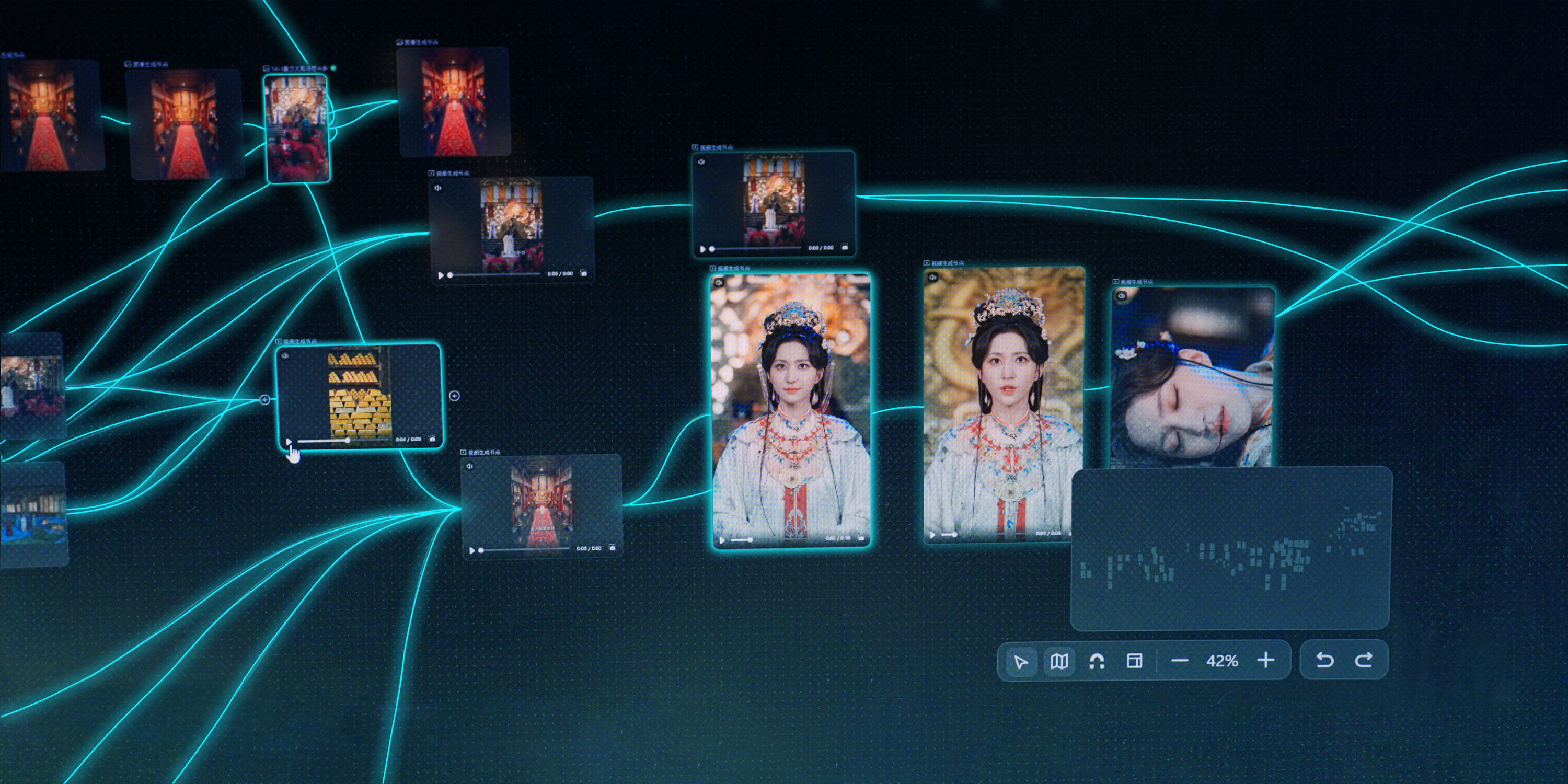
Today, as a technical director at Qidian Interactive, a new AI-video studio in Wuxi, eastern China, Chen is helping build a platform that can compress much of that accumulated expertise into a few prompts.
By last year, he said, AI video had improved enough to rival work that took him days. Then ByteDance’s text-to-video model Seedance 2.0 arrived, making it much easier to generate studio-grade footage, prompting his company to move more aggressively into AI, and put Chen on a project to create their own model.
“I don’t like AI, but I was forced to use it,” Chen tells Sixth Tone. “When I realized one click could sometimes produce something better than two or three days of work, I had to use it.”
The company calls the system Yudian. Chen began building it in April, drawing on programming skills he had taught himself years earlier to automate repetitive VFX work. He produced the first version in about a month.
It can suggest a premise based on trending topics from social media, draft dialogue, create storyboards, arrange characters and objects in three-dimensional space, and assess whether an ending has a strong enough cliffhanger to keep viewers watching.
The goal, one Qidian executive says, is for every employee to be able to make a drama independently.
Auto play
But first, lighting artists, animators, and cinematographers are needed to translate their craft into instructions for the Yudian machine.
Inside Qidian’s production hub, rows of employees sit at brand-new computers behind glass walls, some working across multiple monitors. Team leaders sit alongside their members, while directors occupy small rooms at the far end.
On one screen, a production prompt reads:
“45-60 seconds. Setting: watch repair shop. Barton lunges for the pocket watch as Eliza twists her wrist and shatters its central gear. The action should be extremely fast and explosive, giving the audience no time to breathe.”
It specifies an Arri Alexa 65 IMAX camera, Panavision Primo V/C/T lenses, cinematic lighting and camera movement, no music or subtitles, practical light sources, and smooth continuity.
“Shot 1, 45-48 seconds. Medium shot. 35mm lens. Length: 3 seconds. Barton roars “like a crazed beast,” lunges forward, and reaches for the watch.”
Another screen displays a digital prop room of sorts: characters, locations, objects, and lighting setups that can be reused across future scenes and productions.
Nearby, artists are testing several costumes for the female lead of a romance drama aimed at overseas audiences. They refine her through prompts such as “simulate natural daylight,” “increase skin texture,” and “preserve natural imperfections” to make her look less artificial.
Over the past year, similar AI production studios have proliferated across China, while established film and television companies have opened AI divisions or shifted existing teams into AI production. In some cities, local governments are accelerating the shift with computing-power subsidies and other support.
On the day Sixth Tone visited Qidian, Chen Hao had just updated a plug-in for the new AI platform that lets users position characters and objects in three-dimensional space, giving the model a clearer map of where each belongs within a shot.
Typing a single word — “script” — into the system produces an outline within seconds, generated from recent viral online trends and popular dramas. A team leader checks the output before the system moves on to dialogue and storyboards.
One chat box is used to develop a character. In another, a shot is divided second by second, its prompt altered until the movement or composition works. On more demanding projects, teams may spend hours or days refining what the model produced almost instantly.
A separate model assesses the project across more than 10 criteria: Was the cliffhanger strong enough? Did the emotions build at the right pace? Were scenes being used efficiently? Could any of it run into content-review problems?
“The goal is to shorten the learning curve,” says Chen Jie, a project director at Qidian, not related to Chen Hao. “We are trying to make production faster internally so we can stay profitable even as prices keep falling.”
Like Chen Hao, much of the team behind Yudian came from traditional visual production: lighting artists, animators, key-frame artists, and cinematographers whose craft now lives partly in the platform’s prompts, workflows, and presets.
One of those veterans is Ma Shuan, a lighting artist who spent nearly two decades in film production and worked on visual effects for movies including the science-fiction blockbuster “The Wandering Earth.”
At Qidian, Ma now uses AI partly to repair live-action footage. In one scene set on an ancient battlefield, modern concrete structures had slipped into the background. In another, crew members’ hands holding arrows needed to disappear, leaving the arrows suspended beside an actor’s face before they shot forward.
Some of the cleanup Ma once did frame by frame can now be finished in about half a day instead of two or three, he says. Other jobs, including some background fixes, are still faster with conventional tools.
“To me, AI is only an assistant,” Ma says. “Traditional production is controllable. If I want to change something, I can. With AI, every generated result is a gamble.”
Take two
Across the industry, that gamble is known as “drawing cards.” Some studios even employ dedicated “card operators” whose job is to generate shot after shot until one works.
Huang, 26, who works at a Shanghai production company, spends much of her day generating the same shot three to five times before getting a usable result.
Each attempt may take only a few minutes, but during the afternoon rush, when demand on the system peaks, the wait can stretch to 10 or 20 minutes. Then Huang checks the result and decides whether to generate it again.
“For instance, a sofa that appears as a single-seater in one shot may return as a two-seater in the next,” says Huang, who asked to be identified only by her surname for privacy reasons. “Or leather upholstery may suddenly become fabric.”
For shots that need greater consistency, Huang and her colleagues give the model reference images, then generate again. “You never know what you’ll get, so it becomes a little addictive,” says Huang. “I think the fun is never knowing when the AI will suddenly cooperate and give you a whole take that works. You just keep repeating the process.”
Until recently, both Huang and the company worked mainly in live action. Founded in 2014, the studio produced web series and films before it began experimenting with AI short dramas late last year.
Huang now works entirely on AI dramas for overseas audiences, moving between story planning, directing, generation, and editing.
On live-action sets, Huang says, actors bring their own understanding of a scene, while cinematographers might improvise a camera movement. “It was still a collective creative process.”
“But with AI, the density of decisions becomes much higher. Almost every creative decision is made by just one or two people. Even the actors’ performances are completely under your control, so those pleasant surprises almost disappear.”
Back at Qidian, dramas still need a team, too.
A typical production moves through three small groups. One builds characters and settings, another generates the footage, and a third edits it together, with one or two people at each stage. A team leader — usually someone with more experience in film, animation, or advertising — reviews the work throughout and decides what needs another pass.
The company’s Wuxi production base opened only in April. Within a month, it had recruited more than 50 employees, nearly half of them recent graduates. By June, the studio was producing four or five short dramas a day, each comprising 30 to 44 episodes.
For Qidian founder Wang Ting, one shelved project became an early test of what AI could make possible. Drawing on Wuxi’s traditional Huishan clay figurines, the project follows two characters, A Xi and A Fu, through a fantasy adventure set among local landmarks. It had already cleared China’s broadcasting regulator, but the original plan called for three years of work and a budget of 8 million to 10 million yuan ($1.19 million to $1.49 million). Qidian shelved it.
Using AI, Wang says, Qidian eventually finished the project in two months for around 1 million yuan. “This shows how traditional filmmaking — from shooting and editing to visual effects production — can now be replaced,” she says.
Qidian now uses the same workflow for work far beyond short dramas. During Sixth Tone’s visit, one team was making a Dragon Boat Festival promotional video for a local government, generating scenes of racers paddling across the water. Other teams handle corporate advertisements or use AI to repair and supplement live-action footage.
For one electric-vehicle campaign, the car itself never had to enter the studio. “We simply tell the AI what kind of vehicle we want and what actions it should perform,” says Chen Jie. “And a promotional video can be generated almost instantly.” The next generation
The faster Qidian generates footage, the more Chen Jie has to review. In the past, he might review 20 shots in a week. Now he goes through dozens — sometimes hundreds — every day.
“It’s exhausting because the videos are generated so quickly,” he says. “I’m almost numb to it now.”
AI-generated characters can still look “oily,” he adds, while fine details often fall apart when he freezes a single frame. “The quality isn’t terrible, but it still hasn’t reached the standard of traditional filmmaking.”
Yet what all that speed ultimately buys is less clear.
On one earlier job, Chen Jie spent weeks perfecting the opening few dozen seconds of a promotional video for a major game company. When he later checked it, the video had received 48,000 likes.
“It was promoted by a big company, and it still only got this much attention. What’s the point?” He s, then answers himself: “None.”
“I still have things I want to pursue,” he says. “But my pursuit now is simply to deliver what the client is paying for. That’s all.”
When he started using AI, Chen says, everything he created looked terrible. “Later I realized we have to adapt to it. You can’t fight against the model,” he says. “You have to work within its strengths, compromise with its limitations, and gradually learn how to control it.”
Younger workers have often adapted more quickly. Wang Zheng, who graduated this year in advertising and art design, already leads a small team working on AI-generated videos, character assets, and scene design.
A teacher encouraged him to enter the AI industry, while most students who graduated before him went into traditional advertising. “The training I received still helps,” Wang says. “It taught me visual logic and developed my sense of aesthetics.”
AI, he adds, has given him more freedom to pursue ideas that would once have been difficult to realize. While waiting for the model to finish generating footage, he experiments with projects of his own.
“My dream is to become an AI film director,” says Wang. “I want to create a complete feature film entirely from my own ideas using AI.”
Qidian is already planning an AI feature film of its own, hoping to build a reputation beyond commissioned work.
Feature films, however, are also where Chen Hao still sees limits to replacement. He has friends working on complex visual effects for major productions, where demanding standards for quality and stability still make much of the work difficult to hand over to AI.
Some of Chen’s peers have no intention of following him into AI, even if those technical barriers fall. “One of my friends told me that if visual effects disappear in the future, he’d rather become a livestream dancer than work in AI,” Chen says with a laugh.
He understands the resistance, but believes that if a single sentence can eventually generate 10 — or even 90 minutes — of finished video, many of the jobs that now make up a production may simply no longer be needed.
Through the studio’s glass walls, Chen watches young employees working on Yudian — the AI platform he helped build — some typing prompts, others retouching AI-generated faces in Photoshop.
Qidian now plans to license Yudian to other studios.
“One day it might replace me as well,” Chen says.
He s.
“But you still can’t afford not to do it.”
Additional reporting: Lü Xiao; editor: Apurva. (Header image: Yudian, a system built by Chen Hao, generates story ideas, dialogue and storyboards, and simulates multi-camera setups in 3D space in Wuxi, Jiangsu province, June 2026. Reedited by Ding Yining; photo by Lü Xiao/Sixth Tone)