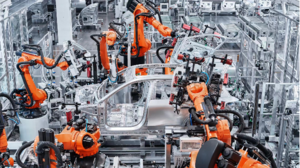
NIO's Hefei plant combines near-total automation with AI-driven production, zero-inventory manufacturing
HEFEI, China — On the body assembly line of NIO’s F2 electric vehicle plant in Hefei, China, there are no people.
Only the sharp hum of machinery and the synchronized choreography of orange robotic arms fill the vast space.
German-based KUKA robots converge on an aluminum vehicle body: One lifts a door into place, a second one measures alignment through sensors, while others complete the welding process in seconds.
Human hands never touch the process. In this 100 percent automated process, where 941 robots orchestrate every movement, NIO EVs roll off the line at a rate of “one car every minute.”
But what is striking is not the automation itself. Robot-dominated body assembly lines have become increasingly common among major global automakers.
The real breakthrough lies in its agility: turning a rigid automated production system into one flexible enough to handle millions of potential vehicle configurations, with different models and specifications moving through the factory in without disrupting the flow.
Smart factory testbed
NIO is among a new generation of EV-makers that have applied the smart factory concept from the outset, rather than adapting legacy production systems.
According to Yang Yi, head of NIO House exhibition center, who recently guided Korean journalists through the facility, nearly 90 kilometers of electrical and data cabling were laid beneath the F2 plant before construction even began, creating a 100-gigabit high-speed network backbone.
The system collects information from across the factory, generating about 1.5 terabytes of data a day and feeding it into an AI-driven platform that continuously optimizes operations.
NIO’s Hefei manufacturing complex is being built in three phases. The F2 plant began mass production in 2022, while a second one is under construction. Each is designed to produce 300,000 vehicles annually, with the third phase is for expansion.
The F2 plant, the EV maker’s first smart factory testbed, integrates four production processes — pressing, body construction, painting and general assembly — and achieves an overall automation rate of 98 percent and a 95 percent yield rate. This brings the human-to-robot ratio to nearly 1-to-1, with 1,500-2,000 employees working alongside 1,300 manufacturing robots and 500 autonomous mobile robots.
To boost production efficiency, NIO adopts the “Island production method,” replacing conveyor belts with a fleet of autonomous rovers that transport vehicles and components between workstations. The company says this flexible layout uses space more efficiently, supports multi-model production and reduces bottlenecks.
Minimizing inventory
Even with highly sophisticated automation, human workers are essential for quality checks and precision refinishing, performing tactile inspections and manually polishing out surface defects.
But these defects are often flagged by automated camera scans, and employees also rely on smart digital tools to cross-reference vehicle specifications and prevent assembly errors.
Now, NIO is rapidly steering the inspection process toward full automation with a new AI-powered quality control system.
“Once a vehicle enters the final quality testing area, it can perform a self-diagnostic of more than 1,000 system functions,” said Yang. “After completing the inspection, the vehicle can autonomously drive itself to a designated location without a human driver, streamlining the final stages of quality control.”
NIO employs a "zero-inventory" production model, where its AI system analyzes data and optimizes factory operations. After a customer places an online order from more than 300 vehicle configurations across 11 EV models, production begins immediately, allowing the company to deliver the vehicle within 10 days.
Yang noted, “Our ultimate goal is to evolve this infrastructure to a point where AI can independently make real-time production line decisions.”
Battery swaps
The cornerstone of NIO’s business strategy is its battery-as-a-service subscription model. As the battery pack accounts for up to 40 percent of an EV’s total cost, setting this apart from the initial purchase significantly lowers the vehicle’s upfront price, while addressing concerns over long-term battery degradation.
NIO’s battery-swapping stations can replace a depleted battery pack for a fresh one in less than “three minutes” without requiring on-site staff. Because these battery packs are built to a standardized format, drivers can enjoy the flexibility of temporarily upgrading to higher-capacity packs for long-distance travel.
The company also operates an extensive charging network, sharing more than 86 percent with other EV brands. However, NIO expects battery swapping to become the preferred option for many users, rather than conventional charging.
Currently, NIO operates with a global workforce of 30,000 to 40,000 employees, including about 11,000 R&D staff. Headquartered in Shanghai with its main manufacturing base in Hefei, the company is expanding across Europe and Southeast Asia, most recently launching its vehicles in Thailand.
NIO has three distinct sub-brands: the flagship NIO (Weilai), Onvo (Letao) and Firefly. Onvo focuses on family-oriented premium EVs, while NIO and Firefly target the luxury and compact-car segments, respectively.
hyejin2@heraldcorp.com