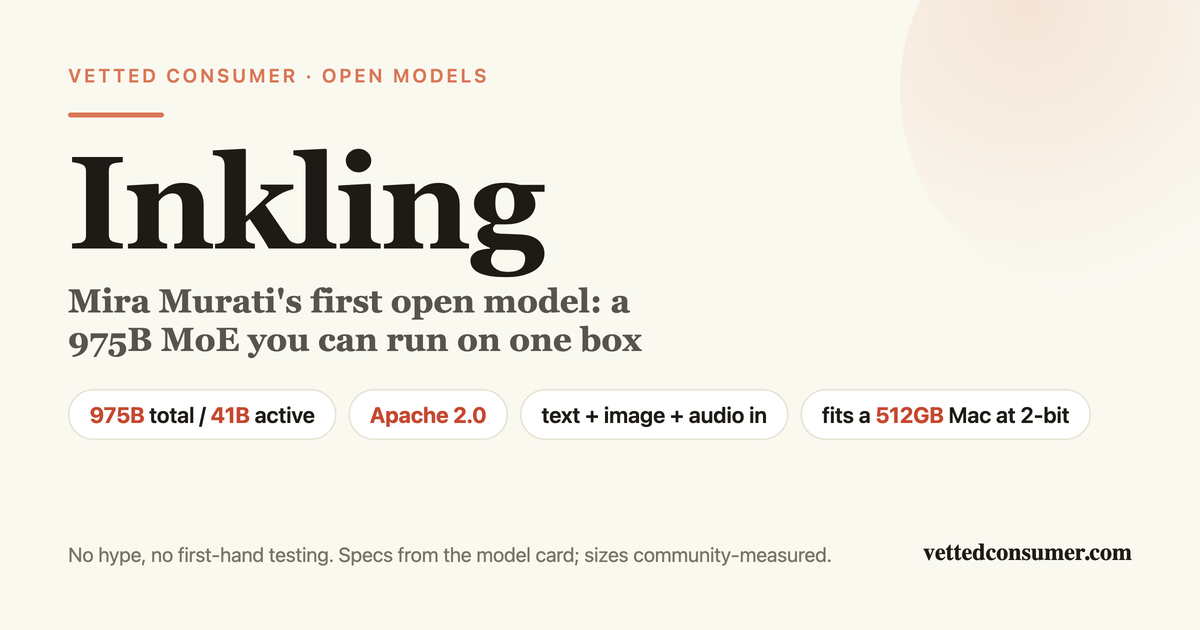
Two weeks after Kimi K3 gave us the largest open model ever and a wall no desktop could climb, Thinking Machines Lab, the startup founded by former OpenAI CTO Mira Murati, shipped its first open model, and took the opposite tack. Inkling is a 975-billion-parameter Mixture-of-Experts released July 15, 2026, and unlike K3 the weights are already on Hugging Face under Apache 2.0. At roughly a third of K3's size, it is the first frontier-class open model in a while that a single well-specced box can hold.
We have not run it first-hand. What follows is built from Thinking Machines' own model card and Hugging Face repos, the one independent eval published so far, and the community quant work that already exists. Everything is sourced at the end.
What Thinking Machines says Inkling is #
| Spec | Inkling (from the model card) |
|---|---|
| Parameters | 975B total, 41B active per token (MoE) |
| Architecture | 66-layer decoder-only transformer; 256 routed + 2 shared experts, 6 routed active per token; hybrid local/global attention |
| Context | Up to 1,000,000 tokens |
| Modalities | Text, image, and audio in; text out (trained across text/image/audio/video) |
| Special | Controllable "thinking effort" (trade reasoning depth for speed) |
| License | Apache 2.0 |
| Training | 45 trillion tokens |
| Weights | Live now: BF16 (~1.9TB) and a native NVFP4 checkpoint (~592GB) on Hugging Face | A few of those lines matter more than the rest. The 41B active count is the one that decides local speed, since generation only reads the experts that fire, as we cover in our MoE explainer. The Apache 2.0 license is unusually permissive for a model this capable. And one correction worth making, because the press blurred it: Inkling was trained across text, image, audio, and video, but its documented inference inputs are text, image, and audio, not video, and it outputs text only. Its audio is a genuine standout, among the strongest of any open-weights model.
There is also a smaller sibling in preview, Inkling-Small at 276B total / 12B active, but its weights are not out yet. For now, the 975B flagship is the only downloadable one.
The benchmarks: one independent number, one vendor table #
The trustworthy figure is the independent one. Artificial Analysis scored Inkling 41 on its Intelligence Index, 10th of 97 models, and called it the leading U.S. open-weights model, ahead of NVIDIA's Nemotron 3 Ultra and well ahead of gpt-oss-120b. The scope matters: Artificial Analysis also notes the top Chinese open models still lead several coding and reasoning tests, so "leading" means leading among U.S. open weights, not the open field outright.
Thinking Machines' own table is a vendor self-report and should be read as claims: 97.1% on AIME 2026, 87.2% GPQA Diamond, 77.6% SWE-bench Verified, and strong multimodal and audio rows (91.4% VoiceBench). Its own positioning is refreshingly modest, it places Inkling roughly "between Kimi K2.5 and K2.6," beating Nemotron on several evals but trailing the best Chinese open models like GLM-5.2 and Kimi K2.6 on some coding and reasoning. A separate blinded human eval (Design Arena's web-dev arena) put it at 1257 Elo, top of the open-weights tier, below Claude Sonnet 5 and Fable 5 but above Kimi K2.6. There is no LMArena text ranking yet, so we will not claim one.
What is genuinely new here #
Three things make Inkling worth a local runner's attention beyond the leaderboard.
Controllable thinking effort. You set a reasoning budget in the system message (roughly 0.0 to 0.99). Thinking Machines claims it can match Nemotron 3 Ultra on Terminal Bench using about a third of the tokens by dialing effort down, which for a self-hoster is a direct lever on both speed and electricity.
NVFP4-native weights. Alongside the BF16 checkpoint, Thinking Machines published a native NVFP4 build, a 4-bit-class format aimed at NVIDIA Blackwell. Like K3's MXFP4 training, this means 4-bit is the model's home precision rather than a lossy afterthought, which is exactly the tier a self-hoster cares about.
Strong open audio plus a stated design goal around censorship. Native audio input this good is rare in open weights, and Thinking Machines explicitly pitched Inkling as resistant to unnecessary political restriction (while still refusing weapons, cyber-abuse, and manipulation categories). The overall framing is telling: they call it "a good open-weights base for customization," not the strongest model outright. Apache 2.0 plus fine-tuning on their Tinker platform is the actual product.
What the community has found (three days in) #
The weights being open changes what we can check, but Inkling is new enough that the picture is half-formed. Quants already exist: Unsloth has a full GGUF ladder down to a 1-bit build, and there are early MLX ports. What does not exist yet is real owner data: llama.cpp support is still an unmerged draft PR, and the r/LocalLLaMA release thread is full of "I'll try it on my Strix Halo" intent rather than measured runs. So we are not going to quote a tokens-per-second number for consumer hardware, because none has been credibly measured yet. The provider figures floating around (hundreds of tokens per second) are all datacenter GB200/B200 numbers, not what your rig will do.
The part that surprises people: you can run it #
Because Inkling's 975B total sits just under Kimi K2's 1T, its real GGUF sizes track K2 almost exactly: about 317GB at a 2-bit quant, 587GB at 4-bit, per Unsloth's measured table. That is the reversal from K3. A heavy 2-to-3-bit Inkling build fits inside a single 512GB Mac Studio, or a 2-to-4x RTX 3090 rig with a big pile of system RAM. We break down every tier, the memory math, and the speed reality in the companion piece: What hardware runs Inkling. Want to know if your machine is in range? Run it through our Can I run it? calculator and grab the right quant with the quant picker.
Is it worth down? #
If you want the single strongest open model on paper, Kimi K2.6 and GLM-5.2 still edge Inkling on parts of the coding and reasoning suite. But Inkling is the more interesting release for a local runner: it is Apache 2.0, genuinely multimodal with best-in-class open audio, tunable on the fly via thinking effort, shipped with a native 4-bit checkpoint, and, crucially, small enough to run on one high-memory box. As a customizable base you own outright, it is the most download-worthy frontier open model since K2. And if the flagship is still too heavy for your hardware, the 276B Inkling-Small on the way is the one to watch.
Sources and how we researched this #
- Specs, license, benchmarks, and design goals: Thinking Machines Lab's Inkling announcementandmodel card, plus theHugging Face repo(Apache 2.0 confirmed, BF16 andNVFP4checkpoints). - Independent evaluation: Artificial Analysis(Intelligence Index 41, 10th of 97). - Community quants: Unsloth GGUF(measured sizes). llama.cpp support is an unmergeddraft PRas of writing. - Reporting: TechCrunch,VentureBeat. - We have not run Inkling first-hand; figures are vendor-stated, independently measured (Artificial Analysis), or from community quant repos, cited inline. No consumer tokens-per-second numbers exist yet.
*Related: What hardware runs Inkling · Kimi K3, the un-runnable giant · MiniMax M3, the other open multimodal frontier model · *Why active parameters decide speed