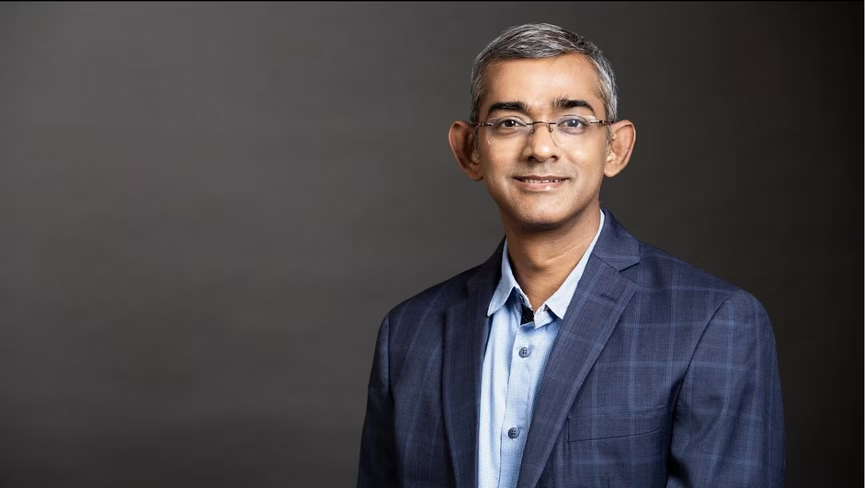
Hyderabad cybercrime police have filed a report against Meta India chief Arun Srinivas over AI-altered videos of Prime Minister Narendra Modi, escalating friction between the government and the platform.
Police in Hyderabad have registered a criminal case against Meta’s India head over AI-altered videos of Prime Minister Narendra Modi that circulated on Facebook and Instagram, escalating a long-running friction between the government and the platform.
The first information report, filed on 31 July, names Arun Srinivas, Meta’s India chief, and comes weeks after New Delhi summoned Meta over content on its apps.
The complaint centres on manipulated media. Two Instagram users told the city’s cybercrime police they had come across several digitally altered videos and images of Modi that they described as misleading, derogatory, and obscene.
The videos had a political backdrop. They spread after a student protest at Delhi’s Jantar Mantar, organised by a group calling itself the Cockroach Janta Party, part of a wave of unrest that has rattled the government.
Police are examining serious provisions. Investigators said they are looking at possible violations under the Bharatiya Nyaya Sanhita, India’s new criminal code, and the Information Technology Act.
The case is still at an early stage. The report notes the investigation is preliminary and that no conclusions have been reached, but naming a senior executive in an FIR is itself a significant step.
Meta has moved to reassure the government. The company said it would tighten oversight of prominent accounts, requiring at least two senior staff to review before acting on such posts, a concession aimed at cooling the row.
The friction did not start here. India’s IT ministry recently summoned Meta executives and asked for an explanation “at the highest level” after a Modi post was briefly restricted, which the company blamed on an inadvertent block.
The rules were built with companies like Meta in mind. India’s content-policing regime was designed to bear down on the largest platforms, and the government has grown increasingly assertive about how they handle material involving the prime minister.
The student protests sharpen the stakes. The unrest recently forced an education minister to resign and prompted Modi’s first public comment on the turmoil, making anything touching his image politically charged.
India is a vast and sensitive market for Meta. The country is among its largest by users, which gives New Delhi unusual leverage and makes the company wary of being seen to defy the authorities.
The legal exposure is real but uncertain. Reports against tech executives in India often function as pressure tactics and do not always lead to charges, yet they carry the threat of summonses, travel curbs, and prolonged scrutiny.
There is precedent for the tactic. Indian authorities have previously opened cases against and summoned executives from platforms including X over content disputes, using individual liability as leverage over companies headquartered abroad.
Deepfakes have become a policy flashpoint. India has wrestled for years with how to regulate synthetic media, and officials have at times blurred the line between deepfakes and ordinary fake news.
The framework is still hardening. The country has built out an expanding regime for policing social media and streaming platforms, and manipulated political content sits awkwardly between free expression and defamation.
For Meta, the episode is a familiar bind. It is caught between users posting protected, if unflattering, political content and a government that treats derogatory Modi material as a law-and-order matter. The company’s calculus is delicate. Removing too much invites accusations of censorship, while removing too little invites cases like this one, and there is little room to satisfy both sides at once.
What happens next will be watched closely. Whether the Hyderabad case advances or fades, it signals that India is willing to reach for criminal law, and for named executives, when it wants platforms to police content about its leader.
Get the TNW newsletter #
Get the most important tech news in your inbox each week.