Almost 2,000 years ago, Mount Vesuvius devastated the Roman city of Pompeii and its neighboring town, Herculaneum. Miraculously, however, a library of ancient scrolls at Herculaneum survived—in a carbonized form so fragile that scholars dared not touch it. But scientists found a workaround, as they typically tend to do.
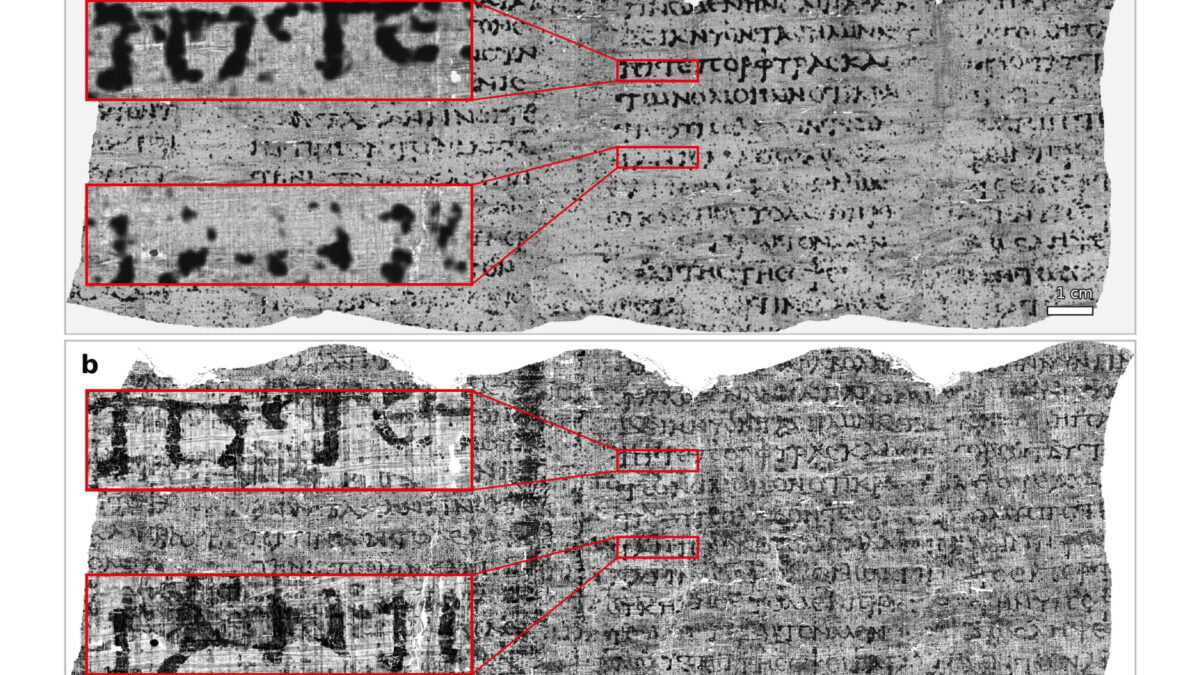
In a first, researchers succeeded in virtually unwrapping and deciphering “PHerc. 1667″—roughly 4.6 feet (1.4 meters) of papyrus and 22 columns of Greek. The findings, reported in a preprint, represent a milestone of the Vesuvius Challenge. The challenge is a global competition calling for all and any qualified teams to use machine learning, computer vision, and geometry to retrieve valuable information from the carbonized Herculaneum scrolls.
“Just a year ago it would have been crazy for any of us to believe that there would be a complete scroll read completely non-invasively with hundreds of columns of text,” Brent Seales, project co-founder and a computer scientist at the University of Kentucky, said in a press conference on the milestone. “And today, we showed you that that has happened.”
The sealed lump #
The Villa of the Papyri in Herculaneum was first discovered in the 18th century. But it was only in 2015 that Seales and his colleagues used X-ray tomography and computer vision to demonstrate that it was possible to recover information from the charred scrolls without having to pry them open.
And that revelation led to the Vesuvius Challenge, which kicked off in 2023. The challenge has led to a steady and impressive flow of discoveries and new approaches. The amalgam of knowledge and experience allowed researchers to come ever closer to reading the ancient scrolls, which the challenge hosts have said “has kept a cruel bargain” for almost 2,000 years.
Unlocking the lump #
The team behind the findings first scanned PHerc. 1667 with high-resolution X-rays at the European Synchrotron Radiation Facility. Then, the researchers reconstructed the scroll into a flat, readable surface. Finally, a machine learning program helped refine the visible traces of ink. As the team noted in the preprint, these models are “used as visibility amplifiers for expert inspection, not as autonomous reading systems.” In other words, it was then up to the papyrologists to transcribe and decipher what they were looking at.
And according to these papyrologists, the text seems to be a philosophical treatise on ethics, specifically a Stoic work. For instance, there is reference to Aristocreon, an ancient scholar and the nephew of Chrysippus, a renowned Stoic philosopher. But other passages (all available in the open-access preprint) also discuss Stoic themes on human nature, impulse, and the moral progress of human beings, the team said in the announcement.
“These unopened Herculaneum Scrolls look like dead books, but they’re not,” Federica Nicolardi, a papyrologist at the University of Naples Federico II in Italy involved in the latest work, told The Guardian. “They’re starting to speak again.”