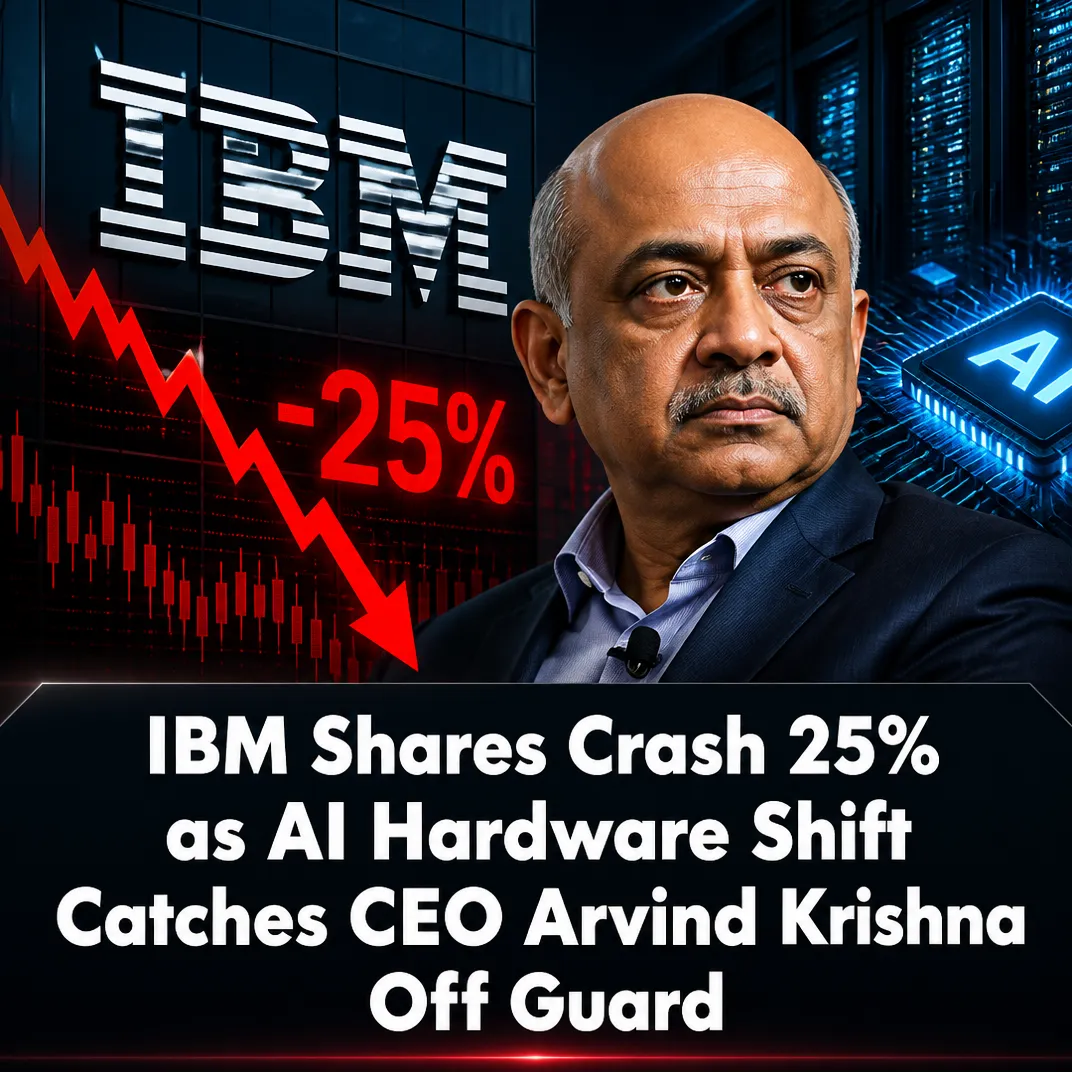
July 15, 2026, (Inside AI) — IBM shares plunged 25% on July 14 after CEO Arvind Krishna warned that the company failed to adapt quickly enough to a rapid shift in customer spending from software to hardware like chips and servers. The tech giant forecast second-quarter revenue of just $17.2 billion, a mere 1% increase year-over-year—its slowest growth since early 2025.
The miss underscores a painful reality: IBM’s ambitious pivot to artificial intelligence is colliding with a market that is moving faster than its legacy business model can handle. In a candid letter to employees, Krishna admitted the company misjudged the pace of change.
"We did not adapt and move quickly enough, and numerous large deals failed to close on the timelines we expected, driving the majority of our shortfall," he wrote.
The warning sent shockwaves through the tech sector, raising questions about whether other established firms can keep up with the AI-driven hardware boom. IBM’s struggles highlight a fundamental tension: the shift from selling long-term software contracts to meeting immediate demand for AI infrastructure is reshaping the industry’s economics.
The Hardware Grab: Why IBM’s Software Strengths Became a Liability #
For years, IBM bet heavily on hybrid cloud and AI software, acquiring Red Hat for $34 billion in 2019. But the generative AI frenzy has flipped priorities. Enterprises are now pouring budgets into graphics processing units, high-bandwidth memory, and specialized servers to train large language models—often at the expense of software licenses. IBM’s mainframe and server businesses saw some tailwinds, but not enough to offset the software shortfall. The company’s consulting arm, which helps clients deploy AI, also faced delays as customers reallocated funds to hardware purchases first. This mismatch left IBM caught between its legacy strengths and the new reality.
Analysts note that rivals like Dell and HPE have been quicker to capitalize on AI server demand, while cloud giants like Microsoft and Amazon are integrating AI directly into their platforms, squeezing IBM’s middleware value proposition. Krishna’s letter signals a strategic misstep: IBM underestimated how quickly corporations would prioritize raw compute over software tools.
Echoes of Past Transformations: Can IBM Rewire Again? #
This is not IBM’s first existential pivot. The company famously shifted from hardware to services in the 1990s under Lou Gerstner, then to cloud and AI under previous CEOs. But the current transition is uniquely challenging because it requires excelling in both high-margin software and capital-intensive hardware simultaneously.
Krishna, an engineer by training, has pushed to streamline operations, including job cuts and divestitures. Yet the speed of the AI infrastructure buildout has outpaced internal restructuring. The 25% stock drop reflects investor fears that IBM’s turnaround may take years—and that the AI opportunity could benefit nimbler players more.
Competing viewpoints emerge from industry observers. Some argue IBM’s deep enterprise relationships and hybrid cloud expertise will eventually pay off as AI moves from training to inference at the edge. Others point to the company’s missed chance in public cloud a decade ago as a cautionary tale. The current hardware cycle may not wait for IBM to catch up.
The revenue warning also casts a shadow over other legacy tech firms attempting AI transformations. SAP, Oracle, and even Cisco face similar pressures to realign product portfolios toward AI infrastructure while maintaining software revenue streams. IBM’s stumble suggests the transition is more treacherous than many assume.
Looking ahead, IBM plans to accelerate its own AI hardware offerings, including the recently announced Telum II processor and Spyre accelerator for AI workloads. But these products are still ramping up, and competition from Nvidia’s dominant GPU ecosystem remains fierce. Krishna’s ability to execute on this hardware push will determine whether the current setback is a temporary blip or a deeper structural decline.
The broader lesson: the generative AI boom is not lifting all boats equally. As spending concentrates on chips and servers, software-centric firms must adapt faster or risk being left behind. For IBM, the fire is real, and the clock is ticking.