A Pi Durable talk sent me back to Elixir and OTP. Six days later I released H and was steering the same coding sessions from my phone on the way to Thailand.
- Published
- Reading time
- 7 min read
- Series
- Show and tell
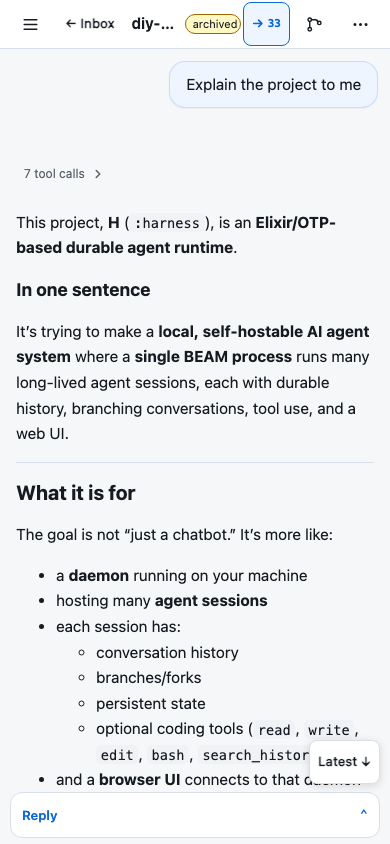
On my way to Thailand, with time to kill before airport security, I opened my phone and went back to work on my coding harness. The phone was on my VPN. In the browser I could pick up a session, look at what the agent had changed, and tell it what to do next. I could have opened SSH and used a terminal. For this, I preferred the browser. Reading a conversation, checking a file, and attaching a screenshot are better phone interactions than trying to give a terminal more of my screen.
The harness is H, an open-source Elixir/OTP daemon that owns coding-agent sessions. hi is its Rust terminal client; I call the Phoenix LiveView client hiweb. Both can open the same conversation, and work continues on the host when I close either client. I’ve switched from Pi to using these two. The first public release, v0.1.0, is out.
Pi Durable #
I had been using Pi all day. My old setup with tmux and worktrees worked because a conversation stayed with a project and I could return to it after doing something else. Then I watched Mario Zechner explain Pi Durable. The question that stuck with me was what happens if the process itself goes away, not merely the terminal displaying it.
Pi Durable already had the distinction I wanted. Save the intent before calling a tool. Save the outcome afterward. If the process dies in between, the answer depends on what the tool does. I asked the model to compare H’s plan against Zechner’s talks and writing, then check what Elixir and OTP already gave us. I wanted to borrow the design decisions that held up, not reproduce the TypeScript architecture module for module.
The experiment I wanted to run was small. Could one BEAM VM host a separate coordinator for each active session, supervise its workers, and recover the session from a local store? By the end of the evening I had a history model that could branch and a durable session runtime. The first history commit and the coordinator commit are 54 minutes apart. That measures those two commits, not all the thinking before the first one. The following day, the terminal and Phoenix clients were talking to the same daemon. Six days after the first commit, there was a public release with a Mac app and Linux bundles. I still find that an incredible turnaround.
The rules I gave the agent #
My first target was self-hosting. I wanted the early browser client to be usable enough to work on H itself. In the initial session I wrote, “If we can do without a database dependency like SQLite, this would be even better for now.” The store still needed an interface. It just didn’t need a database dependency to prove the first version. H’s file backend writes checksummed commit frames and snapshots. After a restart it can load the snapshot, apply later complete commits, and discard a torn final frame.
I also asked why the proposed transport was HTTP with server-sent events instead of WebSockets or Phoenix PubSub. The split we ended up with let each client use what made sense. In the bundled app, Phoenix calls the daemon in the same VM. The Rust terminal client sends JSON requests and subscribes to updates over SSE. Neither client owns the session. Writing the terminal client in Elixir wasn’t a condition of using Elixir where I wanted it most.
Later, while working in H, I caught myself using poll loops to wait for work in another session. I wrote, “Ok, this then should ideally use a signal and not polling.” A child session can now notify the parent when its submission settles. The parent’s waiting state lives in the coordinator, without a tool worker sitting around to check whether the child is done. I still use separate Git worktrees for parallel changes. Remembering who asked for a piece of work doesn’t make two edits to the same file compatible.
Recovery and branching #
One design rule in AGENTS.md is worth keeping verbatim: “Supervision is not persistence.” A supervisor can restart a worker. It can’t tell whether that worker wrote a file before it died. H commits intent before dispatch and the outcome when it has one. After a crash, it can try an interrupted read again. An interrupted bash call is reported as interrupted rather than run a second time on the assumption that nothing happened. If the command might have changed a file, I can inspect the checkout before deciding what to do. The architecture notes link to the storage, tool recovery, and VM restart tests.
Branching a conversation solves a different problem. Say I’ve asked the agent to propose changing a parser to return nil for an invalid date. I can fork from that point and ask what an explicit error tuple would mean for callers. The new conversation refers to the existing history up to the fork point. It doesn’t duplicate the prefix or rewind the Git checkout. If I want both versions implemented side by side, they still need separate worktrees.
This is where using models to write Elixir surprised me. I could explain who should own a transition and what must survive a crash. I rarely had to spell out how to put the short-lived work under a task supervisor. OTP gave us a vocabulary the models already understood. I still had to review the recovery semantics, especially where the filesystem or a provider was involved. Those decisions didn’t become correct just because the modules compiled.
Trying H #
The release page has the signed downloads for Apple Silicon and Linux. On a Mac, open the DMG and drag H.app into Applications. The app carries its own BEAM runtime, starts the local daemon, and opens the web workbench. The menu-bar app can put hi on your PATH. Once the daemon is running, try these from a project directory:
hi login                    # Set up a Codex account, if that's your provider
hi                          # Open a coding session
hi inbox                    # Find sessions across workspaces
An installer isn’t the only way to use H. The engine is a Mix application named :harness that you can depend on from source without embedding either client. That range is one of my favorite things about Elixir. I could take KMS out of an umbrella and turn it into a standalone project, and here I can go the other way, borrowing the engine as a library or bundling the whole thing as an app.
The web workbench controls tools that have the host user’s permissions. It isn’t a sandbox or a public service. My phone reaches my own authenticated instance over my VPN. The browser is another way into that machine; it isn’t where the agent runs.
If you try H, I’d like to hear what you wish it did differently. There’s an extension example that registers a harness profile without calling a model or touching the workspace. I’d love to see what people do with their own profiles, extensions, and clients. Mine started because someone else explained his design well enough that I wanted to try an idea of my own.