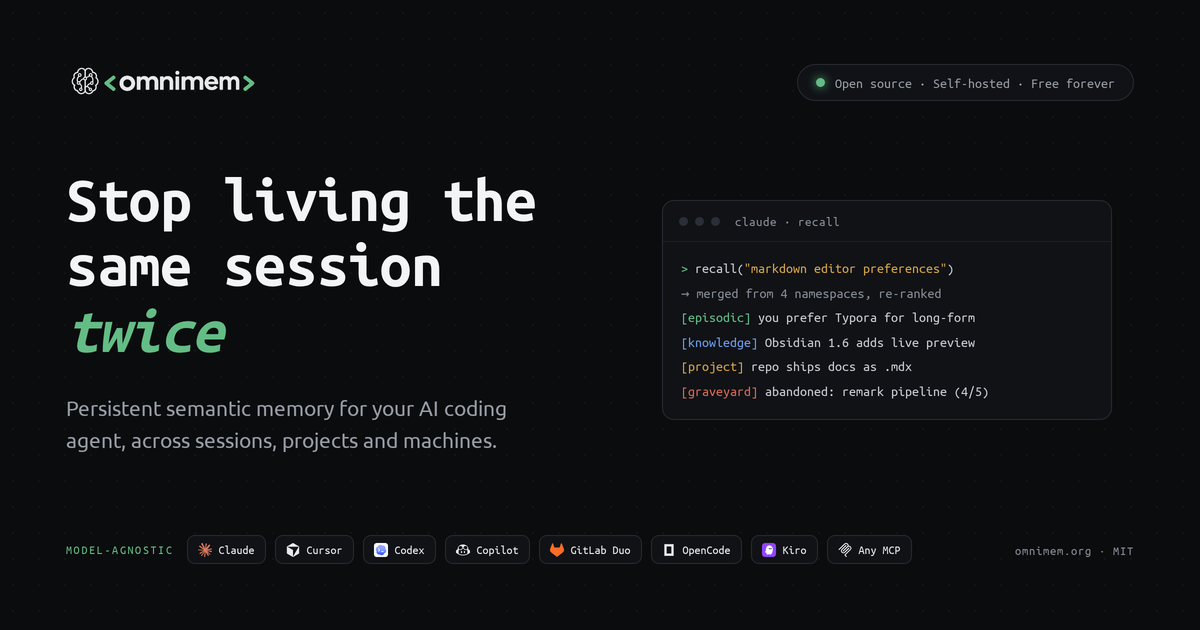
Stop living the same session twiceSelf-hosted memory for Claude Code and every MCP agent
OmniMem is an open-source MCP memory server that gives Claude Code, Codex, Cursor and any other MCP agent persistent memory across sessions, projects and machines. One app for your desktop or one binary on a server, everything on your own hardware and, yes, it's free.
Your AI agent doesn't know your project. It doesn't remember what failed last week. It has no idea you spent three hours last Tuesday figuring out why WebKitGTK quietly ignores a redirect from a custom URL scheme, only to find something that actually works.
So you explain everything again. It suggests the same broken library again. Same alarm, same song. It's Groundhog Day: you're Bill Murray, and your agent is Punxsutawney.
// without omnimem
claude>answer the settings form with a 303 redirect
... 45 minutes of debugging later ...
form submitted, window never moved (WebKitGTK, omnimem://)
You fixed this exact problem last Tuesday.
Claude doesn't know that.
// with omnimem
claude>answer the settings form with a 303 redirect
⚠ WARNING: previously abandoned approach
303 from omnimem://: WebKitGTK never follows it (effort 4/5)
→ answer with a page that replaces itself instead
Measured
Fewer tokens, smaller bills, less waiting
We gave Claude Code the same task twenty times on a fresh copy of the code: ten runs without OmniMem, ten with it. The task's TODO recommends a crate that fails at runtime, and only running the tests shows it. With OmniMem the earlier failure is already in memory, so the agent skips the dead end and gets on with the job.
Tokens
−26%
833k → 616k median tokens per run, fewer in 8 of 10 pairs.
without
OmniMem
Money
−26%
Median cost per run down by a quarter: $2.16 → $1.51 for all ten runs.
without
OmniMem
Time
−35%
Median wall time per run, because nobody spends a test run finding out the crate is broken.
without
OmniMem
Dead ends
0 of 10
Runs that walked into the known dead end, against 8 of 10 without. Red test runs went from 7 to 0.
without
OmniMem
OmniMem 7.0.12, Claude Haiku 4.5, one scenario and ten pairs, so treat the token saving as promising rather than proven (a sign test gives p = 0.05); the dead-end result doesn't depend on it. A dead end that takes longer to find would be worth more. Read the full report (PDF), which also covers contradictions, forgetting and project isolation.
See it in action
One recall() pulls context from everywhere
Personal preferences, ingested articles, past conversations, project context. It all gets ranked together and merged into one properly useful answer.
claude · recall
› what tools do we know about that are useful for writing markdown in?
-
BookStack (MIT, PHP): wiki with markdown supportknowledge
-
Wiki.js (AGPL-3.0, Node.js): wiki with markdown editor
-
Docmost (AGPL-3.0, Docker): Confluence alternative
CMS with markdown support:
- Sveltia CMS and DecapCMS: both work with Forgejo/Gitea backendsproject
That's the lot, pulled from your preferences, your articles, a repo you trained it on, and your project's own stack, all ranked together.
› nope that's great, you reminded me of exactly what I use
● Glad it worked well. OmniMem connected your preferences and past writing into one useful answer.
A real recall() about markdown editors. Every tagged line traces back to a different memory source (they're the four on the right).
[episodic]
Episodic memory
Picked up from your conversations: decisions, bugs, what you tried, and the things you mention in passing.
[knowledge]
Knowledge base
RSS articles, auto-summarised and embedded. They surface when relevant to what you're asking.
[preference]
Preferences
How you like to work, stated once and applied from then on: the editor you reach for, the licence you prefer, the way you want things written.
[project]
Project context
Extra context it knows matters to you, like your preferred tools and platforms.
What makes it different
Not just a key-value store with an MCP wrapper
OmniMem models how memory actually works. Things fade over time, they sometimes contradict each other, and the hard-won stuff earns its place.
The graveyard
Every dead end, kept on purpose
What you tried, why it failed, and how much time it burned. Your agent checks the graveyard before it reaches for a library or a pattern, so the same rabbit hole only costs you once.
A warning comes back with the way out attached: what was abandoned, and what worked instead.
warn_if_abandoned("global limiter") ✗ abandoned· effort 4 · 6 tries → use one limiter per shard instead
recall()
One call. Ranked by similarity, lifecycle, age and what it cost you to learn.
48
MCP tools
Remember, recall, audit, compile. One server, every client that speaks MCP.
1.8×
Battle-hardened
Four attempts and a weird workaround? That is gold. The harder it was, the higher it surfaces.
Four namespaces
Searched together, never muddled
Decisions and bugs, stack and state, articles and extracted facts, and how you like to work. Compiled skills sit alongside them.
episodicprojectknowledgepreference
One-call briefing
No three-step warm-up
One briefing() hands over project context, experience stats, stale memories, new articles and contradictions.
If a new memory disagrees with one you already have, OmniMem catches it on write, and Claude can dig deeper on demand.
Deduplication
Semantic, not string
Too close to something stored? You get a heads-up, not a duplicate. find_duplicates cleans up in bulk.
Settings window
A window for all of it
Browse, search and manage memories, feeds, projects, skills and backups from the tray icon, without touching the command line or opening a port.
Telemetry
Know what earns its keep
Recall counts and last-accessed per memory, what's gone cold, and how much of your agent's context OmniMem takes before a single tool is called.
Auto-maintenance
Tidies itself
Every few briefings it scans for duplicates and checks for conflicts in the background. No babysitting.
Lifecycle
Memory is not binary
Most systems either remember or delete. OmniMem has a proper lifecycle. When you say "forget about X" you usually mean stop bringing it up, not wipe it from existence.
ACTIVE
1.0× weight
→
DEPRIORITISED
0.2× weight
→
ARCHIVED
0.0× weight
→
DELETED
gone
Deprioritised memories aren't gone for good. Attach reinstate hints, and if a future query matches, the memory comes back with a note explaining why it was pushed down. You can mute entire topics across all sessions.
Five factors decide what comes back. Semantic similarity on its own isn't enough, so lifecycle state, age, how hard something was to figure out, and whether it happened near a date you asked about all play a part.
Effort
Meaning
Weight
1
Worked first time
1.0×
2
Minor friction
1.1×
3
Multiple iterations
1.25×
4
Significant struggle
1.5×
5
Battle-hardened
1.8×
Skills
Skills that build (and evolve) themselves
Memories tell an agent what happened. A skill tells it how you work. OmniMem compiles skills from the work you actually did: the breakthroughs, the gotchas that keep coming back, and the graveyard of dead ends. As new experience lands, the skill evolves with it.
A PATTERN EARNS A RULE
One-off episodes don't compile. A lesson has to recur before it becomes policy, unless you bless it to jump the queue.
NOTHING WRITES SILENTLY
Every compile proposes a diff you can review. Rewrites of existing rules get flagged loudly, and nothing commits until you say so.
DERIVED, NEVER HAND-EDITED
Memories are the source of truth and the skill is just build output. Want different guidance? Update the memories and recompile.
SUGGESTED, NEVER AUTO-LOADED
The briefing recommends relevant skills for the session. You and the agent decide what loads.
compile_skill("python") distils a domain's accumulated experience into a loadable SKILL.md: do this, watch out for that, and never try X again because it cost you an afternoon. Load it at the start of some Python work and the agent works your way from the very first prompt.
// the flywheel
work → record_experience() → compile_skill() → SKILL.md → work
Every skill tells the agent to keep recording lessons and dead ends whilst it works. A richer pool compiles a better skill next time, and the knowledge watch flags fresh articles that contradict a compiled rule, so your skills stay current.
✓ SKILL.md committed · every rule cites its memories
How it compares
Most memory servers just store and retrieve
Claude Code's built-in memory (CLAUDE.md, plus the newer auto-memory that writes markdown notes for itself) is still flat, machine-local files with keyword recall, as persistent memory for Claude Code explains in more detail. No semantic search, no lifecycle, no contradiction handling. OmniMem goes quite a bit further. mem0 is the other name you'll hear. It's a good product aimed at a different job, a memory layer for products serving many users with a managed cloud behind it, and the table includes the things it does that OmniMem doesn't.
A green box with a tick matches or beats OmniMem on that row, and ~ marks a partial one. A black box in the OmniMem column is a straight no where another system has it. Compared in September 2026, against each project's own documentation.
Local embeddings, one SQLite file, one process. The MCP server, the RSS scheduler and the enrichment worker share one memory engine, and the desktop app's settings window talks to it directly, so there's no dashboard port for anyone else to find.
RSS scheduler · enrichment worker ONNX embeddings, no GPU Claude Haiku, if you give it a key
// recall pipeline
→ query
→ abandoned fast-path (keyword scan)
→ embed query
→ exact vector search, 20+ per namespace
→ filter archived + deleted
→ filter out-of-project + suppressed topics
→ apply surface_score
→ apply recency (0.9 at 90 days)
→ apply experience_weight
→ apply date_boost
→ check reinstate eligibility
→ surface contradiction warnings
→ merge namespaces, facts fold into their sources
→ drop anything under the relevance floor
→ re-rank, return top_k
→ log event + increment counters
Get started
Up and running in two minutes
Pick the app for your computer, or the server if your agents live elsewhere. Nothing else to install: no Docker, no database, no Python. The embedding model fetches itself on the first start.
01
Install it
Download the app: drag it to Applications, run the MSI, or open the Flatpak. It lives in your menu bar or system tray from then on. For a server, install the .deb or .rpm from the release page, or run the Docker image.
a Linux servercopy
sudo apt install ./omnimem_<version>_amd64.deb
curl http://127.0.0.1:8765/healthz   # {"status": "ok"}
02
Connect your agent
In the app, the tray menu's Add to Claude Code and Add to Claude Desktop do it for you, and never add it twice. Copy MCP URL covers every other agent. By hand, for Claude Code:
bashcopy
claude mcp add --transport http --scope user omnimem http://127.0.0.1:8765/mcp
03
Add an Anthropic key optional
OmniMem works fine without one. With a key, Claude Haiku pulls the facts out of what your agent saves, rephrases recall queries so they find more, double-checks contradictions and summarises your RSS feeds. Paste it in the settings window's Configuration page, under Claude, and it takes effect at the next start. It's kept in your OS keychain. On a server, set ANTHROPIC_API_KEY in omnimem.env. Embeddings still run on your machine either way.
Coming from 6.x? Stop it first, since both use port 8765. Take a backup on 6.x with dump_to_file(), then restore it on the settings window's Backups page or run omnimem import memory_backup.json. Every memory is embedded again from its text, so recall and skills behave as they did.
Pro tip
Agents mostly don't ask their memory anything, so for Claude Code there are hooks: omnimem hook puts the project's briefing in every session's opening context and stops a tool call that repeats a known dead end before it runs.