The product is the crane
Most things branded “harness engineering” are skills, agents, and slash commands that sit inside Claude Code or Copilot. That is a wrapper around a host you do not own. The host still holds context, tools, and whether the trajectory finishes.
ai-gantry is the
runtime: one Distroless Go process, one persona, one OpenAI-compat model,
memory you can sqlite3
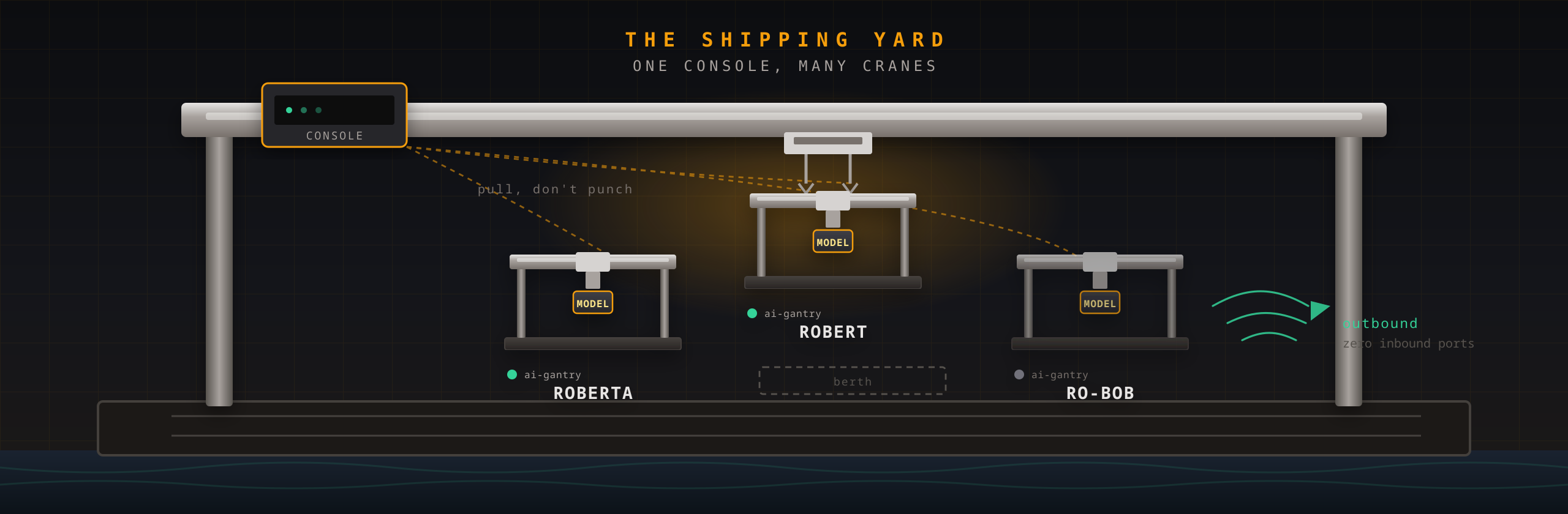
, chat that dials out. Gantree is the shipping yard those cranes live in — a board for an operator, never a hop in a chat turn.
-
gantry
-
The rigid frame that holds and positions tools. The frame does nothing by itself; the tools and the memory do the work.
-
gantree
-
The shipping yard those cranes live in. Files and Docker. Pull, don’t punch.
The difference
A harness is a process. A marketplace is a costume. #
What this stack is
- A binary you run. Aims, personality, and work still exist on Thursday.
- The model is a socket — Ollama, Gemini, ChatGPT, Grok. Swap it. The loop stays.
- MCP listed in
mcp.toml
is the grant. Omit it and it does not exist.
- Outbound chat (Telegram, Discord, Slack). No open ports. Ever.
- Independent lookups fan out in one round; the next round uses the results. Garmin → sheet → Strava is one thread.
What it is not
- A Claude Code or Copilot plugin marketplace with “harness” in the README.
- Prompts, skills, and sub-agents that still live in someone else’s context window.
- A chatbot that dies when the window gets expensive, then
/new
lobotomizes it.
- A dashboard or gateway in the token path so every message pays a platform tax.
- MkDocs around a wrapper. Documentation is not a runtime.
The crane
ai-gantry holds the person. The yard does not talk. #
One process. One persona. Chat stays Telegram. Health is an exit code, not a port. Mid-chain does not die on a typo — the loop was hardened on the 7–12B class, then pointed at Flash when you want the trajectory now.
static binary + persona + mcp.toml + any OpenAI-compat LLM → outbound chat
Want a bot tonight? Stay here. Open the board, build a crane — this yard
pulls shotah/ai-gantry
, writes the files, recreates. You do not need the other checkout to stand one up.
The yard
Operate named pets. Never sit in the turn. #
Gantree is the operator plane: board, doctor, grants, logs, spend. It reads Docker and files after the fact. If a chart would make the harness slower, the chart is wrong. Agents open zero inbound ports. Only this UI is reachable, and only through a path you chose.
browser  →  gantree (localhost | Tailscale | tunnel)
                                                 gantry  gantry  gantry
Hello
Docker on the same Linux host. Node 22. First boot is /setup. #
git clone https://github.com/shotah/gantree.git
cd gantree
cp gantree.toml.example gantree.toml
npm install
npm run build
npm start                 # http://127.0.0.1:3000
Open the board. Build a crane. Grant a tool. Message it on your phone. The UI never sits in a chat turn. Home Mini vs cloud VM: install.
Operator docs
The board, the door, the files. #
Install Home Mini or cloud VM. Same console. Zero inbound agent ports. Console Board, grants, doctor, avatars. Chat stays Telegram. Operators Setup, login, profile, roles on a handful of people. Headless Attach existing dirs, tunnels, the gotchas. Architecture Why Vinext on the Docker host, and why the yard pulls. Security The door: bind, passphrases, sessions. Not a reason to open WAN 3000. Custom MCP Your binary, still a [[server]] in that crane’s mcp.toml. ai-gantry Design, features, MCP — the harness repo.