Previously: I gave an AI agent one job: find free money, where 279 of 314 hourly scans came back “QUIET.” This one is a bonus. It isn’t about making money. It’s about spending it, carefully.
I’m looking at a 1.25-acre lot in the Mojave Desert. The asking price is $4,000. I’ve emailed the seller’s agent about a possible offer at $3,000, and nothing is agreed yet. If it happens, I want to build an earthship on it: a mostly off-grid house made of rammed tires and earth, bermed into the ground, with a wall of sloped glass facing south. So I spun up a new agent, named it “land purchase,” and started asking it questions.
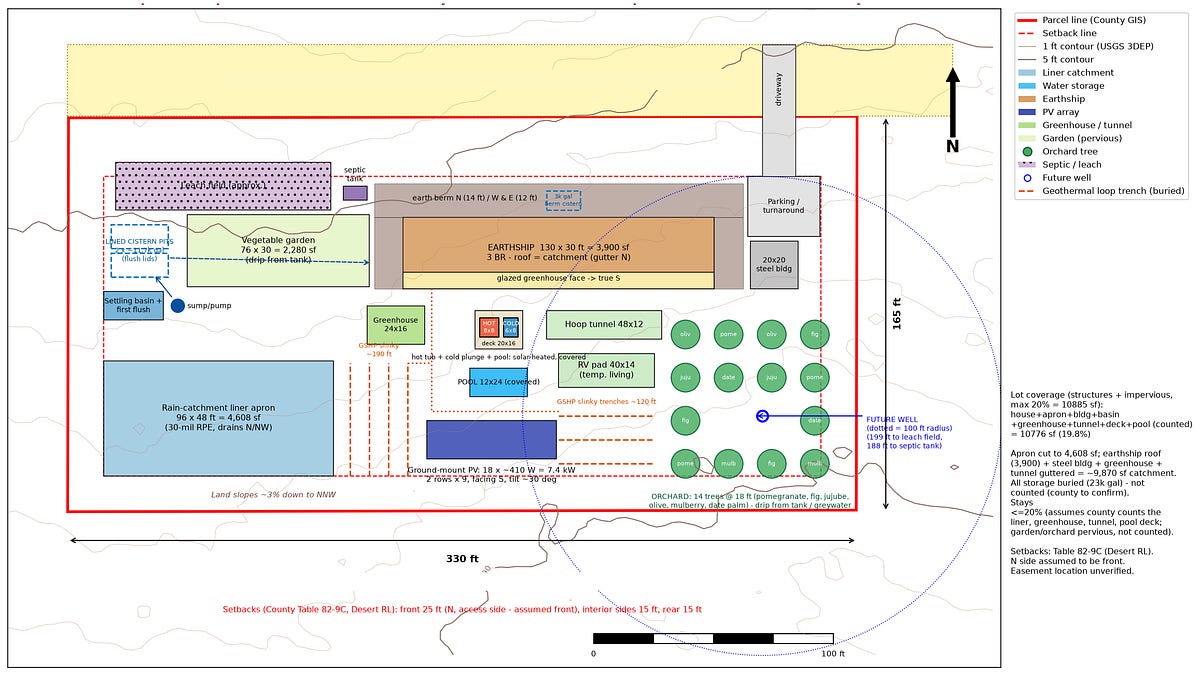
Between about 10:30 PM and 5:45 AM, it produced five versions of a site plan, three versions of a budget, two floor plans, a cross-section, and a true-scale 3D model. Every number below came out of that session, and every one of them is an estimate, not a quote. The agent was strict about saying so.
Step 1: Look at the dirt #
Before drawing anything, it pulled real data:
- Parcel lines from the county’s GIS.
- Topography from USGS 3DEP elevation data, at about 1 m resolution, turned into 1 ft and 5 ft contours. The land slopes about 3% down to the north-northwest.
- Roads from OpenStreetMap. The access road is unpaved.
- Zoning rules: the county’s Desert RL setbacks (25 ft front, 15 ft sides and rear) and a20% lot coverage cap . On a 54,426 sq ft lot, that’s 10,885 sq ft of roof and hardscape, total.
That coverage cap ended up driving almost every design decision.
Step 2: Fit everything under 20% #
My wish list kept growing: a 3-bedroom house, a garden, 14 fruit trees, a greenhouse, a hoop tunnel, a pool, a steel shop building, an RV pad to live in while I build. Each time, the agent re-ran the coverage math.
The final version lands at 10,776 sq ft, or 19.8% of the lot. That’s 109 sq ft to spare. To get there it:
- grew the house from 90x25 ft to 130x30 ft (3,900 sq ft, 3 bedrooms) ,
- shrank the rain-catchment liner from 6,156 to 4,608 sq ft,
- buried all the water storage, which frees about 380 sq ft of coverage (it flagged that the county still has to confirm buried tanks don’t count).
Step 3: Water is the whole game #
The site gets about 4 inches of rain a year. The agent’s math: about 9,870 sq ft of catchment (house roof, liner apron, shop, greenhouse, tunnel) times 4 inches times a 0.8 runoff factor is about 19,700 gallons a year, or 54 gallons a day.
Storage is 23,000 gallons, a little over a year’s worth, because desert rain shows up in a few big storms and some years it doesn’t show up at all.
Then it told me the part I didn’t want to hear: rain isn’t enough for the permit. The county requires an approved water source, either a well (estimated $20k–45k for roughly 250–270 ft) or a water district hookup. That cost sits outside every budget below.
Step 4: Three budgets, each one argued with #
For scale, the agent started with sourced per-square-foot prices. A turnkey earthship from Earthship Biotecture runs $300–425/sq ft, which is about $1.17M–1.66M at 3,900 sq ft. Scaled DIY ranges came out to roughly $130k–390k. Then it built a bottom-up DIY budget, line by line, with every line labeled as either its own estimate or a sourced price:
- v1: $105k–251k. Buried manufactured tanks, licensed septic.
- v2: $88.6k–205.7k. DIY lined cistern pits, composting toilets.
- v3: $95.6k–223.1k. My own solar prices, my dad doing earthwork, earthbag walls, geothermal.
v3 is the interesting one, because it went up even though two things got cheaper:
- My prices for power: used panels at $0.19/W and LiFePO4 batteries at $110/kWh. That made a bigger 9.8 kW array cheaper than the old 7.4 kW one.
- My dad has the equipment and will dig. $5k–12k of skid-steer rental turned into a $1k–3k fuel allowance.
But I also asked for earthbag walls instead of free tires (+$7k–16k, mostly cement stabilizer and plaster) and a geothermal heat pump (+$6k–12.7k). The agent’s recommendation was a hybrid: tires for the bermed retaining walls, earthbags for the interior walls, which brings the total to about $90k–213k.
The part I’ll actually reuse #
The most valuable output wasn’t a number. It was the list of things I can’t DIY my way around:
- A state-licensed structural engineer has to stamp it. Tire and earthbag walls go through the code’s “alternative materials” route, case by case.
- If the county requires septic, a licensed contractor has to install it. No DIY.
- Salvaged glass in the sloped wall has to be marked tempered or laminated. Old patio doors work. Ordinary windows don’t.
- Ordinary above-ground poly tanks collapse if you bury them.
- Trenches deeper than 5 ft need shoring. Call 811 before digging.
What I learned about using an agent for this #
- One night, one agent, a real design loop. I’d ask “what if the house were bigger” or “what if my dad digs,” and it would redraw the plan, redo the coverage math, and re-run the budget. Each version is saved, so I can see what changed and why.
- Labels matter more than numbers. Every budget line says E (its own estimate), S (sourced, with a link), or U (a price I gave it). That’s the same rule from my bonus scout: mark what you couldn’t verify.
None of this is built. The land isn’t even mine yet. It’s a very detailed conversation with myself, with an agent keeping score.
— Blake
Previously: I gave an AI agent one job: find free money, where 279 of 314 hourly scans came back “QUIET.”