Nvidia-powered vehicle to debut in 2028 ahead of in-house AI rollout in 2029
Hyundai Motor Group’s autonomous driving subsidiary, 42dot, is accelerating its drive to narrow the technology gap with industry leaders Tesla and Waymo.
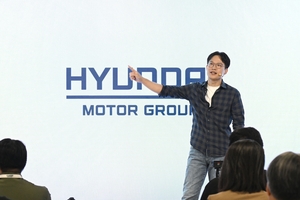
While aiming to facilitate its market entry with Nvidia, the automaker is gearing up to deploy its own Atria AI-powered vehicle fleet in 2029. In a media briefing at 42dot headquarters in Pangyo, Gyeonggi Province, Park Min-woo — 42dot CEO and head of Hyundai’s advanced vehicle platform — emphasized that Hyundai’s global annual sales of 7 million vehicles across 190 countries provides a massive data pool to train and refine its AI models.
“Once the group begins commercial production of our autonomous driving system, we expect to surpass our competitors in real-world data volumes within five years,” Park said.
Hyundai is targeting its initial mass deployment of Level 2+ vehicles around Nvidia’s Drive platform and Hyperion 10 sensor package in 2028, enabling faster market entry and more rapid collection of fleet data.
Comprising 10 cameras, one front radar and 12 ultrasonic sensors powered by the chipmaker’s Orin X compute platform, this standardized hardware system provides a cost-effective setup with enough computational headroom for continuous over-the-air updates over a seven- or eight-year vehicle lifespan.
In the second half of 2029, Hyundai will launch its Atria AI-powered Level 2++ vehicle fleet, with plans to scale the AI model up to Level 4, which does not require human intervention during driving.
Kwon Jung-hyun, the group’s newly appointed head of the autonomous driving development center, noted that deploying Nvidia’s commercial solution first provides crucial mass-production experience for Hyundai.
“As nearly all production challenges encountered with Nvidia’s stack will apply to Atria AI, we plan to learn that knowhow and rapidly feed the data generated and collected during Nvidia-based deployments into Atria AI’s training pipeline,” Kwon noted.
In the meantime, however, 42dot’s primary objective is to advance its “Data Flywheel,” a self-reinforcing feedback loop where vehicle data improves the Atria AI model, leading to better performance, which continuously gathers more data.
According to Park, over the next three years, the company plans to advance the Atria AI model by improving its training of rare “edge cases” using Data Flywheel. Information on those cases is important because they reflect unexpected and high-risk driving conditions — including extreme weather, unusual road obstacles or sudden jaywalkers — that fall outside standard training data.
Currently, among Hyundai’s 40 Ioniq 6-based test cars, or pace cars, around 10 to 20 units are dedicated exclusively to autonomous driving tests, while others serve general software-defined vehicle (SDV) validation. New SDV test cars released last month, will be deployed to the Gwangju Autonomous Driving project and will be used by 42dot developers for daily commutes to accumulate edge-case data in Seoul and Pangyo.
As a dual-track strategy, 42dot is developing Vision-Language-Action models that add language reasoning capabilities to traditional Vision-Action End-to-End models such as the Atria AI. This will enable vehicles to understand complex instructions from drivers, adapt quickly to new driving rules and navigate edge cases and unmapped road scenarios with less training data.
Lee Hee-seok, head of VLA development at 42dot, said that the company’s model performance already matched Nvidia’s reasoning-based Alpamayo.
hyejin2@heraldcorp.com