Robotaxi fleets are growing as self-driving vehicle companies start to roll out commercial services while still collecting data for further development and safety. For instance, Zoox Inc. this month began charging for rides in Las Vegas.
The Foster City, Calif.-based Amazon subsidiary recently partnered with Uber as it expands to multiple cities. While Zoox has explained how it approaches safety for its autonomous vehicles (AVs), which have no steering wheels, there are no federal standards yet.
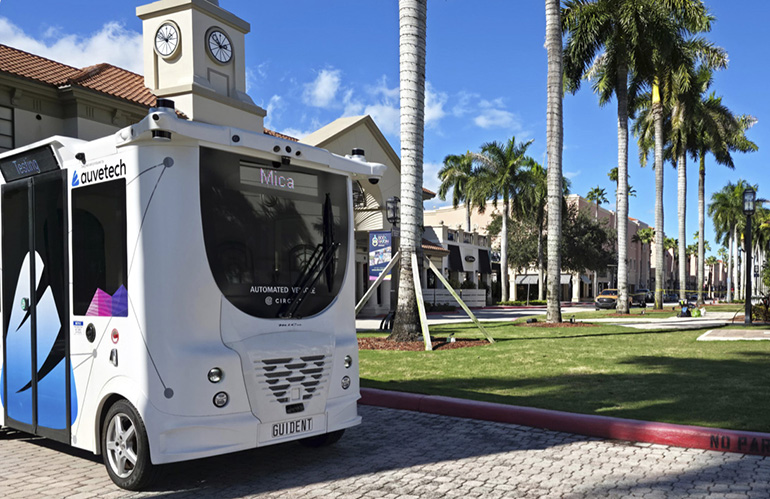
Guident Corp. claimed that its GuideOn platform addresses the critical human-in-the-loop layer, providing AI, remote monitoring, and teleoperation for AVs and robotaxis. It operates six remote monitoring and control centers and has partnered with six autonomous shuttle operators.
The Herndon, Va.-based company last week also extended its partnership with Coastal Waste & Recycling by three years, as deployments of its WatchBot inspection robot and related software expand across locations in Florida, Georgia, and South Carolina.
Harald Braun, CEO of Guident, replied to the following questions from The Robot Report about AV safety and remote monitoring.
Technology can help human oversight keep up #
How can human-in-the-loop architectures keep up with growing AV fleets?
Braun: The key is that human-in-the-loop does not mean that a person is manually driving every vehicle or watching every vehicle continuously. Its purpose is to provide oversight and assistance when the autonomous system encounters a situation it cannot safely resolve on its own.
As fleets grow, the technology needs to make that human oversight scalable. The autonomous vehicle should handle the normal situations, while AI-driven monitoring can identify when something unusual is happening and bring the right information to a remote operator.
That operator can then provide guidance or, when technically appropriate and legally permitted, intervene to return the vehicle to a safe operating state.
In my view, that is the right model for scaling autonomous mobility. You don’t want to eliminate the human from the equation. You want to use technology to make the human much more effective.
Guident’s approach is built around that combination of autonomous systems, AI-driven monitoring, and human oversight.
Editor’s note: Physical AI, enabling technologies, and field robotics are among the session tracks at RoboBusiness 2026, which will be at the Santa Clara Convention Center on Oct. 20 and 21. Register now to attend.
Robotaxi safety requires consistency and data to build trust #
What are the dangers of robotaxi developers setting their own safety standards? Don’t they already need to comply with existing road-safety rules?
Braun: Existing road-safety rules are important, but autonomous vehicles introduce new situations that traditional road-safety frameworks were not necessarily designed to address. The question is not only whether a vehicle follows the rules of the road, but also what happens when the autonomous system encounters something unexpected or outside of its normal operating conditions.
In my view, there needs to be a consistent framework for how AVs are monitored, how incidents and edge cases are reported, and how human intervention is handled when necessary. I don’t think the answer is to tell companies exactly how they have to build their technology. The industry needs room to innovate. But there should be clear safety expectations and measurable standards that apply across the industry.
Ultimately, if we want public trust and widespread adoption, people need to know that there is a safety architecture around these vehicles and that there is a way to respond when the autonomous system encounters a situation it cannot resolve itself.
We’ve seen testing in more AV-friendly jurisdictions, but we’ve also seen restrictions, particularly of delivery robots, in others. How can authorities find reliable data on which to build requirements that apply on a wider scale?
**Braun: **The most important thing is consistent, real-world data. Every autonomous system will eventually encounter situations that were not anticipated during development.
If companies are measuring and reporting those situations differently, it becomes very difficult for regulators to understand what is actually happening across the industry. We should be looking at data from the entire operating environment, not just whether an AV successfully completed a trip. What happened when it encountered an object in the road or another type of edge case? Did it need assistance? How did it respond? Was a human operator required to intervene?
The more standardized and transparent that information becomes, the better regulators can distinguish between an isolated situation and a systemic issue. That gives authorities a much stronger foundation for developing requirements that can be applied across different jurisdictions while still allowing the technology to evolve.
Autonomous systems must account for speed and edge cases #
What are the differences and similarities for monitoring and control of self-driving vehicles and mobile robots?
Braun: A robotaxi is operating around passengers, pedestrians, other vehicles and traffic at much higher speeds, so the consequences of an incident can be very different from those involving a mobile inspection robot.
However, the underlying principle is very similar. Autonomous vehicles, whether they are cars, robots or other types of autonomous systems, need to be monitored and, when necessary, controlled. That is the strategic thinking we have had at Guident from the beginning.
The autonomous system should be able to perform its mission independently, but it may encounter situations it does not understand or cannot safely resolve without assistance. A monitoring system needs to identify those situations, provide the right information to a remote operator, and allow that operator to assist or control the vehicle when necessary.
What are some of the edge cases that AV fleets might encounter as they scale? How will this affect public perception and potential government regulation?
Braun: There are thousands of potential edge cases because the real world is constantly changing. You can have an unexpected object in the road, an unusual traffic situation, a vehicle that is blocking the normal route, an accident with another vehicle, or some other emergency situation that the autonomous system was not expecting.
The important question is not whether you can eliminate every edge case. The important question is what the system does *when *it encounters one.
If the vehicle can recognize it is in a situation it cannot safely resolve, bring that information to a remote monitoring and control center and have a human operator assist it, then you have another layer of safety around the autonomous system. That is how we think about human oversight at Guident. It is not necessarily there because the autonomous system has failed; it is there because the real world will continue to produce situations that are difficult to predict.
Public perception will ultimately depend on how reliably these systems handle those situations. The industry needs to demonstrate that autonomy is not simply about the vehicle driving itself, but about having the appropriate safety architecture around the vehicle when something unexpected happens.
Third-party safety, data sharing don’t have to impede innovation #
As the technologies of Waymo and Zoox mature and AV deployments continue to spread, what incentives do they have to collaborate with third-party software providers such as Guident?
Braun: As autonomous fleets scale, the operators are going to have to think not only about the driving technology itself, but also about the operational infrastructure required to safely manage hundreds or thousands of vehicles.
I don’t see third-party remote monitoring and control software as replacing the autonomous driving system, but as a complementary layer. The AV company can focus on what it does best, which is developing the autonomous driving technology, while a company like Guident can provide monitoring, assistance, remote intervention and operational support around it.
A specialized third-party platform can also provide vehicle-agnostic infrastructure, redundant connectivity, and standardized operational data across different vehicle types. This allows fleet operators to avoid duplicating supporting systems while maintaining a consistent safety and oversight layer.
The larger the fleet becomes, the more important that infrastructure becomes. A small pilot operating in a controlled environment can rely on more manual processes.
When you have thousands of vehicles operating simultaneously, you need a system that can continuously monitor those vehicles, identify situations that require attention and bring a human into the loop when necessary.
If data is the foundation for training robot behaviors, who should control it?
Braun: I think there are two different issues here: who generates and owns the data, and who needs access to the data to ensure that autonomous systems are operating safely.
The companies developing and operating these systems are obviously going to generate a tremendous amount of valuable data, and they need to be able to use that data to improve their technology.
At the same time, when you are talking about safety-related information from autonomous vehicles operating in public environments, there is a broader interest in having appropriate transparency.
I don’t think all of that information needs to be public. There are privacy, security, and commercial considerations. But regulators should have access to the information they need to evaluate safety, and there should be consistent ways of reporting incidents and edge cases.
Ultimately, the goal should be to use data to make autonomous systems safer. The industry needs to find the right balance between protecting proprietary information and making sure the data necessary for safety and accountability is available.
Clarity and redundancy light the way to AV safety #
What standards would you like to see to enable safe and profitable scaling of these fleets?
Braun: There should be clear expectations around operational monitoring, incident reporting, remote human oversight, communications reliability, cybersecurity, operator qualifications, and fallback procedures when an autonomous vehicle encounters a situation outside its normal operating parameters.
I also think scalability is important. A safety architecture that works for one AV must remain reliable when applied across an entire fleet.
In my view, that combination of autonomous technology and human intelligence is what will allow the industry to move from individual pilots to large-scale commercial deployment. The goal is not to have a human manually operating every vehicle, but to have a human oversight layer that can effectively monitor multiple vehicles and intervene when necessary.
Does adding a remote operator create another potential point of failure?
Braun: It can, if the vehicle depends on a single operator or communications link. A properly designed remote-operations system should instead provide an additional safety layer without replacing the vehicle’s onboard autonomy and fallback capabilities.
If connectivity is degraded or lost, the vehicle must be able to reach a safe state. That requires redundant, secure communications, trained operators, and clearly defined fallback procedures. At Guident, we use event-driven oversight, ultra-low-latency communications, and redundant connectivity. The operator becomes involved only when assistance is needed. The objective is to ensure that no individual operator or communications link becomes a critical point of failure.