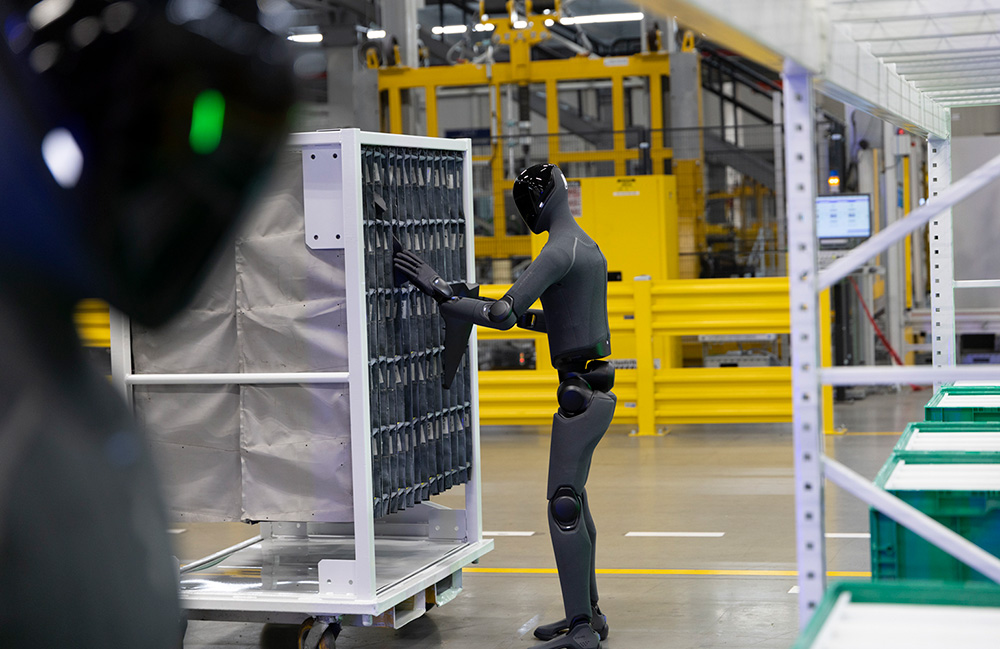
While the tech industry thinks AI is the main barrier for robots joining the manufacturing workforce, the real issue has less to do with intelligence and more to do with robotic unit economics and financial viability. AI has come a long way, vision systems have matured, foundation models keep getting better and the hardware has significantly improved. But for most manufacturers, the cost of automating using humanoids at today’s prices just isn’t feasible.
The technology is mostly ready #
Physical AI has evolved quickly and robots now handle manipulation tasks that seemed out of reach only a few years ago. Several vendors have shown machines running real warehouse operations. The hardware has advanced with stronger actuators, better mobility and effectors that keep improving. Even the hands, which have been a sticking point for years, are close enough that plenty of use cases work without them being perfect.
There are some organizations that have had real robotics success. Generalist’s robots can perform precise manipulation tasks. Agility Robotics’ humanoids have achieved proven results in the warehouse. The robot hands built by Alt-Bionics have improved both humanoid robots’ dexterity and broken new ground in prosthetics. All of these wins are paving the way for further innovation and accessibility in the space.
Many people in robotics will tell you the core technology problems have either been solved or are nearly there. The demos are becoming more impressive and the conversation has moved from “Can they do the work?” to “Can we justify the cost?”
People must stay in the loop #
Despite technological progress, human oversight will be key to filling in what gaps remain, especially when a robot encounters something it didn’t expect.
Some developers lean hard on teleoperation, where a person controls the robot’s movements directly. That requires almost all of the operator’s attention, which caps how far it can scale because every robot needs a human tied to it.
A better model is to treat people as high-level supervisors who step in only when a robot faces something unusual or needs direction on a task. This way, one person can supervise 50 or more robots at once, and every intervention serves as training data to improve the AI over time. Over time, that involvement may drop, but it never hits zero.
Specialized robots still outperform humanoids #
The promise of humanoids is their flexibility. In theory, one machine can do many different jobs without much reconfiguration. But that flexibility comes with a price. A factory automation system built for one workflow is optimized for it from end to end. In high-volume production, that specialization beats general-purpose humanoids.
For example, in parcel sorting, the best humanoid demonstrations hit around 1,000 picks per hour in controlled conditions. Specialized parcel-sorting robots run between 1,300 and nearly 3,000 picks per hour depending on the application. That’s a big gap for anyone weighing out the ROI. In a lot of applications, conventional industrial robots give you more productivity for less money.
The economics are the real problem #
The biggest hurdle facing humanoid robots is robotics unit economics. They cost too much and only a small number of applications make the cost justifiable.
One leading humanoid developer put the cost at several hundred thousand dollars per robot. Spend that, and you’ll need a multi-shift operation running the machine around the clock before the numbers begin to work in your favor. And if you already run that kind of operation, you can put the same amount of money into a specialized automation solution that gives you more throughput and pays off faster.
The math changes when the prices of humanoids come down. For instance, lower-cost humanoids coming out of China have fewer capabilities than the premium platform, yet they still show what large-scale production does to cost. However, regulatory policy can disrupt that playbook, as seen in the FCC’s recent move to ban Chinese humanoid imports over national security concerns. The key for humanoid developers is to reach the production volumes that bring the price down.
Manufacturing scale is the advantage #
The robotics industry loves to rank companies by their AI models, dexterity and manipulation demos. But the most important advantage is knowing how to manufacture complex hardware and at a massive scale.
Take Tesla for example. Building electric vehicles dragged the company through years of manufacturing challenges, supply chain fights and production scaling. Designing a humanoid robot is hard. Building hundreds of thousands of them efficiently is a completely different skill. Manufacturing scale drives down component costs, tightens supplier relationships, sharpens production and spreads engineering investment across far more units. Every one of those elements improves robotics unit economics.
Tesla is bringing its manufacturing expertise to Optimus, its humanoid robot. This will allow it to reach commercially viable prices years ahead of competitors whose real strength is robotics research instead of mass production. Tesla will lead the market because manufacturing capability matters as much or more than AI capability.
The win happens on the factory floor #
The race to commercialize humanoids is on. What’s left to prove is that humanoid robots can beat the economics of the automation manufacturers are already running. That takes lower prices, which requires manufacturers at scale, and that relies on companies that can build sophisticated hardware efficiently and repeatedly.
Editor’s Note: The opinions expressed in this article are those of the author and do not necessarily reflect the views of The Robot Report, its editors, or its parent company.
About the author #
Shaun Edwards is the co-founder and CTO at Plus One Robotics. Since co-founding Plus One in 2016, he’s helped scale the company’s core technology platforms, pioneering human-in-the-loop systems for parcel handling, and shaping the future of automated warehouse logistics. Today, he focuses on advancing continuous learning and edge-based AI to help global supply chain leaders scale their automation operations.
Prior to founding Plus One Robotics, Shaun was a senior research engineer at Southwest Research Institute (SwRI), where he founded and led the ROS-Industrial (Robot Operating System) open-source program, fundamentally changing how industry and academia collaborate on industrial robotics software. He holds a B.S. and M.S. in Mechanical Engineering from Case Western Reserve University.