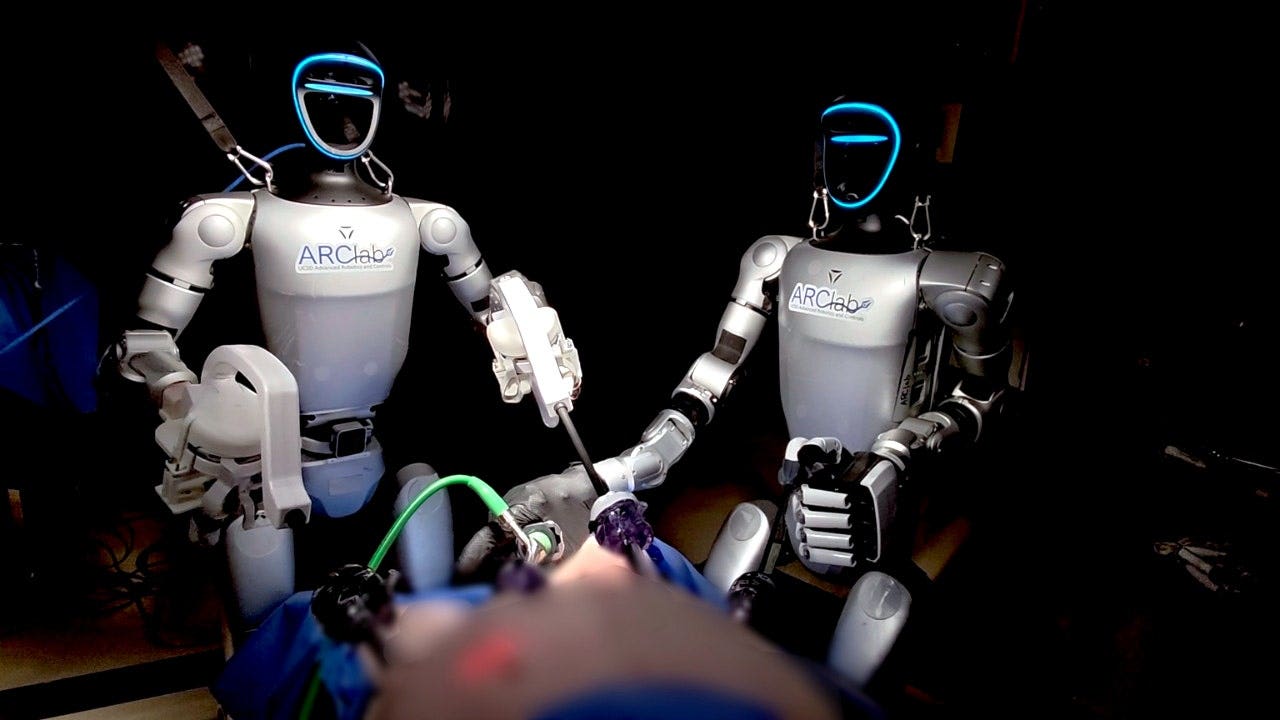
Humanoid robots have officially stepped up to the operating table, helping complete two surgeries for the first time. During the preclinical trial, surgeons remotely guided the machines through two gallbladder removal procedures. The robots copied the surgeons' movements rather than making medical decisions, and no human patients were involved.
Unlike bulky robotic systems fixed in place, these five-foot machines used standard surgical tools and worked inside an operating room built for people. The experiment offers an early look at how a specialist could someday operate through a mobile robot in a rural clinic or another place where surgical care is hard to reach. Here is what the team accomplished and what still needs to happen before this technology reaches human patients.
AI MAY SPOT DEADLY HEART RISK IN A ROUTINE ECG
Free live CyberGuy class: Sick of Spam? Join us July 22
Join us Wednesday, July 22, at 1 p.m. ET for a free CyberGuy Live class that will help you cut down on robocalls, spam texts, junk email and other unwanted messages. Kurt "CyberGuy" Knutsson will walk you step by step through simple ways to filter spam, clean up your inbox and recognize the messages that could put your personal information at risk. No technical experience is needed. You’ll also receive our spam-stopping checklist, and every registrant will get a link to the class recording afterward.
Reserve your free spot today at CyberGuyLive.com.
Two humanoid robots completed live surgeries
Researchers from the University of California San Diego reported the results in the journal Nature earlier this month. The team tested its system during two laparoscopic gallbladder removal procedures on pigs.
During one operation, a humanoid robot handled surgical instruments while a human surgeon assisted beside it. During the second procedure, two humanoid robots stood next to each other and worked as a team. Surgeons remotely controlled both robots throughout the operation. The experiment involved delicate tasks used during minimally invasive gallbladder surgery. The robots moved tissue and dissected around the gallbladder. They also helped place clips before removing it.
Researchers designed the trial as a proof of concept. They wanted to learn whether a general-purpose humanoid robot could handle standard surgical tools with enough control to complete an operation. It could. However, the trial also exposed problems that researchers must solve before testing the system on humans.
The trial marked the first time teleoperated humanoid robots successfully completed live gallbladder surgeries. Robotic gallbladder procedures have been performed before, but this experiment was the first to use general-purpose humanoid machines. The work builds on UC San Diego's earlier research with the same type of robot. CyberGuy previously covered how a remotely controlled humanoid performed seven medical procedures, including physical exams and ultrasound-guided injections.
How these humanoid robots fit into a standard operating room
The researchers created Surgie by modifying commercially available Unitree G1 humanoid robots. Each machine stands about 5 feet tall and weighs around 60 pounds. That makes Surgie dramatically smaller than many existing robotic surgery systems, which can weigh approximately 1,800 pounds.
Large surgical robots may require extensive setup and take up considerable space. Hospitals sometimes need to retrofit an operating room before installing one. Surgie can stand in a room designed for human medical workers. Researchers added adapters to its hands so the robot could grip standard laparoscopic instruments.
A surgeon then controlled the robot from a remote console. When the surgeon moved the controls, Surgie copied those movements at the operating table. That human-like design is important. A hospital may be able to bring the robot into an existing room instead of rebuilding the space around it. A medical team could also move it between rooms or transport it to a smaller facility. "We were surprised at how well Surgie meshed with our workspace and workflow," said Nikita Thareja, MD, a general surgery resident at UC San Diego School of Medicine and a co-author of the study.
Unitree currently lists the base G1 at $13,500 before taxes and shipping. However, that price does not include the surgical adapters, instruments or remote-control equipment used in the study. The price still points to a potentially significant difference between a general-purpose humanoid and today's specialized surgical systems. Da Vinci surgical robots can cost from about $700,000 to more than $3 million, depending on the model and configuration. Researchers have not disclosed the total cost of the complete Surgie setup.
CHINA’S ROBOT-RUN HOTEL OPENS TO PUBLIC IN 2027
Why use a humanoid instead of a surgical robot?
Modern robotic surgery systems already help doctors perform highly precise procedures. However, those machines usually stay in one location and depend on specialized equipment. A humanoid robot offers more flexibility because it can operate in spaces built for medical workers. It can also hold tools designed for human hands.
Researchers believe future versions could retrieve an instrument during surgery. The robot might also help prepare or clean the room after a procedure. Most importantly, a mobile system could potentially bring a specialist's skills to an area where surgeons are difficult to find.
Michael Yip, a professor in UC San Diego's Department of Electrical and Computer Engineering, said remotely operated humanoids could expand access to critical procedures. Researchers envision sending the robots to communities with limited medical staffing or temporary field hospitals.
The goal isn’t to hand medical decisions to a machine. A trained surgeon would remain in control while the robot carried out those movements at the patient's location. That could give a trauma team on a battlefield access to a specialist located far away. The same approach could help a patient in a remote town avoid a long trip to a major medical center. Researchers have even discussed using the technology during future space missions.
That idea is already moving beyond the laboratory with traditional surgical robots. In March, we reported on a London surgeon who remotely removed a patient's prostate cancer from 1,500 miles away. The difference is that the London procedure used a specialized surgical platform. Surgie could eventually offer a smaller system that works inside a standard operating room.
The robots still needed plenty of help
The successful procedures do not mean hospitals are ready to start using humanoid robots on patients. Researchers had to recalibrate the robots several times during surgery. The operations also took much longer than procedures performed with established surgical systems.
Latency presents another concern. Latency is the delay between a surgeon moving a controller and the robot responding. A slight lag may feel annoying during a video call. During surgery, even a small delay could affect precision. That challenge becomes more serious when the surgeon and robot are separated by a long distance.
Researchers will need to improve the robot's reliability and response time. They must also prove that the system can repeat its performance safely across many procedures. Hospitals would need a backup plan as well. A qualified surgical team would have to remain ready to step in if the robot stopped responding or the remote connection failed.
Could a humanoid robot eventually operate on its own?
For now, human surgeons control Surgie's movements. The UC San Diego researchers eventually want to develop what they call an autonomous surgical assistant. That type of robot could recognize which tool a surgeon needs or complete a limited task under supervision. Researchers elsewhere are already testing a different approach to autonomous surgery. CyberGuy previously covered an AI-powered robot that independently completed a key phase of gallbladder removal on a lifelike surgical model. However, operating on a living patient presents a much greater challenge. Bleeding can begin without warning. A patient's condition can also change in seconds.
A robot would need to recognize the problem and respond safely. Medical workers must also be able to take control immediately. Autonomous surgery raises difficult questions about responsibility. Hospitals would need clear rules covering who makes each decision and who is accountable when something goes wrong. Remote operation introduces another concern. Hospitals would have to protect the robot's software and communications from unauthorized access. At the same time, the system would need to continue operating safely during a connection problem.
WOULD YOU PAY $8,000 FOR A ROBOT TO FOLD LAUNDRY?
What this means to you
You will not see a humanoid robot independently performing your next surgery. This research remains at the preclinical stage, and the team tested the system on pigs rather than humans. Still, the experiment offers an early look at where robot-assisted medicine may be headed.
A mobile surgical robot could eventually give you access to a specialist without requiring a long trip. It may also help a smaller hospital offer procedures that currently require transferring patients elsewhere. However, access should never come at the expense of safety. Before agreeing to a robot-assisted procedure, you should know who controls the machine. You should also ask what happens if the connection fails and whether a qualified surgical team will remain in the room. The robot may hold the instrument, but human judgment remains the most important part of the operation.
Kurt's key takeaways
Watching two humanoid robots work over an operating table may make you uncomfortable. Still, the technology could address a serious healthcare problem if researchers can make it reliable and safe. Many communities struggle to attract enough surgeons. A compact robot that works with standard instruments could let a distant specialist enter the operating room without physically traveling there. The comparatively low starting price of the base robot could also make this approach easier to deploy than some specialized surgical systems. This experiment remains an early milestone. The robots needed recalibration, and the operations took longer than usual. Communication delays also remain a concern. The researchers now need to prove that Surgie can perform consistently before anyone considers human trials. Hospitals will also need strict safety protections and trained medical workers ready to take over.
Would you let a surgeon operate through a humanoid robot if it cut months off your wait for care? Let us know by writing to us at CyberGuy.com.
CLICK HERE TO DOWNLOAD THE FOX NEWS APP
Sign up for my FREE CyberGuy Report
- Get my best tech tips, urgent security alerts and exclusive deals delivered straight to your inbox.
- For simple, real-world ways to spot scams early and stay protected, visit CyberGuy.com- trusted by millions who watch CyberGuy on TV daily. - Plus, you'll get instant access to my Ultimate Scam Survival Guide free when you join.
Copyright 2026 CyberGuy.com. All rights reserved.