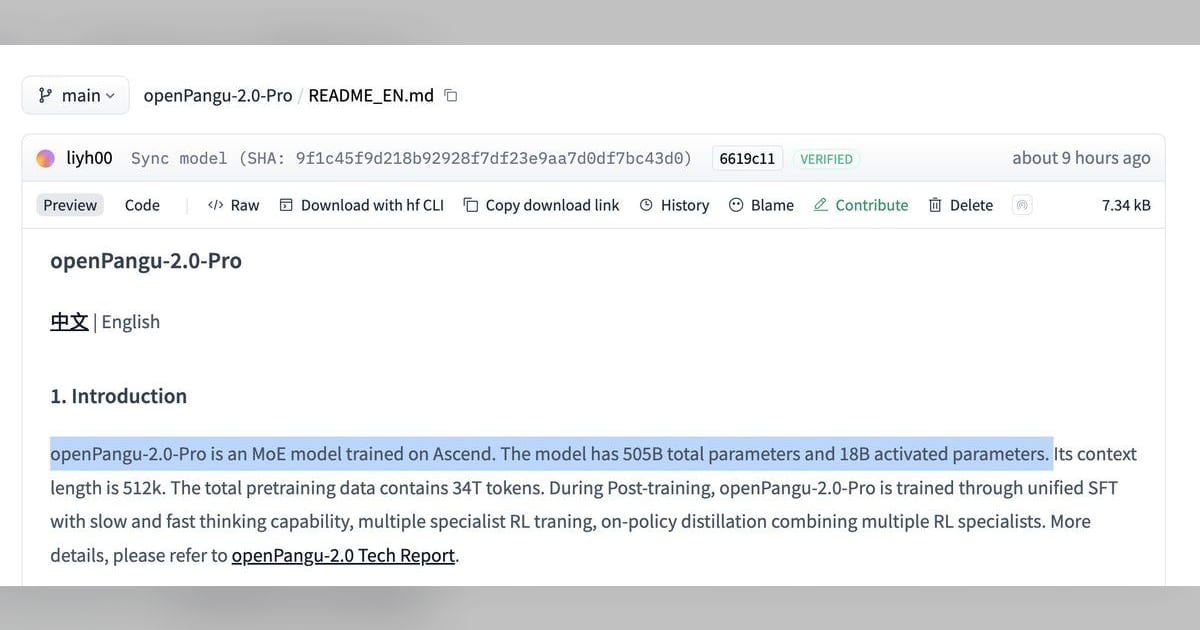
Huawei has released openPangu 2.0 Pro, a Mixture-of-Experts language model that Huawei says was trained entirely on its Ascend AI processors, putting weights from one of the largest models built on a non-Nvidia compute stack into developers' hands.
The model card lists approximately 505 billion total parameters, with 18 billion activated for each token, a 512K-token context window and roughly 34 trillion training tokens. The repository appeared around July 30th, after Huawei introduced the openPangu 2.0 family at its June 12th developer conference. Poe Zhao (@poezhao0605) drew attention to the full Pro release on July 31st.
The parameter count requires a qualification. Huawei's model card and technical report say 505 billion, while Hugging Face's automated metadata reports 541 billion. The repository does not reconcile the difference. Its files occupy approximately 1.08 TB.
A model built around Ascend
The release turns openPangu into a public test of Huawei's vertical AI strategy. Ren Zhengfei founded Huawei in 1987 with CNY21,000, according to his company biography. Nearly four decades later, Huawei is assembling its own processors, training systems, models, cloud infrastructure and device software into a single stack.
That stack is the central claim behind openPangu 2.0 Pro. Huawei says the model was trained on Ascend NPUs and provides Ascend-native inference code through its omni-infer framework. The inference repository is licensed under Apache 2.0.
Huawei's architecture uses sparsity to keep the active computation per token well below the model's total parameter count. It combines multi-head latent attention with two attention patterns: sliding-window attention for local context and dynamic sparse attention for longer-range information. Huawei says it arranged those layers in a 2-to-1 ratio. A four-stream residual design, the Muon optimizer and three multi-token prediction heads are intended to improve training and inference efficiency.
The model offers thinking and non-thinking modes and is aimed at reasoning, coding, tool use and agent tasks. Huawei reports scores of 68.5 on SWE-bench Verified and 85.7 on LiveCodeBench V6 for the thinking version, both measured using averages across three runs. Those figures are Huawei's own evaluations and should be read within the test configurations published in its model card.
Published specifications place openPangu 2.0 Pro among the larger open-weight MoE releases. DeepSeek-V3 lists 671 billion total parameters, 37 billion active parameters and a 128K context window. Alibaba's Qwen3-235B-A22B lists 235 billion total and 22 billion active parameters, while Moonshot AI's Kimi K2 lists 1 trillion total and 32 billion active parameters. Each of those published configurations has a 128K context window, one quarter of the length Huawei claims for openPangu 2.0 Pro.
Raw model size does not establish performance or usability. Huawei's more consequential assertion is that it trained a model at this scale on Ascend and has released the weights, architecture code and deployment path needed for outside developers to examine that claim.
Open weights, restricted license
Huawei is distributing the weights under its custom OpenPangu Model License Agreement 2.0, rather than a standard open-source license. The agreement grants rights to use, modify and redistribute the model, while explicitly barring access, deployment or use within the European Union.
The license also requires products or services based on the model to display a "Powered by openPangu" acknowledgement and a Huawei trademark notice. Those conditions narrow the addressable developer base and make the release materially less permissive than Apache 2.0 models such as Qwen3, even though the openPangu inference code itself uses Apache 2.0.
Huawei has the balance sheet to treat the model as infrastructure for its broader computing business. In its 2025 annual report announcement, Huawei reported CNY880.9 billion in revenue and CNY192.3 billion in research and development spending, equal to 21.8% of revenue. Huawei said it would continue investing in AI and build developer adoption around Ascend, Kunpeng and HarmonyOS.
OpenPangu 2.0 Pro gives that strategy a model developers can download and inspect. The next test is operational: whether teams outside Huawei can reproduce the reported performance, run the trillion-byte release efficiently on Ascend infrastructure and build products under a license that excludes the European Union.