Fortress AI Fourteen months, two mentors, and a spreadsheet of risk weights later, Deriv runs its own vendor risk platform. This is the story of Vendiant.
In August 2025, UpGuard, the platform Deriv’s security team used to rate the security of our third-party vendors, came up for renewal at close to USD 100,000 a year. It worked well enough. It was also a black box that did things its own way, and nobody on our side could change it when it got something wrong.
Instead of signing again, the team tried something a little reckless. They handed the problem to the two of us, a pair of interns, gave us two mentors and a spreadsheet of the risk categories that mattered, and asked us to build something better.
Fourteen months later, UpGuard is gone. In its place is Vendiant, an in-house third-party risk platform that scores more than 400 vendors from public signals alone and now watches for leaked employee and client credentials as well.
Starting from nothing #
There was no architecture diagram and no roadmap. There was a list of a few hundred vendors, a weighting sheet, and one firm rule from the penetration testing team: everything had to be strictly passive. No scanning tools that knock on doors. Vendiant would have to learn about a vendor the way a careful outsider would, from public signals only, without ever touching their systems.
Within two days we had our first working pieces:
- Subdomains pulled out of certificate transparency logs, then checked to see which ones were alive.
- HTTP headers read from those servers, with version strings matched against the National Vulnerability Database.
- A full TLS assessment built on top of
testssl.shthat penalised weak ciphers, retired protocols and sloppy certificate chains.
Within a week we had added domain reputation checks, DNS and email hygiene, and a news module that used a language model to dig up a year of security incidents for every vendor. By the second week the data had moved out of spreadsheets and into PostgreSQL, and a batch of 132 domains scanned end to end in eight minutes.
That pace became the rhythm of the project. Every few days a new update went out: here is what we built, here is what broke, here is what we are doing next.
Using AI where it helps #
"AI-driven" was in the brief, and it would have been easy to put a chat window on a dashboard and call it a day. We tried to be more disciplined than that.
The AI explains. The maths decides.
We used language models for the jobs that need reading and judgement. Checking whether a vendor holds SOC 2 or ISO 27001, for instance, normally means a human trawling through trust centres and compliance pages. Vendiant does that automatically, pulling out the certification, the date and the source so an analyst can verify it in one click. The same goes for the incident feed and for the plain-English summary that opens every vendor report, which explains what the scans found and what to do about it.
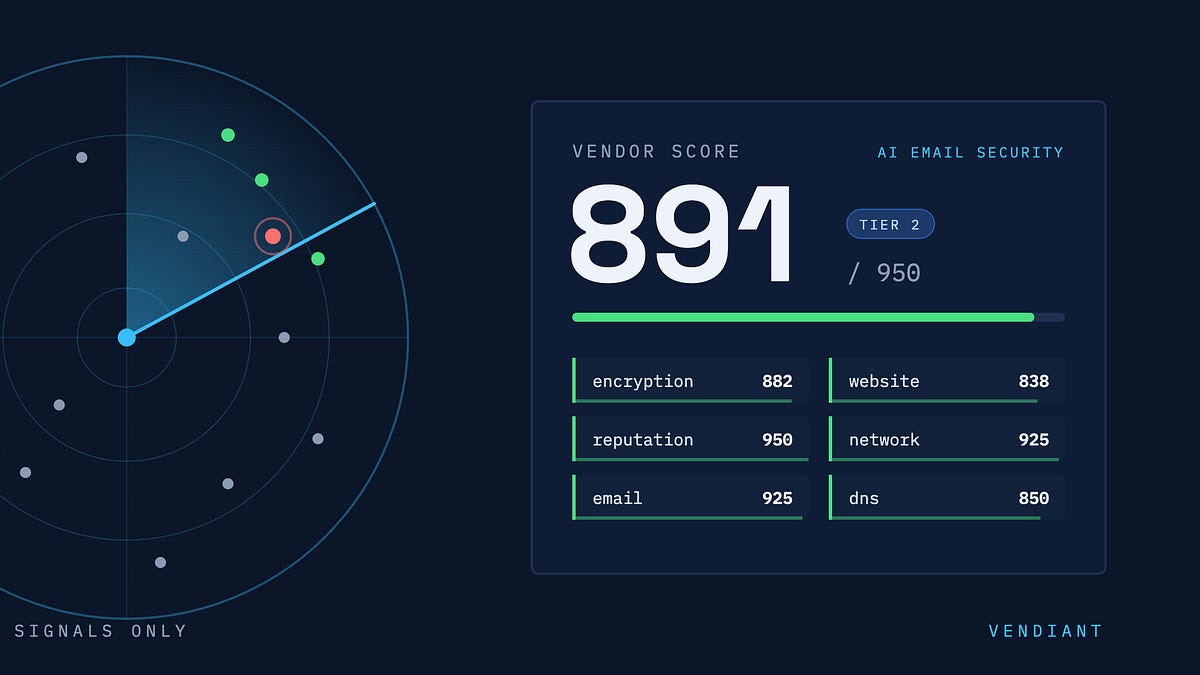
The scores themselves are pure arithmetic. Every vendor starts at 950 and loses points by severity across six weighted areas: encryption, website security, domain reputation, network exposure, email, and DNS.
Early on we ran our numbers side by side with UpGuard's for the same vendors, found some odd inconsistencies in how UpGuard weighted things, and tuned our own model until the two broadly agreed. Keeping the language model out of the scoring is a large part of why the security team trusts the numbers.
Building fast and in the open #
We built all of this in a few months the way a lot of good software gets built now, quickly and in the open, with AI coding assistants doing much of the typing and the two of us making the decisions.
You can see it in the sheer volume. Between August and October:
- The back-end was rewritten from Flask to FastAPI.
- Single sign-on went in.
- A separate, locked-down API layer appeared with hashed keys and proper documentation so other teams could plug in.
- There was a dark mode, an audit log, a side-by-side vendor comparison page, portfolio views and PDF exports.
- A background scanning engine gained checkpoints, so a forty-hour run could crash, restart and pick up exactly where it left off.
You can also see it in our mistakes, which we made no attempt to hide.
The day it became real #
On 1 October 2025 Vendiant went live with its API, and the head of the vendor risk programme told the team to use it for every new system review from then on. Five days later the first full scan of the vendor estate finished: more than 400 vendors, 52,218 subdomains, and 84,204 findings, 10,891 of them critical or high, in about 40 hours.
A few weeks later one of our senior security engineers shared a commercial vendor-risk product he had spotted on LinkedIn, noting how closely it resembled Vendiant and adding that what we had built was "far more capable, mature and has more functionality." We'll admit, that one made our week.
Closing the last gap: Breach monitoring #
Then came the hard moment. One weekend in late November, UpGuard raised an alert that Vendiant had missed. It was a leaked-credentials finding, the one area the home-grown tool had not yet solved, because high-quality breach data lives behind expensive paywalls and the free sources are stale.
With the renewal deadline weeks away, leadership asked us directly whether Vendiant was ready and, if not, what was missing. We answered with a feature-by-feature comparison. Every capability UpGuard offered was either already in Vendiant or already covered by another process. Breach monitoring was the single gap, and we were already evaluating specialist providers to fill it.
Leadership let UpGuard lapse in January 2026, and in February the project was formally reclassified from an experiment to a production system.
Beyond vendors: watching our own front door #
Closing that gap turned out to be the most valuable thing the project did, because it pushed Vendiant past vendor risk and into protecting the company itself.
Over the following months we built two leak-monitoring modules directly into the platform:
- Employee credentials. Any time a username or password tied to one of our corporate domains turns up in a breach dump, an infostealer log, or a dark-web listing, Vendiant knows about it within minutes and the security operations team is alerted immediately, with the sensitive details kept inside the dashboard and never in the notification itself.
- Client credentials. The second does the same for our clients, catching compromised customer logins that appear in the wild and routing them to the people who can lock the account down before anyone else uses it.
The same tool that tells us whether a supplier is safe to sign now checks, every day, whether our own people and customers have been exposed somewhere we would never otherwise have looked. A leaked staff password or client login can be dealt with before anyone else gets the chance to use it.
Where it stands today #
Vendiant is no longer an experiment. It is the system we rely on to watch over every vendor we already work with and to vet every new one before we sign. When a team wants to bring in a new supplier, Vendiant is the first stop: within minutes it has mapped the vendor’s public footprint, scored their security posture and flagged anything that should give us .
In the background it keeps rechecking the vendors already in the estate, so a lapsed certificate or a service that drifts into a bad configuration shows up long before it becomes our problem.
Rating vendors was always a means to an end. The point was to keep risky vendors from getting a foothold in the business without slowing anyone down, and Vendiant does that every day for a few hundred vendors and counting. Most of the people who depend on it never think about it, which for a security tool is how it should be.
What it cost, and what it saved #
The bill came to two interns, two mentors, one spreadsheet of requirements, and a handful of paid APIs that together cost a small fraction of the old licence.
In return Deriv has roughly USD 100,000 a year back in the budget, a tool the team can change the same afternoon someone asks for it, and a platform other teams are now building on.
Figures are from Vendiant’s first full scan of the vendor estate in October 2025. Vendor names and internal details have been left out.
Angela Arul and Joel Joseph are now full-time AI Engineers at Deriv. Follow Deriv Tech on X for more updates from our Engineering Team.