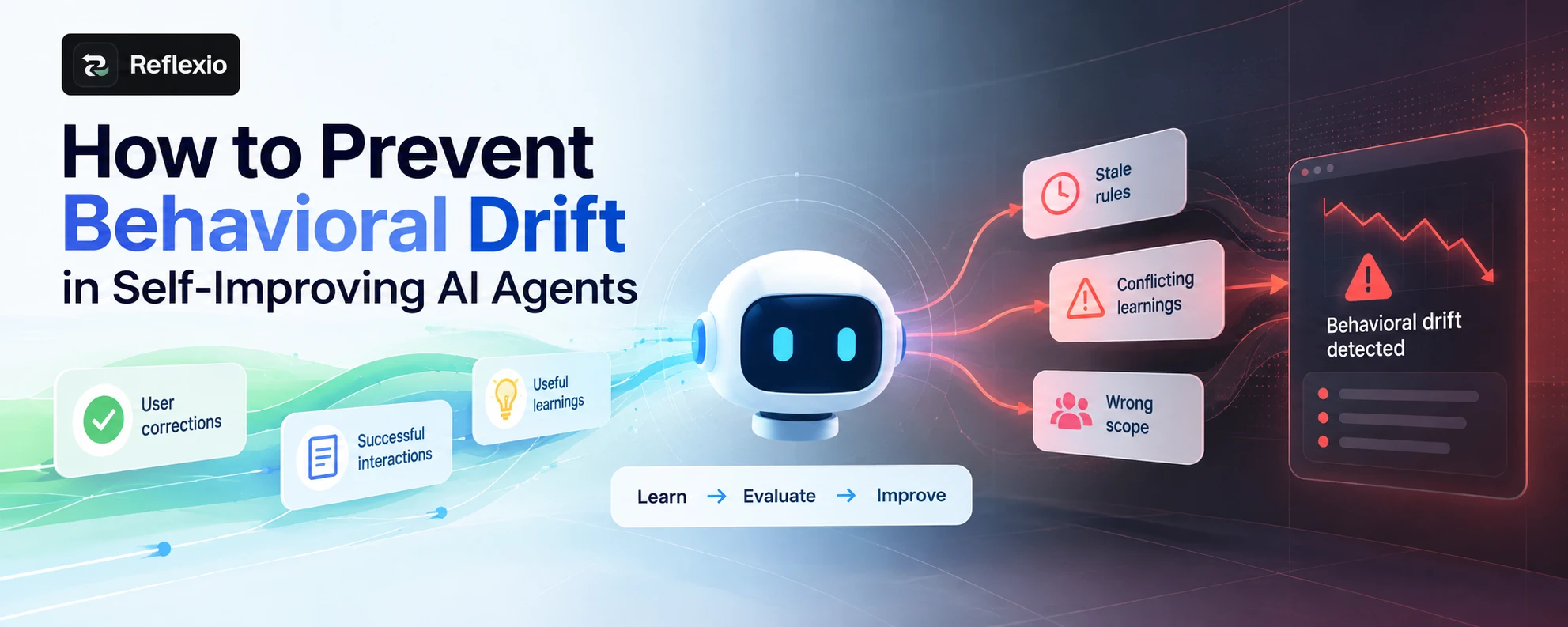
An AI agent can solve the same task correctly for weeks, then suddenly start making mistakes it had already learned to avoid. The model may not have changed. Instead, a new rule, an outdated lesson, or a conflict between learned instructions may have changed how the agent acts.
This is behavioral drift in AI agents. It becomes harder to spot when agents keep learning from real interactions. The answer is not to stop your agent from learning. It is to make each learning visible, test whether it helps, and control how it affects future tasks.
Reflexio helps teams turn user corrections and successful interactions into reusable rules. Developers can inspect these learnings, review their impact, and reject rules they do not want their agents to use. This gives teams a way to improve agent behaviour without retraining the underlying model.
Your Agent Passed Last Week. Why Is It Failing Today? #
Imagine a coding agent that always runs tests before reporting a fix. After several interactions, it learns to avoid unnecessary steps. That sounds useful. But the new lesson becomes too broad. The agent starts skipping tests, even when it changes important code.
The agent still writes code. Its tools still work. Its answers may even sound confident. Yet its behaviour has become less reliable. There are three likely causes:
- A system change: Someone changed the prompt, model, tool, or application code.
- A harmful new lesson: The agent learned a shortcut that does not work for every task.
- An outdated or conflicting rule: An old instruction no longer fits the current task, or two lessons tell the agent to act differently.
These causes need different fixes. Changing the prompt may not help if a retrieved rule is driving the mistake. Reflexio helps teams inspect the learned rules and playbooks influencing future agent runs. This makes learning a useful place to investigate when behaviour changes.
First, Find Out Whether Learning Caused the Drift #
Do not delete rules or rewrite prompts just because an agent has failed. First, find evidence of what changed. Use this process to investigate a suspected regression.
Step 1: Reproduce the failure.
Run the same task again with the current agent setup. Record what the agent did, which tools it called, and whether it completed the task correctly.
Step 2: Record the conditions.
Capture the model version, prompt, available tools, retrieved rules, and task result. Without this information, you may mistake a tool failure for a learning problem.
Step 3: Test the suspected learning.
In a safe test environment, compare the current setup with a version that excludes the suspected rule. Keep other settings as similar as possible.
Step 4: Compare the results.
Check the final answer, tool choices, task completion, and any unwanted actions. Repeat the test if the agent gives different results across runs.
For example, suppose the coding agent skips tests after learning to avoid unnecessary verification. If removing that lesson restores test execution across repeated trials, you have evidence that the lesson contributed to the problem. This does not prove the rule is the only cause. Other changes may still matter. Reflexio helps with this investigation by making extracted learnings visible and manageable. Its learning and evaluation tools let teams inspect playbooks and review how learned context is used. See the LGRO guide to self-improving agents for more on evaluating learning-driven improvements.
Three Types of Learning Drift and How to Fix Them #
Not every bad learning needs to be deleted. The right fix depends on why the rule is failing.
| Drift pattern | Example | Best response | | Stale rule | An agent follows an old API instruction after the API changes. | Update or retire the rule. | | Conflicting learnings | One rule says to verify code. Another says to skip checks for simple changes. | Review the conflict and clarify which rule applies. | | Wrong scope | A rule learned for one customer affects another customer's workflow. | Restrict the rule to the right user, task, or environment. |
These problems can look similar during a failed run, but they need different actions.
A stale rule needs current information. Conflicting rules need clearer instructions and conflict handling. A rule with the wrong scope needs tighter limits on when it can be used.
Reflexio helps teams inspect extracted rules and playbooks, review their contents, and reject learnings they do not want retrieved. Its learning process also works with user-specific profiles and shared playbooks. This helps teams see what the agent has learned and manage how that learning is used.
Detect Drift by Tracking What the Agent Does #
A simple success rate is not enough to show whether an agent is getting better. It may finish the same number of tasks while taking riskier actions or repeating old mistakes.
Track these signals over time:
- Task success: Did the agent finish the user's actual task?
- Safety: Did it follow required checks before taking important actions?
- Tool use: Did it choose the right tools and avoid unnecessary calls?
- Repeated failures: Did a problem return after the agent had learned a correction?
- Retrieved learnings: Which rules were supplied to the agent during the failed run?
Compare similar tasks under similar conditions. A change in results may come from a new model, changed tools, or different user requests, not just from learning.
Also test both tasks that should use a rule and tasks where it should not apply. For example, a coding agent should run tests after important code changes, but it may not need to run the full test suite after changing a typo in a comment.
LangChain's guide to agent evaluation explains why teams should check tool choices and execution steps, not just final answers. Google Cloud's continuous evaluation guide also recommends testing changes against defined measures instead of relying on a few manual checks.
Reflexio complements this approach by making learned rules visible and providing evaluation results that help teams review how their learning process is working.
Stop Harmful Learnings Without Losing Useful Ones #
When a rule causes problems, you do not need to clear every learning and start again. Choose the smallest change that fixes the issue.
- Keep it if the rule still helps and applies to the right tasks.
- Edit it if the advice is useful but too broad or outdated.
- Limit it if the rule only belongs to certain users or workflows.
- Reject it if it is harmful or no longer useful.
For example, a support agent may learn to check all recent charges before discussing a refund. That is useful. But if it also learns to treat every unfamiliar charge as a confirmed fraud case, it may make claims it cannot support. The right response is not to erase everything the agent learned about billing. Review the faulty rule, correct or reject it, and preserve other useful lessons.
This is where Reflexio's approach matters. Teams can inspect, edit, or reject extracted learnings through its portal. Rejected rules are excluded from retrieval, so teams can remove unwanted guidance without retraining the model. See Agent Dreaming vs Replay-Gated Tuning for more on controlling how learned information is refined.
One important distinction: rejecting a learning is not the same as rolling back the entire agent. If a prompt, tool, or application change also caused the failure, that part must be fixed separately.
Put Every Learning Change Through a Safety Check #
The best way to prevent behavioral drift is to test a new learning before trusting it in important workflows.
Use this simple process:
- Capture the lesson. Record the correction or successful action that suggests a new rule.
- Check the rule. Look for outdated advice, unclear wording, conflicts, and overly broad scope.
- Test real examples. Try the rule against both the problem it should solve and tasks that previously worked.
- Compare results. Check task completion, safety, and tool use before and after the change.
- Review risky changes. Require human approval when a learning could affect payments, access, customer data, or other sensitive actions.
- Watch after release. Check whether the old failure returns or a new one appears.
Arize's guide to AI agent regression testing shows why testing only the original failure can miss new problems elsewhere. A proposed fix should be tested against working cases too.
Not every learning needs the same level of review. A low-risk wording improvement may need only a basic check. A rule that changes how an agent handles payments or permissions needs stricter tests and human oversight.
Reflexio gives teams a way to inspect and manage learnings as part of this process. Teams can use their existing tracing and testing tools alongside Reflexio to check the full agent workflow before and after a change.
Is Your Agent Ready for Continuous Improvement? #
Before allowing an agent's learnings to influence more tasks, ask:
- Can we identify which learnings were used in a failed run?
- Do we test new rules against tasks that already worked?
- Can we find stale or conflicting instructions?
- Can we limit a rule to the tasks where it belongs?
- Can we reject a harmful learning without clearing useful ones?
- Do we review high-risk changes before they affect users?
If you cannot answer these questions, adding more learning may make the system harder to control. Behavioral drift in AI agents is not a reason to stop continuous improvement. It is a reason to manage learning carefully. Reflexio helps teams turn real interactions into reusable lessons while keeping those lessons visible and under their control. Combined with repeatable tests and production monitoring, this gives teams a safer way to improve agent behaviour over time.
Explore Reflexio to see how your agents can learn from corrections and reuse those lessons in future tasks.