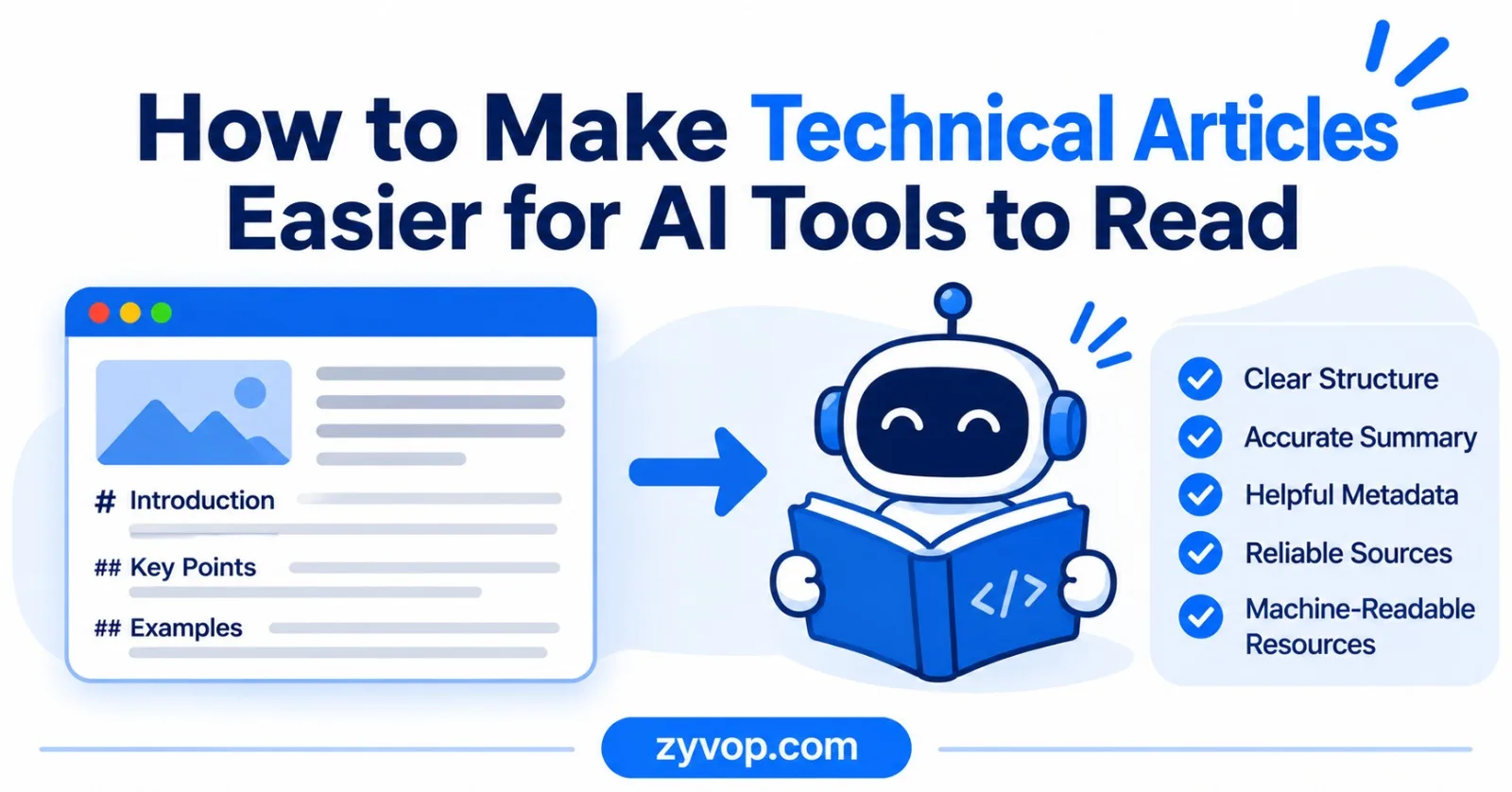
Technical articles are written for people, but they can also be processed by search engines, feed readers, and AI tools. Clear structure helps all of them identify what an article covers, how its sections relate, and which sources support its claims.
There’s no reliable way to guarantee that an AI system will find, use, or cite a particular article. You can still make your work easier to understand by publishing accurate content with useful structure and machine-readable context.
ZyVOP provides clean article resources for compatible tools that choose to use them. Here are practical ways to make use of that support while keeping the article useful to human readers first.
Start with a clear question and answer #
Give the article a specific title that tells readers what problem it addresses. Then use the opening paragraphs to explain the situation, the scope of the guide, and the main takeaway.
For example, “PostgreSQL Indexes” is broad. “How to Choose an Index for a PostgreSQL Query” tells readers more about the question the article will answer.
Avoid making readers infer essential context from a long introduction. State the environment, versions, and assumptions when they affect the advice. If a recommendation only applies to a particular setup, say so near the recommendation.
Use headings that describe the section #
Organize the article with a logical heading hierarchy. Use a main title, then sections for the major steps or ideas, and subsections when they clarify a specific part.
Prefer descriptive headings such as “Measure the query before adding an index” over vague labels such as “Step 2”. A heading should help a reader scanning the page understand what they’ll learn in that section.
ZyVOP’s machine-readable article representation includes the article’s heading structure. Clear headings therefore help readers navigate the article and give compatible tools more context about its contents.
Make summaries and metadata accurate #
An excerpt or subtitle should summarize what the article actually explains. Avoid stuffing it with keywords or promising results the article doesn’t demonstrate.
In a Markdown article, you can keep the summary in front matter:
---
title: "How to Choose an Index for a PostgreSQL Query"
subtitle: "A practical way to compare query plans before changing a production schema."
excerpt: "Use EXPLAIN ANALYZE and representative data to decide whether a PostgreSQL index is likely to help."
canonical_url: "https://engineering.example.com/postgres-indexes"
tags: [postgresql, databases, performance]
---
An explicit canonical URL identifies your preferred article address when the same content appears in more than one place. Canonical declarations are signals, not guarantees that every crawler will select that URL.
Support important claims with sources and examples #
When an article makes a technical or time-sensitive claim, link to authoritative documentation, a relevant paper, or the source code that supports it. Show enough of your method for readers to judge the conclusion: versions, inputs, commands, measurements, and limitations can all matter.
For example, a performance claim is more useful when it includes the database version, table size, query plan, and test conditions. A brief statement of limitations helps prevent an example from being mistaken for a universal rule.
ZyVOP’s machine-readable resources #
ZyVOP offers three resources for compatible agents and tools:
/llms.txtprovides a plain-text overview, canonical links, timestamps, and links to selected articles./llms-full.txtprovides an expanded index of up to 500 canonical articles, with author, date, topic, and excerpt information./api/geo/posts/{slug}provides a clean JSON representation of an individual published canonical article, including its title, author, timestamps, headings, references, and plain text content.
For example, you can request an article’s JSON representation with:
curl -H "Accept: application/json" \
  https://zyvop.com/api/geo/posts/postgres-zero-downtime
The exact article slug and host depend on the published article and publication domain. These resources give compatible consumers a cleaner way to access article information than extracting it from a rendered page with navigation and other interface elements.
Treat machine readability as part of good publishing #
Machine-readable endpoints can make structured content available to tools that choose to use them. They don’t control crawler behavior, guarantee indexing or ranking, or ensure that an AI answer will include a link or citation.
The most reliable writing practices remain straightforward: answer a clear question, use descriptive headings, keep summaries honest, identify your preferred source, and support important claims. ZyVOP’s clean article resources add structured access to that content while the article remains readable and useful to people.