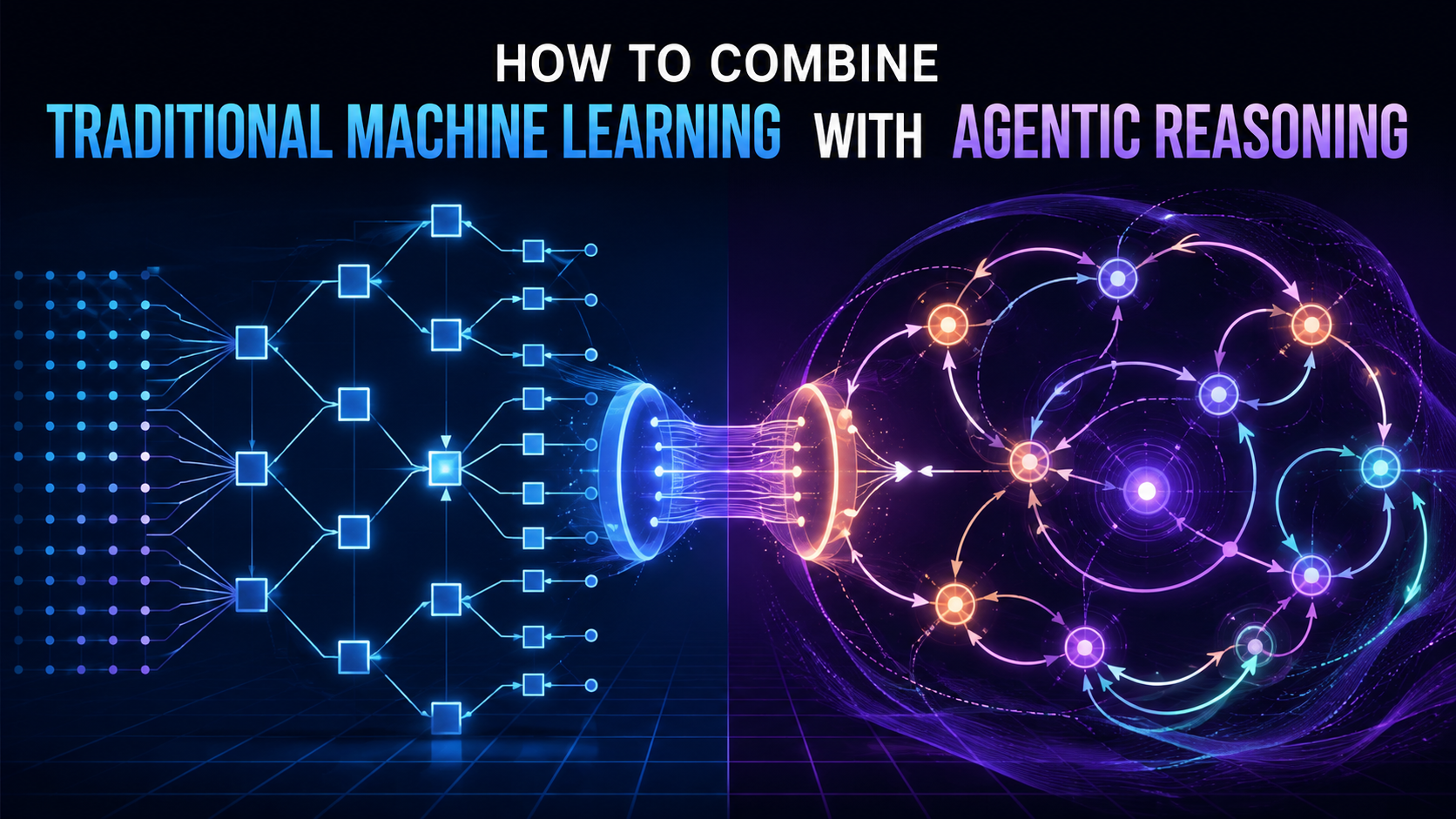
In this article, you will learn where traditional machine learning reaches its limits, what agentic reasoning adds, and how combining the two produces AI systems more capable than either approach alone.
Topics we will cover include:
- What traditional machine learning does well, and where it falls short in multi-step, dynamic, or action-requiring problems.
- How agentic reasoning — built around large language model reasoning engines — adds planning, tool use, adaptation, and real-world action.
- How hybrid systems combine trained models and agentic reasoning, with a concrete insurance claims example.
Let’s get into it.
Introduction #
Machine learning models are remarkably good at one thing: taking inputs and producing outputs. Feed a trained classifier a medical image, and it returns a probability. Feed a regression model a set of features, and it returns a number. The model does exactly what it was trained to do, nothing more.
That reliability is also a limitation. Most real-world problems do not arrive pre-packaged as a clean input-output pair. They require gathering information, making decisions about what to do next, handling unexpected situations, and acting across multiple steps before a final answer is even possible. Traditional machine learning, on its own, has no mechanism for any of this.
Agentic reasoning fills that gap. This article explains where traditional machine learning reaches its limits, what agentic reasoning adds, and how the two work together in systems that are more capable than either approach alone.
What Traditional Machine Learning Does Well #
Before examining the gaps, it is worth being precise about what traditional machine learning actually does.
A supervised learning model learns a mapping from inputs to outputs by training on labeled examples. A fraud detection model learns to distinguish fraudulent transactions from legitimate ones. A churn prediction model learns which customer profiles are associated with cancellation. A demand forecasting model learns how historical patterns relate to future sales volumes.
These models are fast, interpretable, and production-ready. Once trained, they run in milliseconds, handle enormous volumes of requests, and produce consistent outputs that can be audited and explained. Decades of engineering work have made them reliable.
But they are also static. A trained model reflects the state of the world at training time. It cannot update its understanding mid-inference. It cannot ask a clarifying question. It cannot decide that it needs more information before producing an answer. It cannot take an action in the world and observe the result. The model receives its input, applies its learned function, and returns its output. That is the full extent of its operation.
For many tasks, this is exactly what you want. For many others, it is not nearly enough.
Where Traditional Machine Learning Falls Short #
The limitations of traditional machine learning become visible in three situations.
When the problem requires multiple steps. Predicting whether a loan applicant will default is a single-step problem: given a set of features, return a probability. Deciding whether to approve a loan, however, involves additional steps: verifying income documentation, checking for inconsistencies, flagging edge cases for human review, and generating a written explanation for the decision. A model can contribute a prediction to this process, but it cannot manage the process itself.
When the context changes mid-task. Traditional models assume that all relevant information is available at inference time, encoded in the input. But many real tasks involve discovering information as you go. An analyst investigating a potential security breach does not know in advance which logs are relevant. A customer service system cannot anticipate every direction a conversation might take. When the relevant context can only be determined by interacting with the environment, a static model that operates on fixed inputs cannot adapt.
When actions are required. A model that predicts equipment failure cannot schedule the maintenance appointment. A model that identifies a supply chain disruption cannot reroute the shipment. Traditional machine learning produces outputs: numbers, labels, probabilities. It does not take actions in the world. The gap between a model’s prediction and a real-world response must be bridged by something else.
These are not edge cases. They describe the majority of high-value business problems where AI is expected to deliver meaningful impact.
What Agentic Reasoning Adds #
An agent, in the context of AI systems, is something that perceives its environment, decides what to do, takes action, and observes the results. The key difference from a traditional model is that an agent operates across time and interacts with its environment rather than simply transforming inputs into outputs.
Modern agentic systems are typically built around a large language model that serves as a reasoning engine. This reasoning engine can plan sequences of steps, interpret intermediate results, decide which tools or resources to use, and adjust its approach based on what it observes. It is not making statistical predictions in the traditional sense. It is reasoning about what to do next.
Agentic reasoning adds four capabilities that traditional machine learning lacks.
Planning. An agent can decompose a complex goal into a sequence of steps and track progress toward that goal across multiple actions. Rather than producing a single output, it maintains a representation of what it is trying to accomplish and what still needs to be done.
Tool use. An agent can invoke external tools — which might include databases, APIs, search engines, or other models — and incorporate the results into its reasoning. This means the agent is not limited to what was encoded in its parameters at training time. It can retrieve current information, run calculations, or query specialized systems on demand.
Adaptation. An agent can update its plan based on what it observes. If a tool returns an unexpected result, the agent can revise its approach. If a query returns no useful information, the agent can try a different query. This feedback loop is absent from traditional machine learning inference.
Action. An agent can do things in the world: send messages, write to databases, trigger workflows, call APIs. Its outputs are not just predictions but operations.
How the Two Work Together #
The insight that makes hybrid systems work is that traditional machine learning and agentic reasoning are not competitors. They operate at different levels of a system and address different problems.
Traditional machine learning excels at pattern recognition on structured data. A model trained on millions of transactions will detect fraud more accurately than any reasoning process that works from first principles. A model trained on thousands of radiology images will identify a tumor more reliably than an agent trying to reason its way to a diagnosis without specialized training. Trained models are fast, calibrated, and consistent at the specific tasks they were designed for.
Agentic reasoning excels at orchestration: deciding which tools to use, in what sequence, with what parameters, and how to interpret and combine their outputs toward a larger goal.
In a hybrid system, the agent manages the workflow and the machine learning models do the specialized prediction work. The agent decides when to invoke a fraud model, passes it the appropriate transaction data, receives the probability score, and decides what to do with that information in the context of a larger task. It might invoke several models in sequence, compare their outputs, retrieve additional context from a database, and then produce a synthesized response or trigger a downstream action.
Neither component is doing the other’s job. The machine learning model is not trying to plan. The agent is not trying to do fine-grained pattern recognition on raw features. Each does what it is built for.
A Concrete Illustration #
Consider a system designed to handle insurance claims.
A traditional machine learning approach might train a model to classify claims as likely fraudulent or likely legitimate based on structured features: claim amount, claimant history, provider patterns, and so on. The model returns a probability score. A human adjuster then reviews flagged claims.
An agentic system wraps around this model and extends what it can do. When a new claim arrives, the agent retrieves the relevant policyholder records. It passes the structured claim data to the fraud detection model and records the score. If the score exceeds a threshold, the agent retrieves comparable historical claims, searches for related claims filed by the same provider, and checks for documentation inconsistencies. It synthesizes these findings into a written summary and routes the claim to the appropriate review queue, including its reasoning.
The fraud detection model is doing exactly what it was trained to do. The agent is doing everything the model cannot: gathering context, making sequenced decisions, and taking action. The output of the combined system — a routed claim with a documented reasoning trace — is something neither component could have produced alone.
Why This Matters #
The gap between what machine learning models can predict and what organizations actually need to accomplish has always been filled by human judgment, manual workflows, and brittle rule-based systems. Agentic reasoning offers a way to automate that connective tissue without abandoning the reliable, well-calibrated predictive models that already exist.
This is not about replacing traditional machine learning. It is about making those models useful in more places, by embedding them inside systems that can gather the right context, invoke them at the right moment, and act on their outputs in a coherent way.
The result is AI that does not just predict outcomes but participates in the processes that those predictions are meant to inform.
Key Takeaways #
Traditional machine learning models are fast, reliable, and accurate at specific prediction tasks, but they cannot plan, adapt, use external tools, or take actions in the world. Agentic reasoning, built around large language model reasoning engines, provides exactly these capabilities but is not well-suited to the fine-grained pattern recognition that trained models do well. Hybrid systems combine the two: agents orchestrate multi-step workflows and invoke machine learning models as specialized tools. This architecture closes the gap between what models can predict and what systems actually need to do, extending the reach of existing machine learning assets without replacing them.
Further Reading #
- An Introduction to MultiAgent Systems — Wooldridge; theoretical grounding for agent-based reasoning.
- **[Building Effective Agents](https://www.anthropic.com/research/building-effective-agents)** — Anthropic (2024); a practical framework for agentic system design.
- **[ReAct: Synergizing Reasoning and Acting in Language Models](https://arxiv.org/abs/2210.03629)** — Yao et al. (2023); the influential paper on reasoning-action loops.
- LangChain — widely used framework for building hybrid agentic systems.